European ammonia imports
Europe is likely to become an increasing ammonia importer over the coming years as low global ammonia prices and high European gas prices squeeze producer margins, but CBAM remains a wild card.
A consortium consisting of TotalEnergies, Osaka Gas, Toho Gas, and ITOCHU have signed a joint development and operating agreement, granting the Japanese companies a combined 33.3% stake in the Live Oak project – a large-scale facility to produce renewable synthetic natural gas, also referred to as e-NG or e-methane, initiated by TES and TotalEnergies and currently under development in Nebraska. Following the agreement, TES and TotalEnergies will each maintain a 33.35 % stake in the project.
A consortium including Danish companies Skovgaard Energy, Topsoe and Vestas says that it has reached an important milestone with the startup of operations in what they describe as the world’s first-of-its-kind green ammonia plant. The plant, owned by Skovgaard Energy and located in Ramme Denmark, is a demonstrator for a dynamic approach to green ammonia production, which means that the plant will adapt to the inherent fluctuations in power output from the renewable power sources in integration with the plant’s electrolysis and ammonia synthesis loop. This, say the developers, will ensure optimal production and improve the cost-effectiveness of green ammonia, ensuring less need for costly storage solutions of green hydrogen or renewable power. Production capacity is 5,000 t/a of green ammonia, with an associated CO2 reduction of 9,600 t/a. The partnership has received euro 11 million in funding from the Danish Energy Technology Development and Demonstration Program (EUDP).
CRU's fertilizer team provides their top calls for 2026
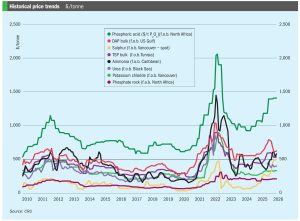
Price trends and market outlook, 18th December 2025.
FertiCoat is a specialised fertilizer coating developed by Omnia Specialities Australia. Its unique formulation helps prevent soil fixation and leaching losses.
Ronald Clemens, ICL's Global Portfolio Manager, explains how new fertilizer technologies are boosting yields, cutting losses and supporting sustainability.
Mark Howell , Head of Agronomy & Product Development at Sulvaris, provides new insights on sulphur nutrition in soybean-maize systems.
Boron fertilization can improve coffee crop quality and yield. Fabiano Silvestrin of U.S. Borax reviews the evidence.
Supplying nitrate with iodine has been shown to deliver blueberry yield and quality improvements, says Katja Hora, SQM’s Research Manager.