Fertilizer International 530 Jan-Feb 2026
26 January 2026
CRU Fertilizers – top calls for 2026
European affordability pressures will persist – leading to lower fertilizer import duties and CBAM carve outs.
Fertilizer affordability remains challenging for European farmers, with crop price indices flat and fertilizer price indices up 25% relative to pre-2023 averages. An additional tariff of €40/t was added to imports of Russian nitrogen fertilizers from July 2025, which will increase to €60/t from July 2026. From 1st January 2026, the EU’s carbon border adjustment mechanism (CBAM) will also impose extra costs on the import of all nitrogen-containing fertilizers, with urea expected to see an annual average CBAM cost of ~$52/t.
Indian urea and DAP imports to remain high – with domestic production facing limitations.
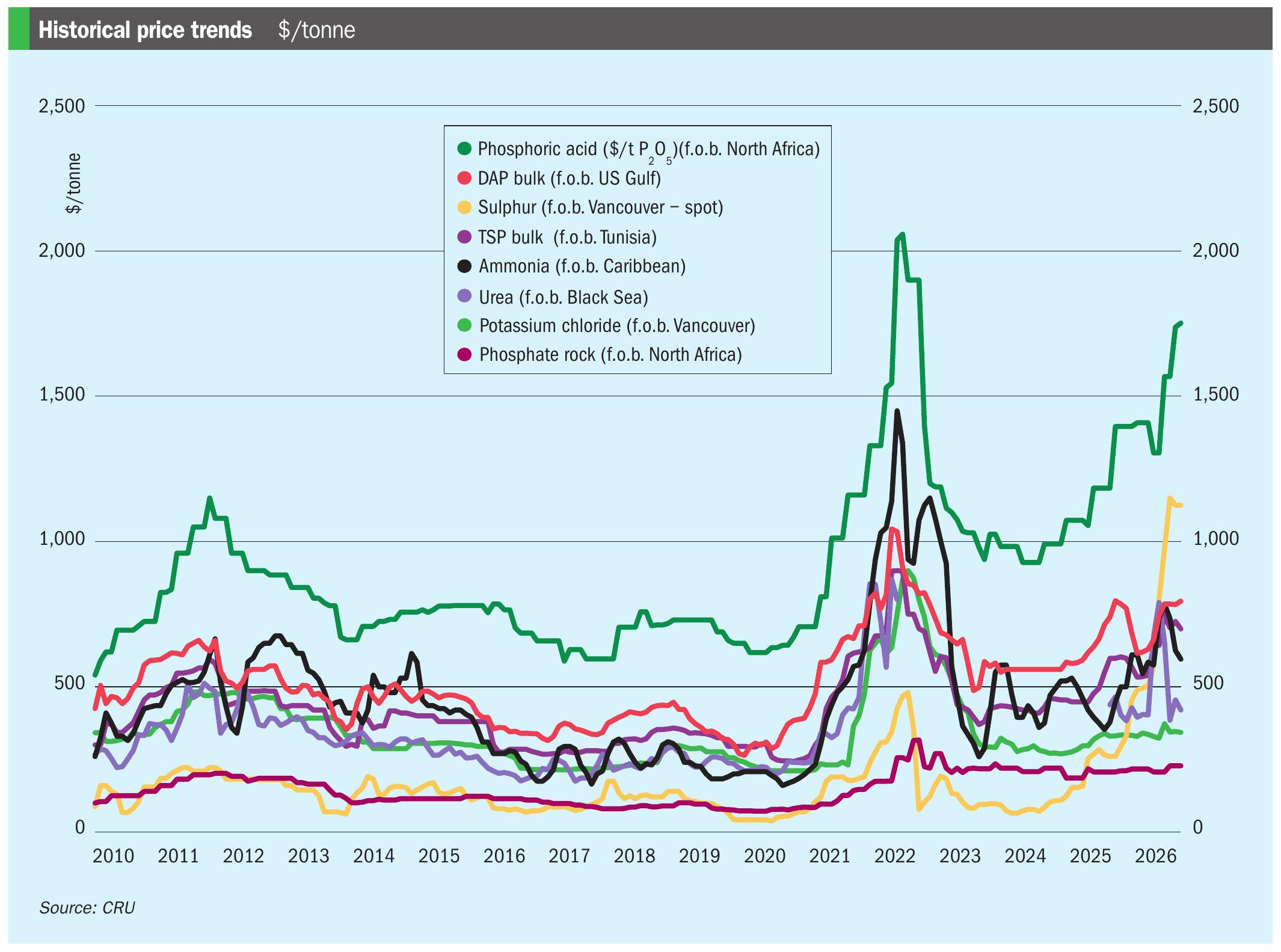
Sulphur prices to remain above historical norms in the first half of 2026 – but the year’s second half will see price relief as supply tightness eases.
The current sulphur price surge has pushed affordability beyond prior peaks. The combination of returning supply and a demand slowdown will, however, see the sulphur market return to balance in 2026.
China NP exports to slow on a shift back to DAP/ MAP – while OCP continues to pivot towards TSP.
We believe China’s NP exports will face tighter scrutiny in 2026, most likely in the form of a P2O5 -based export quota, making a shift back towards higher value products like diammonium phosphate (DAP) and monoammonium phosphate (MAP) likely. Combined with the announcement that exports will be banned until August, this means overall exported volumes from China will be significantly weaker. OCP, meanwhile, has been significantly increasing its triple superphosphate (TSP) capacity and production – expanding in established markets like Brazil and developing new market destinations for TSP such as India.
China urea exports will start earlier and be more substantial – CRU forecasts almost 6 million tonnes.
China’s urea production is expected to reach a record 72 million tonnes in 2025, far exceeding domestic demand. With the government more confident about supply security and keeping prices affordable for local farmers, CRU expects China’s urea exports to increase to 5.9 million tonnes in 2026 – with the export window possibly opening as early as May.
European nitrogen majors to invest in US ammonia capacity and offtakes – pivoting away from their existing high emissions sources.
Europe’s ‘grey’ ammonia production and imports will come under increasing pressure as the EU phases out emissions trading system (ETS) free allowances and phases in CBAM. To avoid cost escalation, EU nitrogen producers will act to secure strategic, long-term sources of low emissions ammonia in 2026, either through investment in capacity or offtake agreements. The US, in contrast to Europe, benefits from low-priced natural gas, advanced carbon capture and storage (CCS) infrastructure and generous 45Q tax credits for CCS operations. These factors, along with relative proximity, make the US a natural partner for EU nitrogen producers seeking low-carbon ammonia volumes to hedge against increasing carbon costs.
“CRU expects China’s urea exports to increase to 5.9 million tonnes in 2026, with the export window possibly opening as early as May.”
Phosphate investment builds momentum – with capital from less traditional sources for projects in riskier jurisdictions.
With supply remaining tight, and Chinese export restrictions unlikely to lift, phosphate prices will remain high compared to historical norms. This has made phosphate projects a more attractive prospect. We therefore expect to see an increasing number of investments made into riskier jurisdictions and backed by foreign financing, especially from China. We have already seen early-stage announcements for large-scale projects in Egypt, Algeria, Tunisia, Uzbekistan and Turkmenistan, for example.
Potash projects internationally will face further delays and capital overruns – while Russia continues to explore further projects and expansions.
China’s anti-involution policy will not result in fertilizer capacity consolidation – but it may lead to looser urea export restrictions.
China’s anti-involution policy is designed to prevent excessive price cutting (price wars) and reduce overcapacity. Yet China’s nitrogen capacity has, in fact, been expanding since 2022, while its (resource-constrained) phosphate and potash capacities are expected to remain stable. The anti-involution policy may, however, lead to a relaxation in export restrictions when prices fall to cost levels – as implied by the unexpected fourth quota allocation for urea exports announced in November.