Fertilizer International 534 Sep-Oct 2026
15 September 2026
Market Insight
Market Insight
PRICE TRENDS
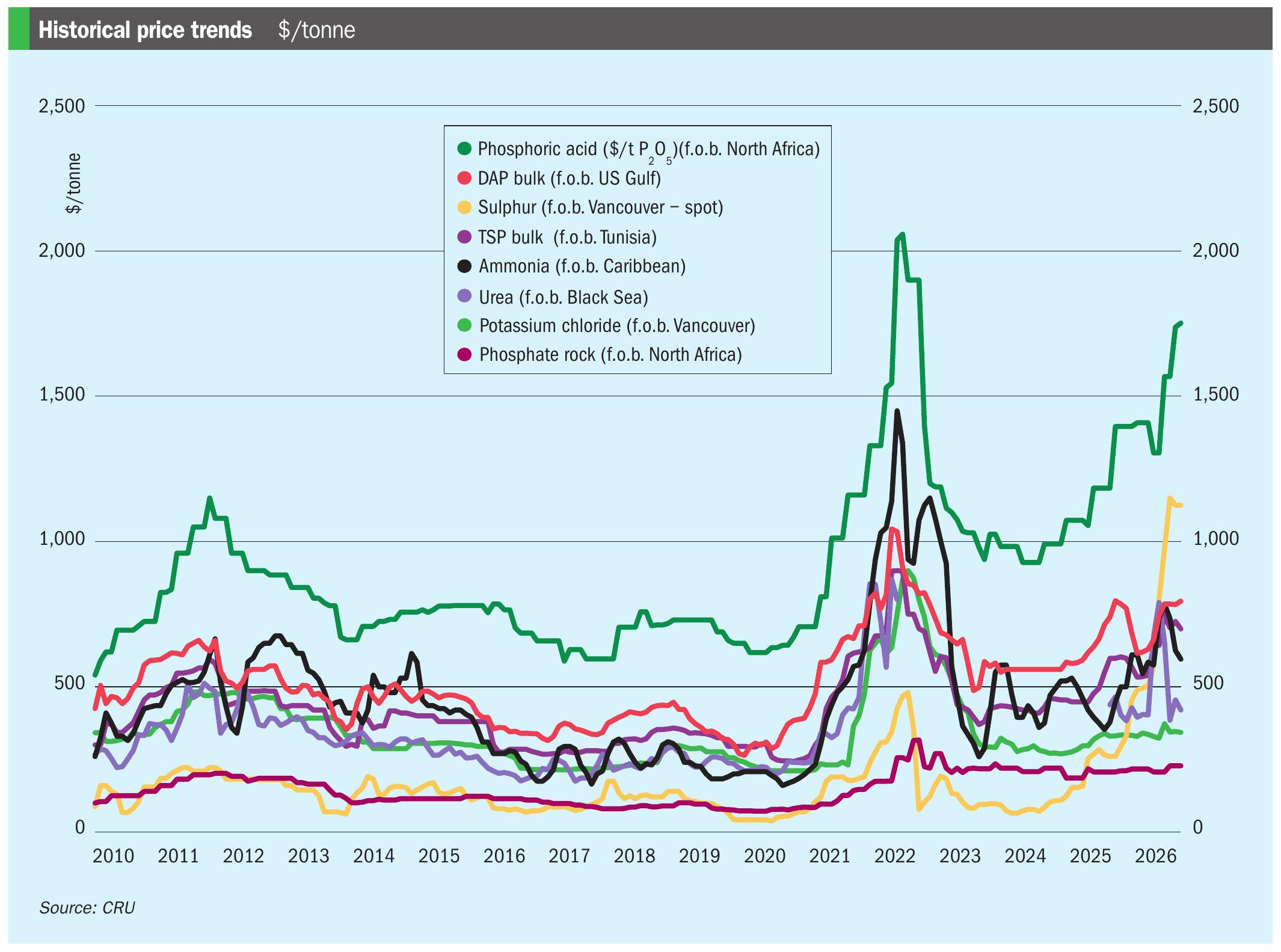
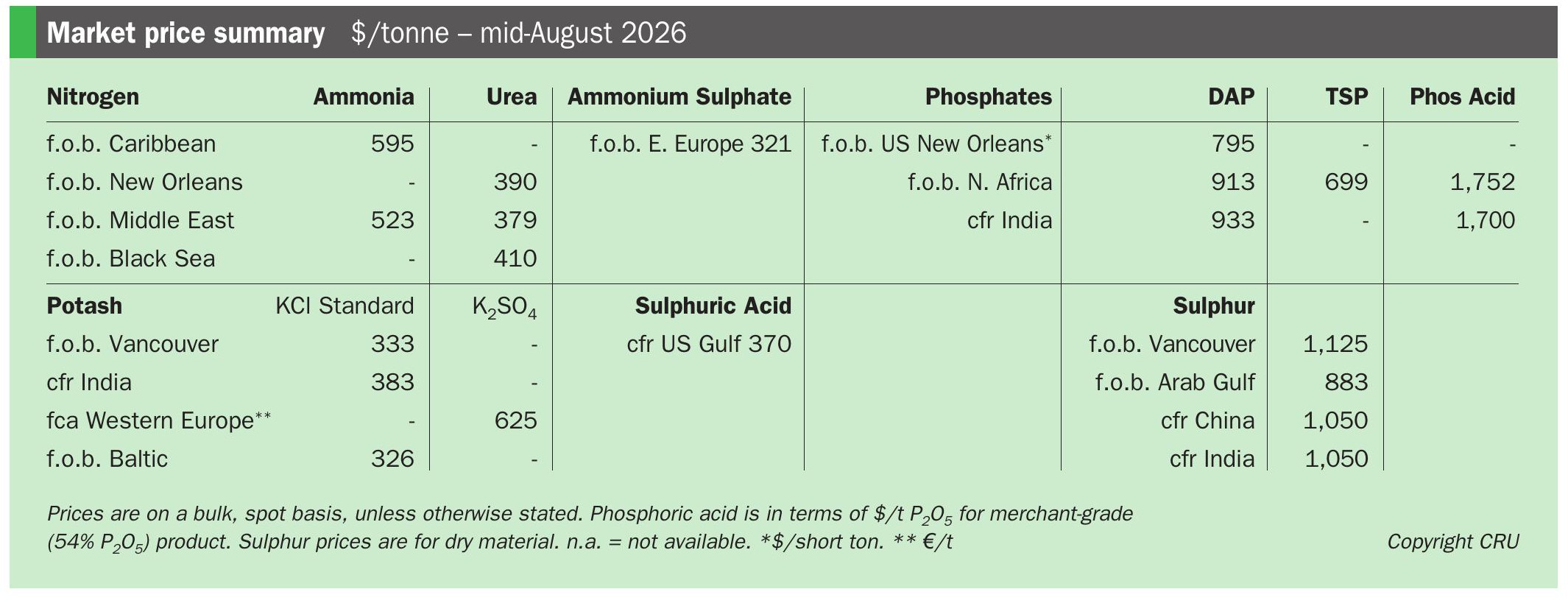
Market snapshot, 20th August 2026
Urea price declines slow: While some granular urea prices appear to have turned a corner, it remains to be seen whether this rally can be sustained. The prospect of significant Chinese supply, meanwhile, continues to weigh on prilled urea pricing.
Rashtriya Chemicals and Fertilizers (RCF) issued letters of intent for the purchase of 1,779,500 tonnes of urea following the conclusion of its 11th August tender. This saw lowest offers in the $390s/t cfr range and is expected to be largely supplied by China, with estimated participation ranging from 1.2-1.5 million tonnes.
In the Middle East, latest prices are in the $390-410/t f.o.b. range, with the shipping situation in the Strait of Hormuz still uncertain. In Iran, the official price was cut to $345/t f.o.b., although several tenders failed to attract buying interest.
The most significant price recovery has been in North Africa. In Egypt, sales were concluded at $450/t f.o.b. by Mopco and at $475/t f.o.b. by Abu Qir. Progressively higher deals were also reported in Algeria, eventually reaching $467/t f.o.b. following an AOA sale for September.
The Americas have also seen a shift in sentiment. In Brazil, offers are reported to have climbed as high as $470/t cfr, although liquidity at these levels is non-existent for now. The US NOLA market also firmed, with September barges trading up to $405/st f.o.b.
Ammonia’s regional divide continues: In northwest Europe, prices are unchanged, holding at above the $700/t cfr mark. This stability is underpinned by high Dutch TTF gas prices, which stood at €63.93/MWh ($21.5/mmBtu) on 20th August, and steady urea values out of Algeria.
East of Suez, Chinese f.o.b. offers in the $430/t range continue to set the floor, putting pressure on other urea producers. This was reflected in Southeast Asia, where the assessed price range eased to $420-500/t f.o.b., including a reported sale to India at $450/t cfr for ammonia of Malaysian origin.
The US market was quiet with attention shifting to the upcoming September Tampa contract settlement between Yara and Mosaic. Expectations are for a moderate decline from the August price of $635/t cfr, with most anticipating a settlement closer to $600/t cfr.
Phosphates prices stable: Spot prices across DAP/MAP markets were broadly stable. Sellers shifted tonnes to a range of destinations in response to slow demand in key import markets.
Bangladesh’s Ministry of Agriculture closed a purchase tender on 18th August for 500,000 tonnes of DAP, 200,000 tonnes of TSP and 250,000 tonnes of MOP, according to market sources, with offers totalling 670,000 tonnes of DAP, 270,000 tonnes of MAP and 420,000 tonnes of MOP. The lowest DAP offer was at $979/t cfr for 40,000 tonnes of DAP from Egypt, while the lowest TSP offer was at $767/t cfr for 30,000 tonnes from Egypt/Bulgaria.
Ma’aden reportedly sold one DAP cargo for the Bangladesh tender at around $920/t f.o.b. The Saudi producer also confirmed it would now be exporting from Duqm port in Oman due to continuing shipping restrictions through the Strait of Hormuz.
In India, DAP was steady at $930-935/t cfr, with price clarity awaited on FACT’s latest import tender. Prices in the subcontinent have remained relatively stable since Indian Potash Limited (IPL) awarded 13 suppliers for 1.347 million tonnes of DAP on its 7th May tender.
Spot prices for MAP cargoes to Brazil were also stable at $850-860/t cfr following two weeks of declines, with sales still scarce despite the price falls.
Early signs of potash price weakening: European standard MOP prices remained stable at €345-360/t cif, while granular prices declined marginally to €350-370/t cif due to waning seasonal demand. Similarly, Southeast Asian standard MOP prices remained broadly stable at $380-423/t cfr, while granular MOP prices declined marginally to $410-420/t cfr due to seasonal factors. Bangladesh’s Ministry of Agriculture, meanwhile, closed its 250,000 tonne MOP tender with the lowest bids at $399/t cfr and the highest at $431/t cfr.
In Brazil, prices held stable at $390-403/t cfr. Some market participants are expecting October deliveries to decline to $370-380/t cfr. The US market remained steady at $340/ st f.o.b., with limited activity reported at ports.
Sulphur market flat with buyers on sidelines: Most key sulphur benchmarks remained stable due to a widespread lack of spot market activity. While confirmed price drops were seen in the Mediterranean and domestic China, the dominant theme across other major regions was one of inaction, as most buyers in India, Brazil and Indonesia remained on the sidelines.
In the Middle East, sulphur f.o.b. prices held at a three-month low. The sulphur market remains caught between weak global demand signals and worsening local supply risks. The sulphur shipping backlog in the Strait of Hormuz has increased to 450,000 tonnes, according to Kpler, with no meaningful progress on securing safe passage for vessels.
In China, domestic port prices declined as inventories rose to an 11-week high of 884,000 tonnes.
The Indian sulphur market was quiet, with prices holding stable at $1,050-1,100/t cfr. Participants are currently awaiting a final decision on a proposed government subsidy.
Indonesian sulphur prices were similarly unchanged and remain at a two-month low. The Brazilian market is also in a stalemate, with prices stable amid a near-total absence of buying interest.
OUTLOOK
Limited urea upside as Chinese supply emerges: Global urea prices are expected to find some support in August, driven by a new tender in India and renewed purchasing in Europe. On the supply side, market tightness is expected to ease. While around 442,000 tonnes of urea across 10 vessels is currently at anchor west of the Strait of Hormuz, shipments should resume gradually through August before increasing in September. This is coupled with newly commissioned urea capacity in Nigeria and Iran. China’s continued presence in the urea export market is also set to weigh on prices.
Ammonia’s east-west divergence widens: In the short term, prices should hold firm in Europe, although values elsewhere could well undergo further pressure. The September Tampa contract price is also expected to decline. Ammonia pricing is increasingly split east and west of Suez. Northwest Europe, for example, is the only benchmark forecast to move higher in August. East of Suez, meanwhile, ammonia prices continue to ease under pressure from abundant Chinese supply and weak regional demand.
Phosphates prices approach ceiling: Phosphate prices are set to remain well-supported in the short-term. While the exceptionally tight availability affecting both finished products and raw materials is likely to drive up some benchmarks further, a price ceiling is approaching with poor affordability limiting the price upside. Gradual phosphate price declines are expected from late in the third quarter or early in the fourth.
Potash to decline as demand weakens: Potash prices are expected to decline in the short-term. This is due to weakening demand in key consumption centres, such as Brazil and China, and ample supply availability. The continuing presence of surplus MOP on the international market could place downwards pressure on prices globally.
Sulphur price correction moderates: The market is expected to remain flat-to-soft in the short-term. While the supply risk in the Middle East provides a floor, the widespread lack of demand across key import markets is preventing prices from moving. Looking ahead, prices are still forecast to fall, although the market correction will be moderated by the ongoing conflict in the Middle East and limited vessel movements in the region.