Market Outlook
• The global sulphur market outlook is flat to soft in the near term: most


• The global sulphur market outlook is flat to soft in the near term: most
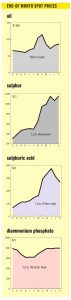
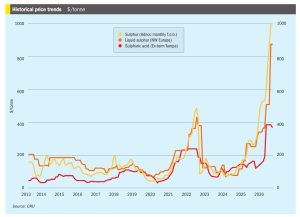
Most key sulphur import markets remained stagnant in late August due to weak demand. A premium is being paid for cargoes with guaranteed delivery schedules, driven by ongoing logistical risks in the Middle East. This has firmed prices in North America and Indonesia, but the potential return of supply from Russia and Kazakhstan may add some downward pressure.
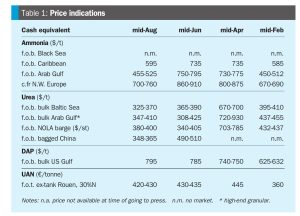
The ammonia market continues be divided on a regional basis during August. In northwest Europe, prices remained high, holding above the $700/t CFR mark, underpinned by high Dutch TTF gas prices, which stood at €63.93/ MWh ($21.5/MMBtu) as of 20 August. The spot market was active, with two cargoes destined for CF Fertilisers in the UK, one an ex-Trinidad cargo supplied by Koch and the other an ex-Algeria cargo supplied by Trammo. Trammo was also linked to a separate, unconfirmed, sale into Poland for Grupa Azoty.
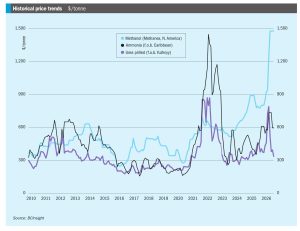
• Prices are expected to hold firm in Europe, though values elsewhere could well undergo further pressure, with Tampa also expected to decline for September.
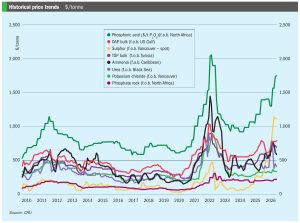
Price trends and market outlook, 20th August 2026.
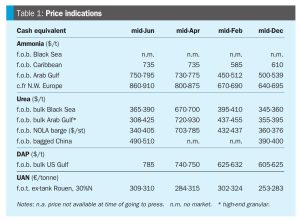
Ammonia values have continued to ease across most regions at the end of June, as the first ammonia vessels begin to exit the Gulf since the Iranian conflict began. Iranian ammonia had also begun to flow to India following the US Treasury’s issuance of a 60-day sanctions waiver on 22 June, allowing dollar-denominated trade in Iranian petrochemical products through 21 August. As a result, Indian bids have been heard as low as $750/t c.fr, as buyers benefit from a widening pool of available supply - Iranian, Chinese and renewed Southeast Asian material are all competing for the same business.
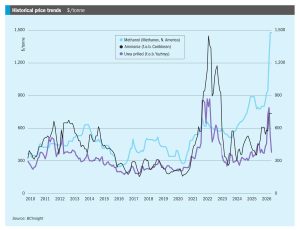
• Ammonia prices are expected to maintain their current downward trajectory, with the pace of correction likely to accelerate as the supply picture improves. Confirmed trades at materially lower levels remain limited, but the direction of sentiment is clearly softer.
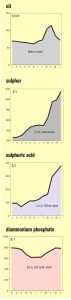
The global sulphur market has entered a holding pattern, as a wave of bearish sentiment has so far failed to move stubbornly high spot prices. The departure of a significant volume of product from the Middle East has emboldened buyers and shifted market sentiment firmly towards bearish, but at time of writing this has so far failed to translate into lower prices. With sellers in no hurry to lower prices and spot availability still tight, the market has stalled as both sides wait for the other to blink first.
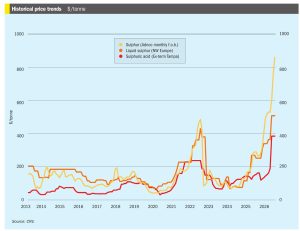
• The market has paused as bearish buyer sentiment has not yet translated into lower spot prices. The direction of the next major deal is now the critical test. This will either initiate a downward price correction, validating buyer caution, or force a recognition of the market’s underlying tightness and bring purchasers back to the table at current levels.
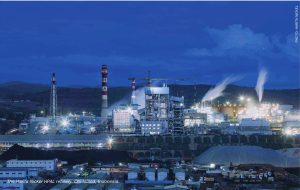
Nickel is becoming increasingly important to the sulphur and sulphuric acid markets, with Indonesia now a key importer.