Nitrogen+Syngas 377 May-Jun 2022

31 May 2022
Price Trends
Price Trends
Market Insight courtesy of Argus Media
NITROGEN
Spot ammonia prices made steep losses in west of Suez regions following the $200/t drop in the Tampa May contract price in late April, as supply and demand start to rebalance two months after the removal of Black Sea ammonia exports from the market. Yara has settled the Tampa contract price for May with Mosaic at $1,425/t c.fr, a $200/t drop from April.
In the eastern hemisphere, prices are stable as firmer contract prices start to narrow the range, but some pressure is on the downside, with the latest Indonesian sales tender attracting bids below last done spot business. No award has been confirmed following the latest Indonesian tender. Pupuk Indonesia issued a tender to sell 15,000t of ammonia for 24-25 May loading, targeting a price of $1,125/t f.o.b. Bontang.
Recent market drivers include fresh demand from Turkey, which could pick up following news that producers there will be permitted to export CAN in May. CAN producer Bagfas had reportedly been delaying finalising ammonia import cargoes until Turkish authorities confirm an end to export restrictions. In the east, the confirmation of the Indian government subsidy is expected to bring fresh inquiries from Indian buyers. The fundamentals suggest that west of Suez markets will soon realign with the east but the market remains exposed to any volatility in European gas pricing.
Urea prices dropped sharply in most markets in the wake of the Indian purchase tender at the end of April. OQ Trading bid lowest at $716.50/t c.fr on the east coast of India, and $750/t c.fr on the west coast, while price levels in southeast Asia fell by around $100/t over 24 hours, with similar revaluations seen in Americas markets too. India has now tendered again, seeking to buy around 1.5 million tonnes of urea on 9 May, at which point some stability should be found.
Trade overall remains illiquid – generally with only small lots changing hands and at sporadic intervals – but pockets of demand have emerged, and more are likely to come in the weeks ahead now the reset has happened.
Current market drivers include Indian buying: the country’s tenders offer a rare opportunity to place significant urea tonnage in a global market that is currently moving at a snail’s pace. Market participants around the world reference it as a hinge around which they determine their trade decisions. There is of course the Russian crisis – despite much-curtailed demand, few will take large short positions because of the fragility of supply in Europe and continued geopolitical tensions.
The outlook looks weaker – demand is still mostly waiting in the wings and supply is still more-than-sufficient to meet it as it arises.

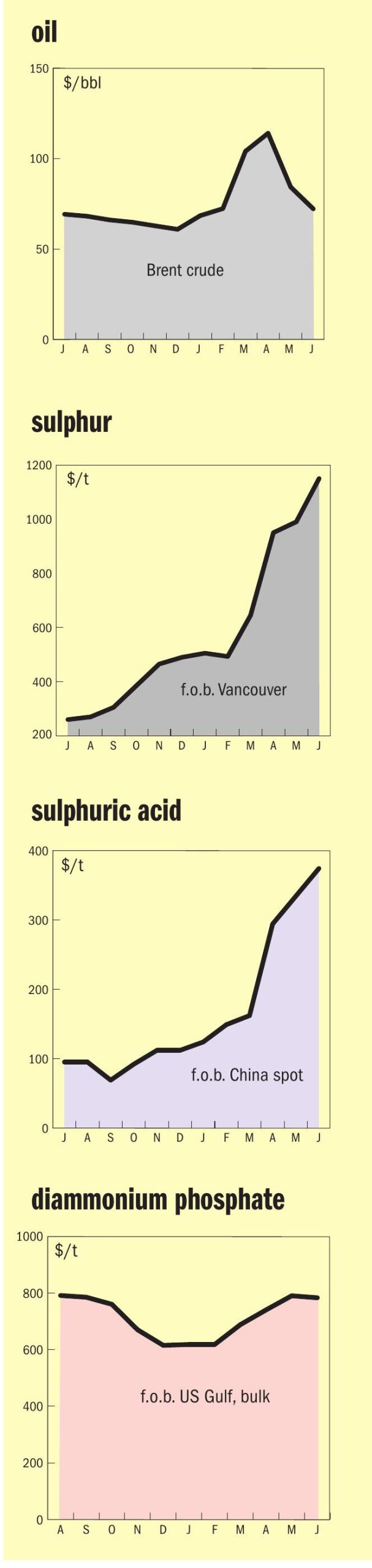
END OF MONTH SPOT PRICES
natural gas

ammonia

urea

diammonium phosphate