Sulphur 426 Sep-Oct 2026
18 September 2026
The global market for sulphuric acid
SULPHURIC ACID
The global market for sulphuric acid
The sulphuric acid market is seeing a contraction due to lack of sulphur availability, demand destruction in the phosphate sector and restricted Chinese exports.
The exceptional circumstances created by the Iranian conflict have had a major impact on sulphur availability, affecting two thirds of global sulphuric acid production. As a result, the industry is seeing a major contraction for the first time in years.
Suppliers
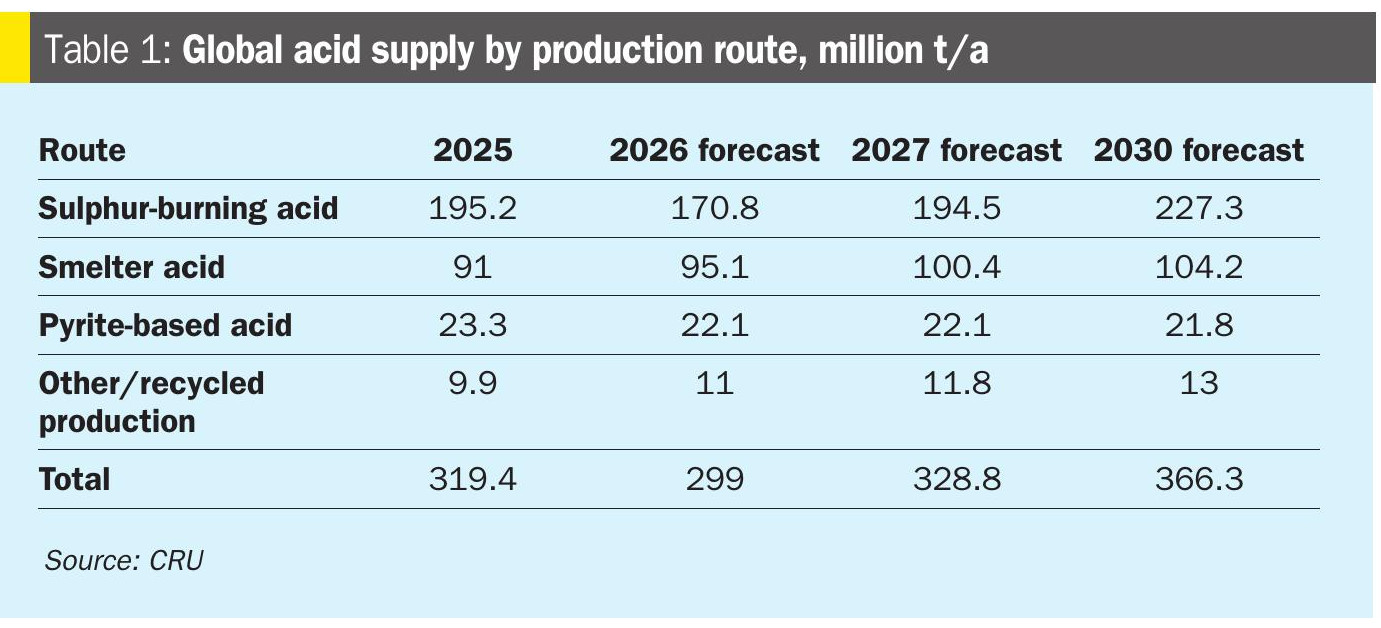
Global sulphuric acid supply is forecast to fall from 319 million t/a in 2025 to 299.0 million t/a in 2026. This represents a 6.4% contraction, and it is the first annual decline since 2022. The main reason for this is a 24.4 million t/a reduction in sulphur-burning acid production, itself arising from restricted sulphur availability, logistical disruption and elevated sulphur costs. This decline is partly offset by greater smelter-acid availability. Smelter acid output is forecast to increase by 4.1 million t/a in 2026, while pyrite-based production declines by 1.1 million t/a. Supply is projected to recover over the medium term, however, as shown in Table 1.
China
China is the largest source of the 2026 global supply contraction. Total domestic acid production is forecast to fall from 127 million t/a in 2025 to approximately 113 million t/a in 2026, a decline of around 10.8%. Output is expected to recover next year, but will likely remain below the 2025 level. As noted above, most of this reduction is led by sulphur-burning acid production – the most flexible source of acid supply. Smelter acid is a by-product of non-ferrous metals production and its availability depends on concentrate supply, smelter throughput and maintenance rather than on acid market conditions alone.
Drivers of the reduction include restricted sulphur availability and logistical constraints due to the closure of the Strait of Hormuz, coupled with high sulphur costs that undermine sulphur-burning economics. This in turn has had an impact on phosphate-sector operating rate, leading to lower acid consumption associated with weaker fertiliser production. Outside of fertilizers, there is also lower demand from the caprolactam and ammonium sulphate sectors, which are similarly impacted by sulphur prices.
Chinese smelter acid output is expected to be broadly stable rather than expanding. Copper-concentrate constraints are limiting smelter throughput, while lower acid values and negative treatment and refining charges are increasing pressure on smelter economics.
China has also started to develop gypsum-to-acid projects, which use phosphogypsum or other waste gypsum materials to produce acid, together with a cement-related co-product. GPCG commissioned a 650,000 t/a gypsum-to-acid plant in mid-2026, using 1.4 million t/a of waste gypsum and producing around 0.8 Mt/y of cement feedstock. This is expected to be expanded to 800,000 t/a by 2028. Other projects over the next few years include Guizhou Wengfu (650,000 t/a of acid), Hubei Dongsheng (300,000 t/a) and Yunnan Xiangfeng (600,000 t/a). On top of this 2.4 million t/a of supply that it already under construction, another 7.1 million t/a of gypsum-based capacity is planned, and could become accelerated if sulphur economics continue to be constrained.
Europe
Europe remains the largest exporting region for sulphuric acid. Regional acid supply is forecast to rise from 17.5 million t/a in 2025 to 18.2 million t/a in 2026, and 19.6 million t/a in 2030. Smelter acid production has recovered from the low point of 2022 and is forecast to reach 8.9 million t/a this year after a number of maintenance-related disruptions. Northern European availability is supported by additional production at Boliden’s Odda smelter, while the outages at Pirdop and Huelva seen last year seem to be easing. All of this should see European exports increase from 5.9 million t/a in 2025 to 6.6 million t/a in 2026, leading to a net trade surplus rising from 2.9 million t/a to 3.8 million t/a, a level which is expected to remain largely consistent out to the end of the decade. However, Europe’s ability to act as a swing supplier is constrained by regional consumption. Despite production gains in 2024 and 2025, European exports in 2025 were lower than in 2023 because additional output was absorbed by domestic demand.
Japan and South Korea
Japan is expected to increase exports in response to stronger international pricing and the market share vacated by China, rising from 3.07 million t/a in 2025 to 3.24 million t/a in 2026. South Korea has less capacity to increase exports. Volumes are expected to remain near 2.4 million t/a, declining slightly year on year from 2025 to 2026 due to a shortage of copper concentrates, which limits smelter throughput and by-product acid availability. Together, Japan and South Korea contribute useful incremental supply to the international market, but the combined increase is modest relative to China’s export loss.
Peru
Peru is an important supplier to the Pacific acid market, particularly Chile. Smelter-based acid availability is expected to improve in the short term as PetroPeru ramps up, adding an estimated 100-200,000 t/a of supply by 2026. Exports are forecast to increase from around 1.0 million t/a in 2025 to 1.24–1.3 million t/a in 2026. However, the longer-term outlook is less supportive of exports. From 2028, the start-up of Tia Maria is expected to increase domestic acid demand, reducing export availability to approximately 700,000 t/a. This decline is strategically relevant to Chile, which remains structurally reliant on imports.
Consumers
Global acid demand is forecast to fall by 20.4 million t/a this year, with fertiliser demand accounts for most (80%) of the contraction, and metals-related demand dropping by an additional 2.2 million t/a.
Morocco
Morocco remains one of the world’s largest acid consumers and importers because of its phosphate fertiliser industry. However, demand is forecast to decline from 23.8 million t/a in 2025 to 21.4 million t/a in 2026, before recovering to 25.5 million t/a in 2027 and 30.6 million t/a by 2030. This year’s reduction is mainly based around restricted sulphur availability and lower phosphate operating rates, together with a shift towards triple superphosphate (TSP) production rather than mono- and diammonium phosphate (MAP/DAP). TSP has lower acid intensity than DAP and MAP, reducing acid consumption per tonne of phosphate fertiliser produced. TSP accounted for around 50% of Moroccan phosphate-fertiliser exports in 2025.
Moroccan sulphur-burning operating rates are expected to average around 70% in 2026. The country is forecast to add 3.0 million t/a of sulphur-burning capacity by 2030, while acid demand is forecast to grow by 5.0 million t/a over the same period. This implies that the country is likely to remain exposed to supply constraints and import requirements during periods of high phosphate operating rates.
Middle East
Saudi Arabia’s acid market is shaped by the geographic separation of its phosphate operations. Despite national acid capacity, facilities at Ras Al Khair and MWSPC cannot fully balance local production and consumption because they are located in different areas. Acid imports reached 1.19 million t/a in 2025, but this year the closure of the Strait of Hormuz is expected to constrain purchasing and reduce imports to around 600,000 t/a. Import dependence is expected to ease from 2027 as Ma’aden III is commissioned, including associated coastal acid capacity. The location of this capacity should improve the ability to serve phosphate operations and reduce the need for imported acid.
Indonesia
Indonesian demand is affected by the economics of nickel high-pressure acid leach projects. In 2026, lower nickel prices, weaker HPAL economics and sulphur availability constraints have limited acid consumption growth. However, acid imports have increased because imported acid can substitute for sulphur where local sulphur-burning capacity cannot obtain feedstock. Imports rose 91% year on year to 800,000 tonnes for the year to August.
Longer term, nickel-related consumption is forecast to expand strongly. Integrated nickel-leaching demand is projected to increase from 9.2 million t/a in 2026 to 27.1 million t/a by 2030, with non-integrated consumption adding an additional 900,000 tonnes, rising to 1.6 million t/a. Import requirements should diminish after 2027 as domestic smelter-acid output recovers and is consumed within Indonesian industrial clusters, but this year sulphur-burning output is forecast to decline by 16% because of sulphur shortages and high input costs. Smelter acid supply is recovering. Freeport Indonesia’s Manyar smelter is returning to production, while PT Smelting is expected to ramp up in the second half of 2026. Both are expected to attain full capacity by late 2027. Total Indonesian acid production is forecast to rise sharply from around 13 million t/a in 2026 to 32 million t/a by 2030, mainly based on sulphur-burning supply. Most new smelter acid is expected to be absorbed domestically, particularly by non-integrated nickel operations and battery-material supply chains. As a result, additional Indonesian smelter output is not expected to become a major export source.
India
Indian acid consumption was 14.3 million t/a in 2025 and is projected to rise eventually to 18 million t/a by 2030. Most of this acid goes to support the phosphate fertilizer sector. Domestic supply is expected to increase from 13.0 million t/a in 2025 to 14.3 million t/a in 2026, supported by new sulphur-burning capacity and the ramp-up of Adani’s copper smelter, which is expected to produce 1.4 million t/a of acid at capacity. In spite of this, India remains structurally short of sulphur-burning acid supply. Imports are forecast at 1.6 million t/a in 2026, lower than previous years as domestic supply rises and global availability tightens.
Brazil
Brazilian demand is expected to decline by around 1.7 million t/a in 2026 as high sulphur prices force cuts to phosphate production. Mosaic has curtailed single superphosphate operations, reducing acid consumption. SSP output is forecast to decline by around 30%. Brazilian imports have nevertheless risen sharply. Imports through July 2026 were already above total 2025 volumes, increasing 81% year on year.
Chile
Chile is structurally the largest long-distance acid import market due to the requirements of copper leaching operations. Copper-sector acid demand is forecast to remain broadly stable at 7.6 million t/a in 2026, before increasing to 8.47 million t/a by 2030. Near-term demand weakness at Chuquicamata and Mantoverde has been partially offset by recovery at Radomiro Tomic. Longer-term growth is linked to mine extensions at Spence, El Abra and Lomas Bayas, along with Marimaca, from 2028, and Collahuasi and Gaby later in the decade. The acid intensity of Chilean copper production has also increased, with the number of tonnes of acid required to produce a tonne of copper rising from 4.5 in 2015 to 7.1 in 2025, as SX-EW copper output declines and processing conditions become more acid intensive.
Chile’s acid-import requirement is forecast at about 3.3 million t/a in 2026, compared with 4.0 million t/a in 2025. The reduction reflects high prices, revised mine plans and alternative supply arrangements rather than the disappearance of structural import dependence.
United States
US demand is forecast to decline from 29.9 million t/a in 2025 to 27.4 million t/a in 2026, before recovering to 30.7 million t/a by 2030. The immediate decline is concentrated in phosphate fertilisers, reflecting affordability constraints and further temporary production curtailments by Mosaic. Imports are forecast to decline by around 200,000 t/a in 2026, but the United States retains a structural deficit in sulphur-burning capacity and continues to require approximately 3.0 million t/a of imports through the forecast period. The medium-term outlook includes new demand from lithium processing. Lithium Americas is expected to add around 1.0 million t/a of acid demand by 2030.
Southern Africa
Acid demand in the Democratic Republic of the Congo has expanded with copper production, rising from to an estimated 5.8 million t/a in 2026. On-site sulphur-burning facilities provide much of the market’s supply, but confirmed additions remain limited. Smelter-acid availability is expected to improve from 2026, including around 700,000 t/a from the Kamoa project. Imports were approximately 1 million t/a in 2025, principally sourced from Zambia. Zambia’s removal of acid export restrictions has reduced a potential supply risk for the Congolese market.
Namibian acid demand is principally associated with uranium production. Demand is forecast to rise from 630,000 t/a in 2020 to 780,000 t/a in 2026. Domestic availability weakened after the Tsumeb smelter entered care and maintenance in June 2025, removing approximately 200,000 t/a of acid production. Supply is expected to improve from 2026 as the Skorpion Zinc smelter resumes production. A further improvement could occur from 2027 if Tsumeb restarts. Europe remains the principal import source.
Trade
Global sulphuric acid trade is forecast to decline from 23.1 million t/a in 2025 to 20.1 million t/a in 2026, remaining near 20 million t/a through 2030. Seaborne trade is expected to decline more sharply, down 3 million t/a to 14.2 million t/a this year, before recovering modestly to 15 million t/a in 2027. As well as the demand destruction and lower sulphur burning acid production mentioned above, China’s effective withdrawal from acid exports weighs heavily upon the market, and is the primary cause of the contraction in seaborne trade. China imposed an export quota of 700,000 tonnes for January–April 2026, after which exports were reportedly suspended for May–December. Exports in the first four months of the year were 50% lower year on year, and are expected to decline from 4.64 million t/a in 2025 to 950,000 t/a for full year 2026.
Set against this, Europe, Japan, South Korea and Peru are increasing or maintaining exports, but cannot fully replace Chinese cargoes. This has increased the importance of regional sourcing, especially European supply into Atlantic and Pacific deficit markets. The trade response varies by region. Chile has seen lower imports, increased reliance on European sources and reduced Chinese participation, while Morocco has seen a sharp import reduction as domestic operations run at lower rates and sulphur is prioritised.
Pricing
Acid prices reached historically high levels in 2026 following China’s export restrictions and reduced availability of sulphur-burning supply. However, demand cuts, buyer resistance and improved expectations for smelter supply have caused delivered prices to decline from their mid-year peak. Delivered prices have softened more sharply than FOB prices. This reflects demand destruction in key destination markets, shifts in cargo availability and changes in freight and supply-chain conditions. FOB values in Europe and Northeast Asia remain relatively firm because these regions have become essential sources of export supply. Chinese domestic prices remained high despite easing during July and August. The national average declined from approximately $310/t in early July to around $292/t in early August.
The relationship between sulphur prices and acid prices is central to sulphur-burning economics. Acid premiums are measured as the acid price minus sulphur cost divided by approximately 3.06, reflecting the relative sulphur requirement for acid production. In China, the domestic acid premium was negative through 2026 and reached around negative $85/t. In practical terms, it was cheaper to purchase acid than to produce it from sulphur at prevailing feedstock costs.
Overall, prices are expected to peak in Q3 2026 and decline in the fourth quarter, assuming demand curtailment and improved sulphur availability. An easing of China’s export restrictions, reopening of the Strait of Hormuz and a release of constrained sulphur supply could all bring prices down, but the principal upside risk remains a worsening copper-concentrate shortage. This could reduce smelter throughput and hence smelter-acid supply, increasing reliance on more expensive sulphur-burning output.