Agricultural
4 August 2026
From the archives: the 'Godzilla' El Niño of 2015/16
Written by Simon inglethorpe
We review the impact of the 2015/16 El Niño on global agriculture and fertilizer demand, and assess how climate change is influencing this irregular weather phenomenon. Maize harvests in South Africa, Brazil and Central America, wheat and barley production in Morocco, Malaysian palm oil output, and rice growing in India and Thailand were all hit by this exceptionally strong weather event.
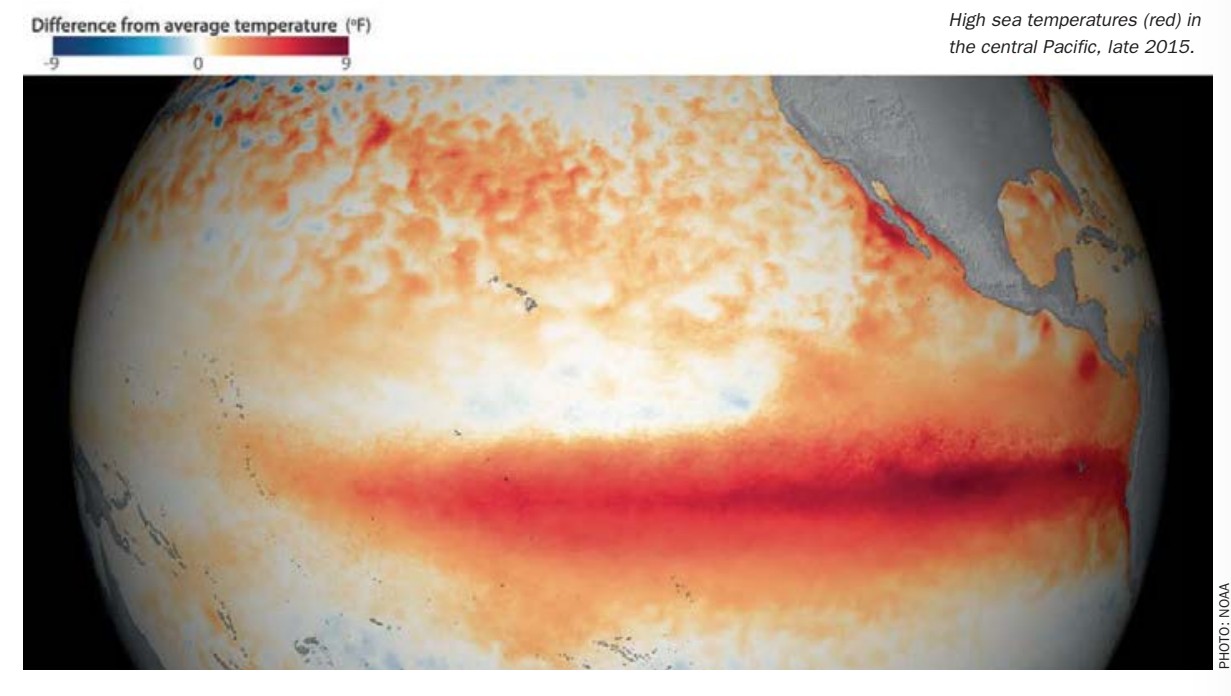
The El Niño episode which began in May 2015 and persisted into the early part of 2016 was either the most intense or the third most intense on record, depending on how it is measured. Such was its strength, some media outlets began calling it the ‘Godzilla’ El Niño due to its unprecedented magnitude.
El Niño – The Boy in Spanish – is associated with a band of warm ocean water that develops near the equator in the central and eastern Pacific Ocean. The converse phenomenon La Niña – The Girl – is caused by the cooling of ocean water in the eastern equatorial part of the Pacific.
Based on sea surface temperatures, the 2015/16 El Niño narrowly edged out the previous record-holder, the 1997/98 event. In the central zone of the Pacific, where scientists look for signs of a developing El Niño or La Niña, sea temperatures peaked in November 2015 at 3.1°C above average, surpassing the previous 2.8°C November 1997 maximum.
El Niño develops when the westward trade winds in the Pacific weaken, allowing warm water to spread eastwards towards South America, bringing with it high rainfall. The event typically triggers drought across large swathes of Asia and Australia, while the Americas typically experience excess rain and flooding. El Niño’s effects are also felt further afield, particularly in Africa.
El Niño, although often called abnormal, is a fairly frequent if irregular weather phenomenon. Episodes occur every two-to-seven years and last between nine months and two years. Some 31 El Niño events have been recorded since 1900.
What has certainly been abnormal about recent El Niño events is their magnitude and severity. The floods, droughts, fires, storms and mudslides triggered by the 1997/98 El Niño killed around 20,000 people across the globe and caused almost $97 billion of damage. The 2015/16 event has also been blamed for a number of damaging and life-threatening extreme weather events across the globe.
Drought, fire and flood
In a typical El Niño event, dryness develops over the Pacific and pushes north and west from Australia through Indonesia and into India as the middle of the year approaches. Central America also becomes unusually dry around this time. Weather impacts tend to peak later in the year, during a three month period from December through to February, as El Niño reaches its maximum strength.
The 2015/16 El Nino carried many of these hallmarks. It was blamed for India’s weak 2015 monsoon, for example, plus the country’s summer heatwave that led to more than 1,100 deaths, as well as South Asian winter floods. Five weeks of torrential monsoon rainfall blighted southern India and Sri Lanka, killing nearly 400 people and causing at least $4 billion in damage. “Southern India is having a lot of rain as it goes into winter, having come out of the dry monsoon. This is only so during extreme El Niño, so it is a confirmation that the El Niño is huge,” commented Wenju Cai of Australian science body CSIRO.
Rainfall during September and October 2015 was also the third lowest on record in Australia, although this dry spell ended before the year was over. At the time, October 2015 was also Australia’s hottest month on record.
Drought and fires in Indonesia in the latter part of 2015 cost $16.1 billion in damage (1.8% of GDP), according to some estimates, exceeding the $9.3 billion worth of fire damage in 1997/98. The UN Food and Agriculture Organisation (FAO) also reported a 60% fall in the maize harvest in El Salvador, Guatemala, Honduras and Nicaragua during late 2015, blaming this on an El Niño-related drought across Central America.
Jeff Knight of the UK’s Meteorological Office, whilst cautious about blaming El Niño for all of 2015’s extreme weather, concludes that El Niño and climate change were contributory factors. “Global warming is a background tide that is rising, and we get all these features like El Niño on top of it,” he said.
Bad for maize, rice and wheat
So what does an El Niño year mean for world agriculture? The impact of the phenomenon on maize, rice, soybean and wheat, the four largest global food crops, was assessed in a recent paper in Nature Communications1. These crops provide nearly 60% of the calorific value of agricultural production, and are also responsible for a major share of the world fertilizer market.
Looking back at past El Niño episodes, the effects on crop production appear mixed, if damaging overall. While El Niño typically pushes up average soybean yields by 2.1-5.4% globally, its influence on maize, rice and wheat yields is usually negative, depressing global yields by as much as 4.3%. Worldwide average yields of all four crops also tend to fall by as much as 4.5% during subsequent La Niña years.
Out of the four largest food crops, maize tends to be the worst affected by El Niño. Yields in North America, Southern Africa and East Asia all suffer slight-to-severe impacts, with any positive impacts being largely confined to Brazil and Australia.
North American and Australian wheat harvests are also typically affected by El Niño due to abnormally warm weather and dry weather, respectively. Warmer and drier conditions in Asia tend to depress rice yields in countries such as Thailand, Vietnam, India and south China.
Soybean yields are generally higher in El Niño years because of favourable effects in Brazil and the US, the two main global producers – as both countries typically receive anomalously high rainfall. Indian soybean production, in contrast, may be negatively affected due to higher temperatures and lower rainfall there.
Commodity markets keep a close watch
El Niño is closely watched on grain, oilseed and soft commodity markets because of its potentially detrimental effect on crop production and the price fluctuations this may cause. Any major change in crop production – from drought in Australia and Southeast Asia and excess rain in parts of the Americas – will also have significant knock-on effects for fertilizer demand.
India, the second largest global market for fertilizers, is particularly sensitive to El Niño. In August 2015, for example, CRU reported that India MOP sales were being hit by dry weather. Retailers in Southern India, where sales are concentrated, were struggling to sell product due to reduced monsoon rains. “[Indian] domestic demand could see a drastic slowdown, building inventories and halting import demand,” said CRU’s Chris Lawson. “Potash is the most sensitive of these fertilizers, with retailers in the main southern consuming states noting slow [MOP] sales despite heavily discounted prices.”
As early as May 2015, there were signs that El Niño was also starting to hurt business across Southeast Asia, a key growth market for fertilizers, particularly for phosphate and potash. By August, CRU was reporting a drop in fertilizer sales of up to 40% in some Southeast Asian countries due to restricted rice planting and falling palm oil output due to the lack of rainfall.
CRU also noted the potential upside to the 2015/16 El Niño. “Price advances from drought-induced supply shocks can help to boost fertilizer demand globally,” commented Chris Lawson. “However, grain and oilseed inventories are currently very high and any supply shocks are likely to be absorbed by these ample availabilities, capping any price spikes.”
The World Bank predicted that the agriculture market fallout from El Niño, although the strongest on record, would be mainly regional. “El Niño … could reduce yields in grains (especially rice) and edible oils (palm oil). However, this risk is regional—in East Asian countries including Indonesia, Malaysia and Thailand—rather than global,” the bank forecast at the end of 2015.
El Niño reaches its peak
El Niño peaked towards the end of 2015. The South African growing season got off to a particularly dry start, with the country in the grips of its second year of drought. Drier than average conditions were also reported in Thailand, Vietnam, the Philippines and Indonesia. Southern Brazil and northeast Argentina, meanwhile, experienced a wet beginning to their growing season.
The 2015/16 El Niño had a limited impact on Australian and North American agriculture. Rainfall in Australia, below average in September-October 2015, subsequently recovered during the early part of 2016. Rainfall in the US southeast was also above average during December 2015. Winter storms also brought welcome rain to northern California. Rainfall in the state was 9% above average between October 2015 and March 2016, although large parts of California remained in drought.
The 2015/16 El Niño eventually waned in May 2016. This allowed meteorologists to take stock and look back at its main consequences, including:
- Floods affecting South America (Peru, north Chile, Bolivia, Paraguay south Brazil), the southern US and north Mexico.
- Poor monsoon rains in India
- Severe droughts affecting Africa (Morocco, Ethiopia and southern Africa) and South America (north and east Brazil, Colombia and Venezuela).
African and Latin American cereals hit
World cereal production was 2,525 million tonnes in 2015, based on FAO estimates. This is some 35.8 million tonnes (1.4%) below 2014’s record cereal production levels. Lower maize and rice harvests were the main causes of the fall.
African agriculture was particularly badly affected by El Niño-related dryness. Maize production in South Africa, for example, contracted by one-third to 10.5 million tonnes in 2015, as the country struggled with its worst drought since 1904. The 2016 harvest was expected to fall further to 7.2 million tonnes.
After a strong cereals crop in 2015, Morocco also fell victim to drought, harvesting one of its smallest crops on record in 2016. The country produced just 2.7 million tonnes of wheat and 600,000 tonnes of barley compared to 8 million tonnes and 3.5 million tonnes, respectively, in 2015 – a 70% collapse in Moroccan cereal production.
Widespread drought, even when it ends, will continue to affect African fertilizer demand this year and possibly beyond, according to the International Fertilizer Association (IFA), as buying power for fertilizers and other inputs will remain limited2. Maize farmers in South Africa have been struggling with debt levels because of drought and poor harvests.
The May to September 2015 cereal growing season in El Salvador, Guatemala, Honduras and Nicaragua was also severely hit by prolonged dry weather associated with El Niño. The UN FAO reported a 60% fall in the maize harvest and an 80% fall in the bean harvest in Central America last year. The region’s 2015 maize harvest, an estimated 3 million tonnes, is down 8% on 2014, a harvest that was also compromised by drought.
Brazil, in contrast, had a bumper harvest and was largely unaffected by El Niño in 2015. In fact, cereal output was a record 107 million tonnes, 6% up on 2014. However, by the end of 2015, El Niño finally made itself felt in Brazil. In the main maize-producing states of Parana, Sao Paulo and Mato Grosso, severe dry weather was reported to have delayed planting of 2016 first season maize and reduced the growing area by 7%.
Asian rice production hit
The global rice harvest fell by 3.4 million tonnes to 491.4 million tonnes in 2015, largely due to adverse El Niño conditions. Although relatively small, the drop was highly significant as it throws into reverse the sharp upwards trend of the past decade. Indeed, global rice production has risen annually since 2006 by an average of seven million tonnes each year. 2015 also marked the second successive year of below-trend rice production, having followed stagnating output in 2014.
The rice production fall in 2015 was particularly acute in Asia, where the estimated harvest of 444.7 million tonnes is about 2 million tonnes below 2014. Thailand, India and the Philippines saw see the sharpest drops in output. The persistence of severe drought in Laos, the Philippines and Thailand hit rice growing particularly hard. In Vietnam, water levels in the lower Mekong River at the end of 2015 were at their lowest level in nearly 100 years ago, putting half a million hectares of fertile land at risk of saltwater intrusion2.
India’s June-September 2015 monsoon rains were also down 14% on the long term average and followed a poor monsoon in 2014. This was an exceptional occurrence as it was only the fourth time India has been hit by two successive monsoon rain deficits in the last 115 years. Monthly rainfall was 16% above average in June but 16% down in July, 22% down in August and 24% down in September.
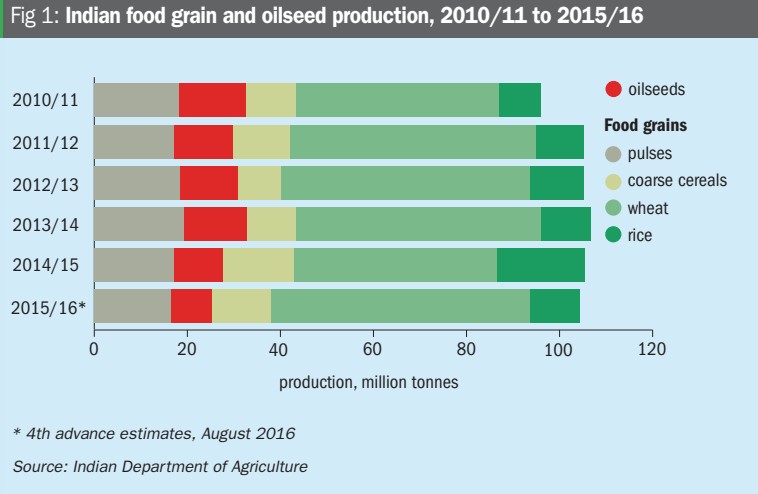
Poor monsoon rains have badly hit India’s agricultural production two year in a row. 2015/16 output dropped for most commodities, with the exception of wheat, following what was already a sizable contraction in 2014/15 (Figure 1). Fertilizer consumption during the wetter 2015 kharif season in India was excellent, according to IFA. However, disappointing sales during the subsequent rabi season led to an inventory build-up in the distribution pipeline, resulting in an overall decrease in 2015 fertilizer consumption2.
A bite out of palm oil production
After decades of continuous growth, Southeast Asian palm oil production declined for the first time in almost 20 years due to the negative effects of El Niño on the world’s two largest producing countries, Indonesia and Malaysia. Excluding China, both countries collectively account for over half of Asian regional potash demand due to palm oil’s high K requirements.
Mature oil palms are grown over an area of 4.8 million hectares in Malaysia. USDA data suggest the country’s palm oil production fell by 11% in 2015/16 to 17.7 million tonnes. El Niño-related drought stress during 2015 and early 2016 reduced Malaysian palm oil yields, reports USDA, with production running well below normal for the past eleven months. Half of the country’s total mature oil palm growing area experienced 4-5 consecutive months of drought and, as a result, Malaysia’s average palm oil yield fell by 13% to 3.69 t/ha in 2015/16.
Fertilizer demand contracts
World fertilizer demand fell by 1.0% in 2015/16 to 181.2 million nutrient tonnes, according to IFA estimates2. Nitrogen (N) and phosphate (P2O5) both fell by 1%, to 108.1 million nutrient tonnes and 40.9 million nutrient tonnes, respectively, whereas potash (K2O) contracted by 0.8% to 32.2 million nutrient tonnes.
IFA linked the drop in demand for fertilizers to factors such as the economic slowdown in emerging economies and lower agricultural commodity prices. But IFA also explicitly cited “dry conditions across South Asia, Southeast Asia, Latin America and Africa owing to an exceptionally strong El Niño event” as being partly to blame for the fall in fertilizer consumption.
Importantly, El Niño conditions prevailed in Latin America, Africa and South Asia, the three regions where 2015/16 fertilizer demand is thought to have declined most sharply. The steep demand fall in Latin America (-5.4% year-on-year) reflected unfavourable economic, political and weather conditions in Brazil and Argentina. This percentage drop is equivalent to a 1.2 million tonne annual fall in primary nutrient consumption in the region.
The 4.2% year-on-year contraction in African fertilizer demand was also attributed to the widespread drought there, as well as low commodity prices. The poor monsoon in India was again singled out by IFA as being partly responsible for a 1.9% drop in annual fertilizer demand in South Asia. The 0.2% decline in annual East Asian demand was also linked to the impact of El Niño over large parts of Southeast Asia.
Hangover in Brazil, respite for India
Although the 2015/16 El Niño finally ended in May 2016, as sea temperatures in the Pacific returned to normal, it disrupted agriculture in many countries during the early part of the year. Below average crop conditions in parts of Africa and poor rice growing conditions in key Southeast Asian countries were still being reported at the end of April 2016 (Figures 2 and 3, respectively).
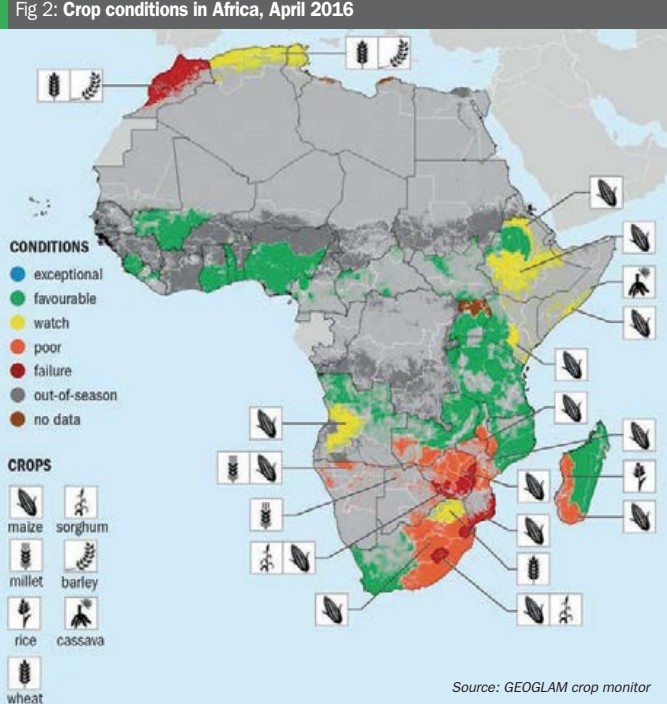
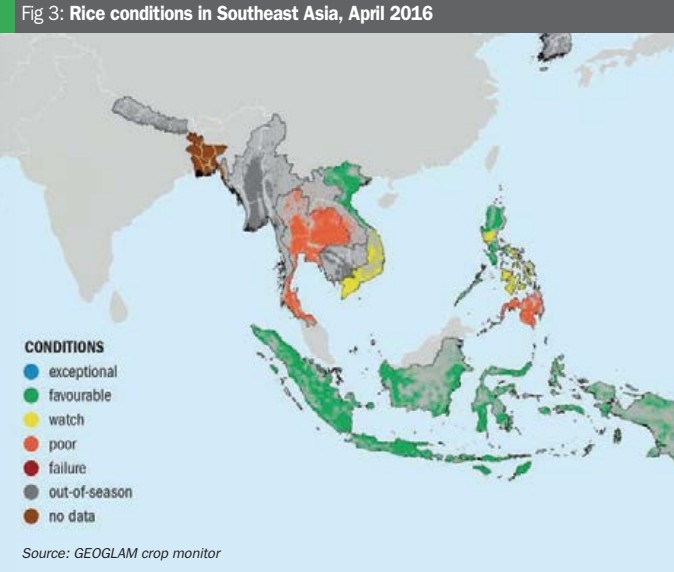
In Argentina, parts of the summer maize and soybean harvests were lost due to flooding caused by heavy rain in April 2016. The absence of rain in late winter and spring 2016 also devastated Morocco’s cereal harvest. In South and Southeast Asia, an exceptional April heatwave made routine agricultural fieldwork difficult in India. The start of summer rice planting in Bangladesh, Sri Lanka and parts of India was also disrupted by heavy rainfalls and flooding. Dry soils also jeopardised spring crop sowing in the Philippines2.
El Niño also has one final sting in its tail for the world agriculture’s powerhouse, Brazil. Cereal production for 2016 (86.9 million tonnes) is expected to be the lowest since 2011, according to FAO forecasting. Early estimates for Brazil’s second season (safrinha) corn crop suggest a 24% decline in maize output and a 27% yield drop, compared to the same season in 2015, due to severe dry weather associated with El Niño. A total maize harvest of 67.9 million tonnes is now expected for 2016. Brazil’s wheat harvest, in contrast, is forecast to increase by 16% in 2016 due to favourable crop conditions.
Unlike El Niño’s continuing legacy in Latin America, there was relief and respite for Asian agriculture over the summer. India’s monsoon rains returned to normal in 2016, with June-September rainfall for the country being restored to 97% of the long term average. The FAO expected a rebound in Indian cereal production because of this. This will be welcome news for the nation’s economy after the 2015 production shortfalls for rice, corn, sugarcane and oilseed crops. Agriculture accounts for almost one-fifth of India’s $2 trillion GDP and employs around half of its 1.3 billion population.
High wet season rainfall in 2016 also ended Thailand’s two-year drought. A major recovery in rice production in Thailand, the world’s largest exporter, is expected, with USDA is forecasting rice production of 18.6 million tonnes for 2016/17, up almost one-fifth on 2015/16.
El Niño getting stronger
Looking ahead, the fertilizer industry may have to accept greater weather-related volatility in global fertilizer demand, as the ‘Godzilla’ El Niño events of 2015/16 and 1997/98 become more common in future.
Research suggests that El Niño episodes in recent decades have been strongest of any other period over the past four centuries3. The frequency of extreme El Niño events also looks set to double this century as a result of climate change4. Droughts and floods during El Niño years, and the resulting agricultural disruption, are likely to become worse because of this. La Niña events are also expected to become twice as common this century due to climate change.
References
- Lizumi, T. et al., 2014. Impacts of El Niño Southern Oscillation on the global yields of major crops. Nature Communications, 5, 1-7.
- Heffer, P. et al. 2016. Medium-Term Outlook for World Agriculture and Fertilizer Demand 2015/16 – 2020/21. 84th IFA Annual Conference, Moscow, 30 May-1 June 2016.
- McGregor, S. et al. 2013. Inferred changes in El Niño–Southern Oscillation variance over the past six centuries. Climate of the Past, 9(5), 2269-2284.
Note
This article originally appeared as ”Godzilla’ El Niño leaves a lasting legacy’ in the November/December 2016 edition of Fertilizer International magazine (Fertilizer International 475, p38). Full subscribers have access to a complete 12-year archive of bimonthly issues going back to the start of 2015.