Nitrogen+Syngas 403 Sep-Oct 2026
16 September 2026
The outlook for low carbon hydrogen
HYDROGEN
The outlook for low carbon hydrogen
The scale up of low carbon hydrogen has proved slower, more selective and more geographically concentrated than the ambitious plans announced earlier in the decade had anticipated.
Low-carbon hydrogen is progressing from a policy-led concept toward an investable industrial market. Supply is increasing and a significant group of projects has reached final investment decision or construction. However, high production costs, weak or uncontracted demand, regulatory uncertainty, constrained infrastructure and slow project maturation mean that only a fraction of the announced pipeline is likely to be operating by 2030.
The market is developing differences by region. North America is the principal centre of low-carbon hydrogen and blue-ammonia development, benefiting from comparatively low natural-gas costs, established industrial clusters, carbon-capture-and-storage infrastructure and the US 45Q tax credit. Meanwhile, China is establishing itself as the low-cost leader in renewable hydrogen and electrolysis equipment, although its low-emissions market remains at an early stage. Europe, Japan and South Korea seem more likely to emerge as policy-supported demand centres and import markets than as low-cost supply hubs. The Middle East retains potential as an exporter of both blue and green derivatives, but project and trade routes are exposed to geopolitical and infrastructure risks.
Furthermore, ammonia appears to be becoming central to the hydrogen outlook, for several reasons; it is an existing commodity with established storage, handling and shipping networks, as well as being a potentially important hydrogen carrier and low-carbon fuel. However, the outlook for dedicated low-emissions ammonia demand is uncertain. CRU expects that the first substantial volumes of low-emissions ammonia will need to compete in the conventional merchant market before large new end uses such as marine fuel and power generation are established. That risks putting pressure on ammonia prices and project economics through the end of the decade.
Rapid growth
Global hydrogen consumption remains overwhelmingly conventional and fossil-fuel (mainly natural gas) based. The International Energy Agency (IEA) estimates that total hydrogen demand was around 103 million t/a in 20251, while low-emissions hydrogen production was still below 1 million t/a – less than 1% of global output. Low-emissions production nevertheless increased by approximately 20% during 2025 and is expected to rise by a further 30% in 2026 to almost 1.2 million t/a.
This growth matters because it establishes industrial operating experience, supply chains and reference projects. However, it also puts the scale of the challenge into perspective. Traditional refining, ammonia and methanol production and industrial consumption still account for nearly all hydrogen demand. New end uses such as transport, power generation and hydrogen-derived fuels represented only 1.1% of hydrogen demand in 2025. Under existing policies, the IEA expects these newer sectors to account for 4.2% by 2030: rapid growth in percentage terms, but not yet a transformation of the overall hydrogen market.
On the basis of projects already operating, under construction or at final investment decision, the IEA sees low-emissions hydrogen production reaching 4.3 million t/a by 2030. Including projects with “strong potential” raises this above 6 million t/a, which would represent about 4% of global hydrogen production by 2030. However, this is far lower than the nearly 27 million t/a of aggregate national 2030 production targets identified by the IEA. Achieving those targets would require annual production growth of around 100% through 2030. By contrast, committed projects imply approximately 40% annual growth over the remainder of the decade. The divergence illustrates a shift from broad national aspiration toward a more project-specific, commercially constrained outlook.
Project rationalisation
The announced pipeline of potential low carbon hydrogen projects remains large, but that pipeline has been considerably rationalised. The IEA has reduced its estimate of announced low-emissions hydrogen capacity for 2030 from 37 million t/a in its 2025 review to 27 million t/a in 2026, reflecting cancellations, delays beyond 2030, paused projects and projects with no reported progress for at least three years.
This rationalisation is not necessarily evidence that the sector is failing. Rather, it indicates that developers, financiers and policymakers are moving from early announcements to stricter tests of project viability. The key distinction is increasingly between announced capacity and capacity that has secured finance, permitting, infrastructure and offtake.
According to the Hydrogen Council2, global committed clean-hydrogen investment exceeded $110 billion across 510 projects at final investment decision or later, an increase of $35 billion over the preceding year. Around 1 million t/a of low carbon hydrogen was operational in 2025, including roughly 700,000 t/a of blue hydrogen production and 300,000 t/a of green production. Blue hydrogen capacity was particularly important in the operational base: approximately 90% came from eight legacy projects in North America. Looking forward, the Council estimates 13 million t/a of announced low-carbon capacity in the 2030 pipeline. After accounting for anticipated delays, pauses and project attrition, it considers 4–7 million t/a potentially feasible by 2030, conditional on offtake being secured. This is broadly consistent with the IEA assessment. The most important implication is that published capacity announcements should not be interpreted as expected supply without a clear view of project maturity. However, timings remain uncertain. The IEA notes that around 22 million t/a of announced projects will not be operational by 2030 if they do not reach a final investment decision by early 2027. More than 100 GW of announced electrolysis projects in the 100 MW–1 GW range face a similar risk if investment decisions are not made in 2026 or 2027. Typical construction periods are 1–4.5 years for electrolysis projects and 2–3.5 years for carbon-capture-based hydrogen projects, although delivery varies by region and project complexity.
Blue hydrogen
Low-carbon hydrogen produced from fossil fuels with carbon capture, utilisation and storage is expected to provide a significant part of near-term clean hydrogen supply. North America is the principal global hub for development. It accounts for 2.2 million t/a of committed low-carbon capacity – 85% of the global total – and could represent 70–75% of the risk-adjusted low-carbon supply projected for 2030.
North America – particularly the United States – advantage derives from an unusually favourable combination of factors, including relatively low-cost natural gas; existing industrial hydrogen and ammonia demand; available carbon-dioxide transport and storage capacity; export infrastructure on the US Gulf Coast; experienced industrial developers and engineering providers; and the US 45Q credit, worth $85/tCO2 for permanently sequestered carbon. These factors can make US low-carbon hydrogen and derivatives competitive, or close to competitive, with unabated alternatives in high gas price and carbon-priced markets.
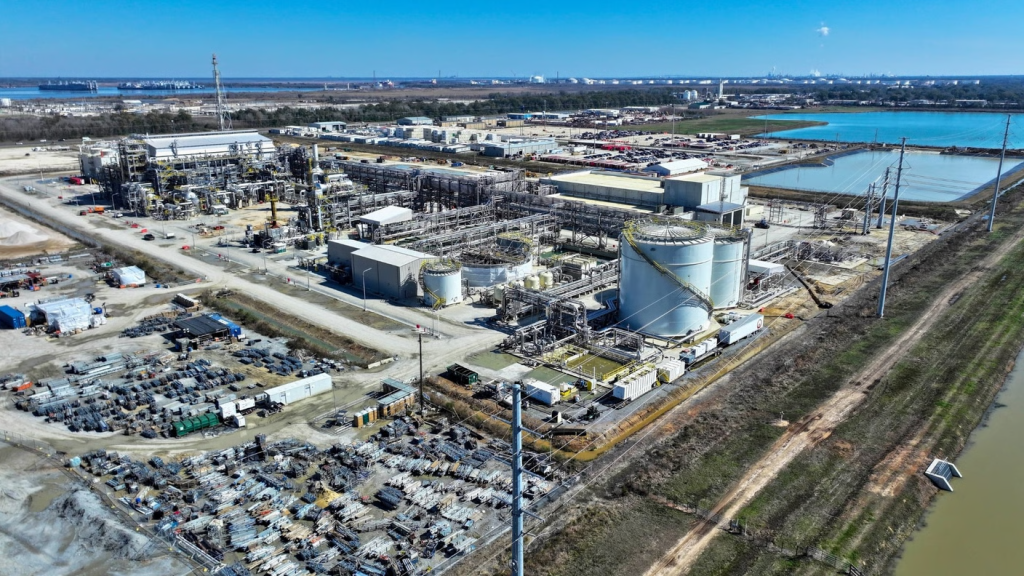
The commercial importance of offtake agreements is evident in the leading projects. CF Industries’ Blue Point project in Louisiana reached final investment decision in the second quarter of 2025 and is scheduled to begin operation in 2029. It is designed to produce 1.4 million t/a of ammonia, equivalent to 246,000 t/a of hydrogen, while permanently sequestering around 2.3 million t/a of carbon dioxide. Ownership-linked offtake is allocated among CF Industries, JERA and Mitsui. Likewise, Linde and Dow’s Path2Zero development in Canada, under construction since 2024 and due in 2027, benefits from a long-term supply agreement and existing regional carbon-dioxide transport infrastructure. The broader lesson from the project pipeline is that projects are more likely to advance where carbon management, feedstock supply, engineering capability, logistics and firm demand are integrated from the outset.
Nevertheless, the strength of the US low-carbon pathway remains uncertain or limited in some areas, leaving many projects reliant on export markets. Projects also remain exposed to cost escalation, carbon-storage availability, changes in regulation, and the treatment of lifecycle emissions by importing jurisdictions. Cost escalation in particular has been an issue for US projects. CRU estimates that, prior to 2023, US ammonia projects reported capital intensity of around $800-$1,350 per annual tonne of ammonia capacity. However, reported costs for the Beaumont project are closer to $2,800/annual tonne, and Blue Point may reach $2,900/t. Beaumont is producing ammonia but the CCS section is not due online until next year and owner Woodside is conducting a strategic review of the way forward. In an interview, Woodside CEO Liz Westcott said “all options” were on the table, and that the review reflects a shift in international policy positions since it agreed to the acquisition in August 2024 and slack demand for lower carbon ammonia; “when we took an investment decision, it was a different world.”
Green hydrogen
Renewable hydrogen has grown quickly, particularly in China, but remains more expensive than conventional hydrogen in most locations. The IEA estimates fossil-based hydrogen production costs in 2025 ranged from below $1/kg H2 to more than $4/kg H2 depending mainly on fuel prices. Adding carbon capture generally increases costs by around $0.4–1+/kg H2. Renewable hydrogen typically remains above $3/kg H2 and may exceed $10/kg H2 where electricity, capital or financing costs are high.
The gap is driven by power costs, electrolyser capital expenditure, utilisation rates and financing. Electrolysers supplied by manufacturers outside China had installed costs of around $1,900–2,500/kW in 2025, compared with about $500–1,100/kW for Chinese systems installed domestically, although non-Chinese installed electrolyser costs could fall to $1,500–1,900/kW by 2030. Still, China has the best prospect of broad renewable hydrogen cost competitiveness by 2030, supported by cheaper renewable electricity, lower-cost electrolysers and lower financing costs. In favourable northern Chinese locations, the IEA expects renewable hydrogen costs below $2/kg H2 by 2030. CRU believes that this outlook is over-optimistic, however, with estimated Chinese green hydrogen costs of around $5.2/ kg H2 in 2030, declining to $3.5/kg H2 by 2050. CRU forecasts Middle East green ammonia levelised production costs of $1,427/t in 2030, declining to $644/t by 2050 in real-2024 terms. Blue ammonia costs are substantially lower, at $375/t in 2030 and $406/t in 2050. This suggests that, without a meaningful carbon price mandate or customer premium, green ammonia is likely to remain commercially constrained relative to blue and conventional ammonia for the foreseeable future.
Demand
The most credible near-future demand opportunities are those that build on existing hydrogen consumption: refining, ammonia, methanol, steel and other industrial applications. These sectors require less transformation of end-use equipment and are often located in established industrial clusters.
The IEA expects committed industrial projects to supply around 2 million t/a of low-emissions hydrogen by 2030, primarily to ammonia, methanol, steel and related industrial uses. Refining demand is also expected to increase, with committed projects lifting low-emissions hydrogen use from below 250 kt in 2025 to above 500 kt by 2030.
Hydrogen derivatives are especially important. More than half of low emissions hydrogen production in 2025 was used to make hydrogen-based fuels and feedstocks, notably ammonia. Nearly 60% of announced 2030 production is aimed at ammonia, methanol, synthetic methane or synthetic liquid fuels. This reflects the practical difficulty of transporting and storing pure hydrogen, as well as the relative maturity of ammonia and methanol handling infrastructure.
By contrast, power generation and transport remain less established demand sources. Hydrogen and ammonia-capable power capacity was only 520 MW at the end of 2025. Announced projects could increase this to 6.8 GW by 2030, but only 2 GW was operational, under construction or at final investment decision. Japan and South Korea are important prospective markets for ammonia co-firing, but progress has been uneven. South Korea’s second clean-hydrogen auction, targeting 3,000 GWh of generation, was cancelled after securing no contracted volume. The outcome reflected tensions with the country’s coal phase-out, high hydrogen and ammonia costs, and limited technology readiness.
Ammonia
Low-emissions ammonia has a pivotal role in the market outlook because it may provide a route to transport hydrogen internationally, decarbonise fertiliser production and eventually serve as a fuel in shipping and power. Yet it also illustrates the risk of developing supply before demand is established.
CRU forecasts low-carbon ammonia demand at 8 million t/a in 2030, 25 million t/a in 2035 and 63 million t/a in 2040, rising to 155 million t/a by 2050. Conventional ammonia demand remains dominated by fertilisers, which account for more than 80% of consumption. Energy-transition applications, including co-firing and ammonia as a hydrogen carrier, are expected to remain at pilot scale through 2030.
At the same time, the project pipeline is very large. CRU identifies 267–268 million t/a of announced low-emissions ammonia capacity, of which the majority is still in pre-FEED or FEED. Only a small share is operating or at final investment decision. Low-emissions projects are expected to account for 63% of total new merchant ammonia additions through 2030. This creates a potential market imbalance. CRU expects low-emissions merchant supply to arrive before dedicated low-emissions end-use demand. Rather than immediately establishing a large premium market, some output may compete with conventional ammonia, contributing to oversupply. It forecasts global ammonia operating rates falling to around 80.6% in 2028 before recovering only modestly to 81.2% in 2030.
Shipping is a major prospective source of demand, but policy remains uncertain. The International Maritime Organization’s Net-Zero Framework was approved in draft form in April 2025, but formal adoption planned for October 2025 was postponed by a year. If adopted as expected in late 2026, it could enter into force in March 2028. CRU views the delay as a setback for global demand certainty, while strengthening the relative importance of regional rules such as FuelEU Maritime. It may also mean the expansion of the LNGfuelled fleet to offer a more immediate emissions-reduction route than ammonia.
Policy, trade and infrastructure
Policy support remains decisive because the cost premium cannot generally be absorbed by voluntary demand alone. The IEA identifies $41 billion of public funding associated with hydrogen-policy progress since its previous review, but observes a continuing imbalance: around $1.5 is directed to supply for every $1 supporting demand. Offtake agreements often remain insufficient, with only around 20% of agreements signed in 2025 being firm contractual commitments.
Europe is particularly dependent on policy implementation. The combined effect of the EU Emissions Trading System, Carbon Border Adjustment Mechanism, Renewable Energy Directive III and national support mechanisms could create almost 5 million t/a of clean-hydrogen demand by 2030. But national implementation remains incomplete, and complex eligibility criteria, permitting delays and grid constraints are delaying final investment decisions.
For ammonia, CBAM may influence trade flows. CRU expects the mechanism to encourage substitution of higher-emissions ammonia imports with lower-emissions material, especially where producers can measure, report and verify actual emissions and demonstrate permanent carbon storage. It forecasts Europe’s import dependency rising from 26% in 2026 to 42% in 2030. However, CBAM does not eliminate Europe’s underlying natural-gas cost disadvantage.
Infrastructure is another binding constraint. More than 40,000 km of hydrogen transmission pipelines are announced for 2035, but only 9% is operating, under construction or at final investment decision. Announced underground hydrogen storage totals around 11 TWh, with just over 7% at comparable maturity. Existing ammonia terminals – around 170 globally – provide a useful basis for early trade, but larger flows will require investment in ports, pipelines, storage, import terminals, carbon-dioxide networks and conversion facilities.
Conclusion
Low-carbon hydrogen is entering a more disciplined phase of development. Its future is increasingly likely to be shaped by projects with firm offtake, integrated infrastructure, credible carbon management, supportive policy and experienced industrial partners – not by the full scale of announced capacity. By 2030, growth should be meaningful but well below early ambitions. Low-carbon hydrogen and blue ammonia appear relatively advantaged in North America, while renewable hydrogen’s clearest cost leadership is likely to be in China. Europe, Japan and South Korea may provide major demand pull if policy frameworks are implemented effectively, while ammonia will remain the principal mechanism for linking distant supply and demand centres.
The central uncertainty is not technical potential, but the conversion of policy ambition and project announcements into bankable demand. Until that demand is secured at scale, the sector is likely to remain characterised by selective project delivery, a large early-stage pipeline and a continuing premium over conventional hydrogen and ammonia.