Fertilizer International 534 Sep-Oct 2026
13 September 2026
Prayon – a company built on quality, innovation and trusted partnerships
INDUSTRY LEADERSHIP
Prayon – a company built on quality, innovation and trusted partnerships
Prayon is both a pre-eminent provider of process technology (Prayon Technologies) and a leading equipment supplier (Prayon Profile) to the global phosphate industry. Notably, the company also manufactures phosphate products of exceptional purity for high-value agricultural, technical and food applications. In an exclusive interview, Fertilizer International spoke to Tibaut Theys, General Manager, Prayon Technologies, ahead of the Arab Fertilizer Association’s Technical Conference in Amman, Jordan, in November.
Phosphate industry pre-eminence
Tibaut, it’s a pleasure speaking with you. Prayon Technologies is synonymous with excellence and innovation in phosphoric acid production globally. Could you provide our readers with a brief overview of the company?
“The core values of Prayon Technologies are: we deliver very high-quality products, we deliver in time and we work together as a team with our customer. These are Prayon’s values.
“Our other big values are trust and transparency. Trust is really the key to what we are doing and means customers are confident about the technology we are selling.
“We also build long-term partnership by being transparent with our customers. We behave with openness and integrity and are very clear about the characteristics of all our products – and would prefer to lose an opportunity rather than sell the wrong product.
“What’s also very important about Prayon is that we are a producing company. What we offer our customers – based on 70 years of operating experience in Belgium – is technology by producers, for producers.
“Providing producers with the certainty they need to operate profitably is also very important to us. I believe it is one of the keys to our success.
“We offer customers the most reliable phosphoric acid technology – plant online time is very critical for us; performance is also critical for us. Producers with our technology also use proprietary items from Profile [Prayon’s equipment division] at their plants. That also means we are increasingly focused on ease of maintenance.
“As a technology provider, we define ourselves by offering the best solution to our customers. Excellence is one of the targets we try to achieve. This can be seen with the five phosphoric acid processes Prayon has developed.
“Slowly but surely in the last decade, we have come to offer – not only dihydrate (DH) phosphoric acid technology – a variety of other processes that answer the specific needs of our partners, such as producing high quality gypsum, reducing their water consumption and having the ability to use low-grade rock.
“We have 130 plant references in 30 countries across the world. That matters because it shows that we are providing high quality designs and are building on the lessons learned from the past to improve our technology today.
“It’s really about capturing our experience from every single phosphoric acid plant to be better for the next one. That’s important because it means we can guarantee our customers a very high confidence level for project success if they work with us.
“The assurance of a successful project also means their bank financing will be accepted because Prayon is a recognised technology. Management can also be certain they will generate revenue from day one of start-up.
“Every phosphate rock contains different quantities of impurities and behaves differently. Having worldwide experience with 65 validated phosphate rock types is therefore really essential for us.
“We have developed a very large database on rock behaviour throughout the world. This knowledge means we really gain time when designing a phosphoric acid plant that’s consuming a new type of phosphate rock – because just a limited number of pilot tests are needed.”
Technology licensor, equipment maker and phosphate producer
Uniquely for the phosphate industry, Prayon is three companies in one, being a technology provider, equipment manufacturer and producer. Does the holistic nature of the business provide Prayon with both a depth of market understanding and a competitive advantage?
“Yes, Prayon is a phosphate producing company, has Profile as an equipment company, Prayon Technologies as a technology company and Praytech Maroc as a maintenance company. The expertise of our division, Prayon Technologies, is converting laboratory and pilot data into an industrial reality. That’s really our mission.
“We have a team of expert process engineers at Prayon Technologies focused on that. The beauty is, my team knows exactly how to design an industrial plant. That means with our partner companies, straight from the laboratory tests at the beginning, we can design together an industrial plant with the highest confidence that it will work.
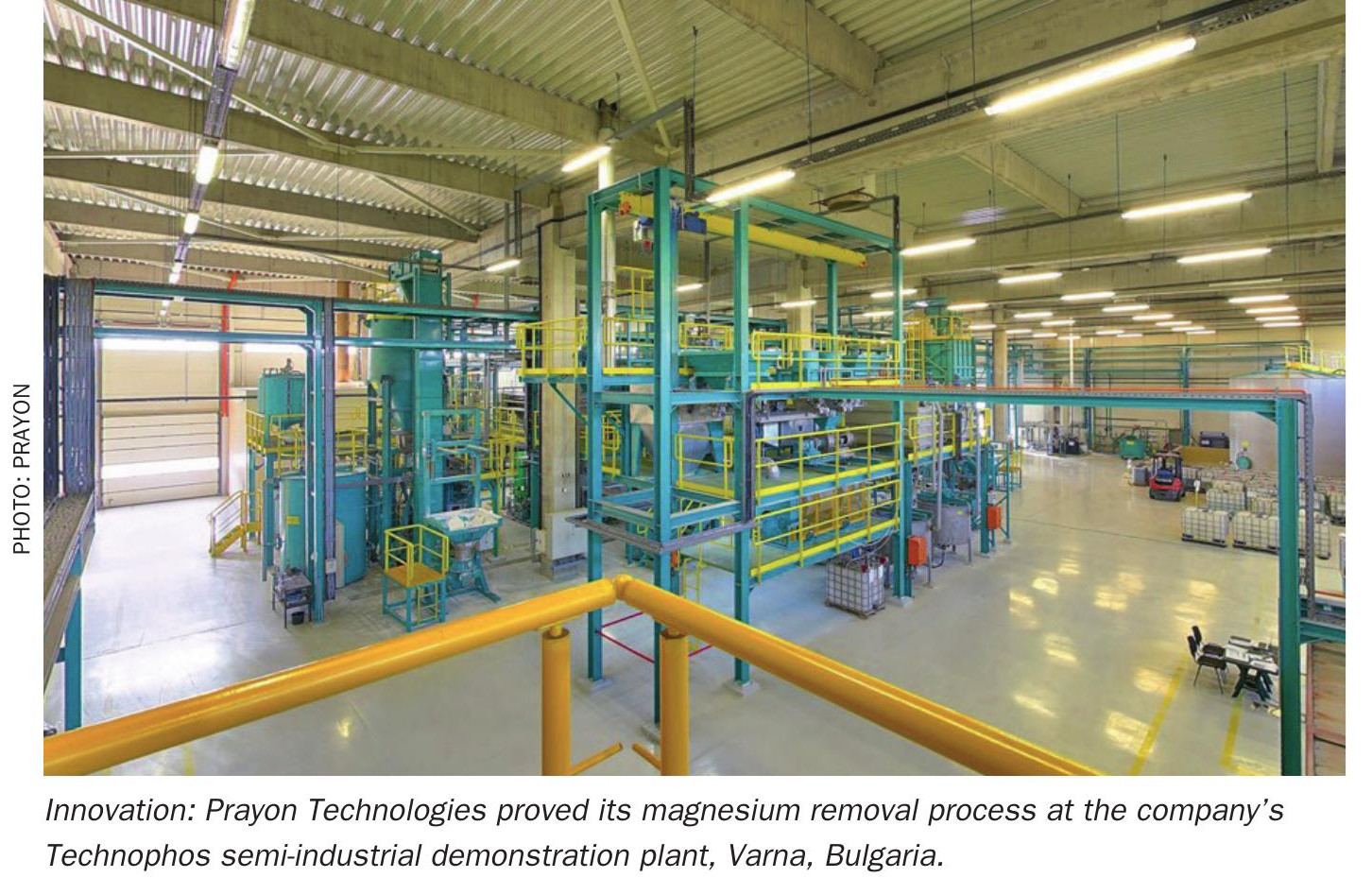
“As an example, Prayon has successfully developed and patented a magnesium leaching technology in collaboration with an industrial partner. The technology has been validated through pilot and industrial-scale testing and is now part of our licensing portfolio.
“For general licensing, one thing that’s very important is that, with phosphoric acid, the technology itself is not extremely complicated. But at the same time you have lots of small details and know-how that needs to be well implemented during engineering, procurement and construction (EPC).
“We therefore need to have very strong and knowledgeable EPC partners whom we can work with to ensure the plant design is done perfectly. So that, once the plant is built, we’re sure it’s going to be a success with a quick start-up.
“For EPC, we have three general licensee partners we work with right now: De Smet Agro in Belgium, Ballestra in Italy and thyssenkrupp Uhde in Germany. We work in very close collaboration with all three – and that allows us to develop reliable solutions.”
A growing technology portfolio
As the phosphate industry has evolved, Prayon Technologies has kept pace with the changing operating environment and new production challenges by innovating and expanding its process portfolio. What new technologies has the company brought to market in recent years – and what’s been driving this?
“So, to be the best solution provider for our customers, innovation is one of the missions we gave to ourselves. That means we have either developed or have acquired new technologies. GetMoreP and DA-HF were developed by us, Ecophos and Puma were acquired, for example.
“These technologies provide our customers with specific advantages or valuable characteristics. GetMoreP and Ecophos, in particular, offer a very good way to valorise low-grade phosphate rock.
“The main advantage of Ecophos currently is the fact that it requires hydrochloric acid, not sulphuric acid. That makes a big difference as the price of hydrochloric acid is currently more competitive than sulphuric acid.
“The Ecophos process produces dicalcium phosphate (DCP), a very concentrated product with between 39-47% P2O5 , depending on whether it’s anhydrous or a dihydrate. From that, we can produce a very pure form of merchant-grade acid (MGA).
“This is 10 times more pure than standard MGA but 10 times less pure than purified phosphoric acid (PPA). That means it’s an interesting starting point if you want to produce perfect battery- or fertilizer-grade monoammonium phosphate (MAP).
“From a sustainability viewpoint, we are also looking at the agronomical benefits of directly using DCP as a fertilizer. It’s soluble in citric acid and partly soluble in acid soils.
“We know from the literature that DCP has been used as a fertilizer in the past. It has very controlled nutrient release and could be used directly on certain soils.
“The Ecophos process could therefore valorise low-grade phosphate rock to make a high P2O5 fertilizer without having all the energy needs of merchant-grade acid. Moreover, its water-soluble content can be easily increased in a controlled manner by a small nitric acid addition to make concentrated NP.
“I’m so impressed by the creativity of my Prayon team. That’s what’s fun and what I enjoy. I’m always waiting to see what they’re going to invent for me today, which good ideas, crazy ideas they will come up with!
“I believe innovation creates innovation. In the sense that the more you know about the technology, the more you are able to create new technology. Essentially, the more we know, the more we can find a solution.
“In practical terms, the more you understand an issue entering into a new project, the more you’re able to see how to solve it. It’s about creating knowledge, a database, about how we can help our customers, about how we can provide value to our customers.
“Our team spends between 15-20% of their time just on innovative projects. Basically, most of the licensing fees we acquire are dedicated to developing new solutions.
“I believe that the people best positioned to develop innovative solutions and improve existing processes are the members of our own team. They are in direct touch with both the plants we have designed for customers and with Prayon’s own production plant.
“This gives them a deep understanding of our customers’ operational challenges and enables them to identify practical opportunities for improvement and develop solutions that address real industrial needs.
“Our team works closely with the engineering teams of our partners, as well as with our internal R&D experts. That’s a unique position which allows them to bridge the gap between research and industrial application – transforming ideas and laboratory test results into robust, full-scale industrial solutions.
“As a result, our team’s capabilities combine operational knowledge, engineering expertise and innovation. That makes them ideally suited to drive continuous improvement and advances in technology across our processes.”
Leadership role on sustainability
Prayon was celebrated as circular economy pioneer during a recent visiting by Walloon government minister Yves Coppieters. Phosphogypsum reuse and the decarbonisation of phosphate production are also now being taken seriously at the highest levels in our industry. Prayon – and Tibaut personally – have been very engaged with this agenda. Are you pleased with the leadership role of the International Fertilizer Association (IFA) on both circularity and decarbonisation?
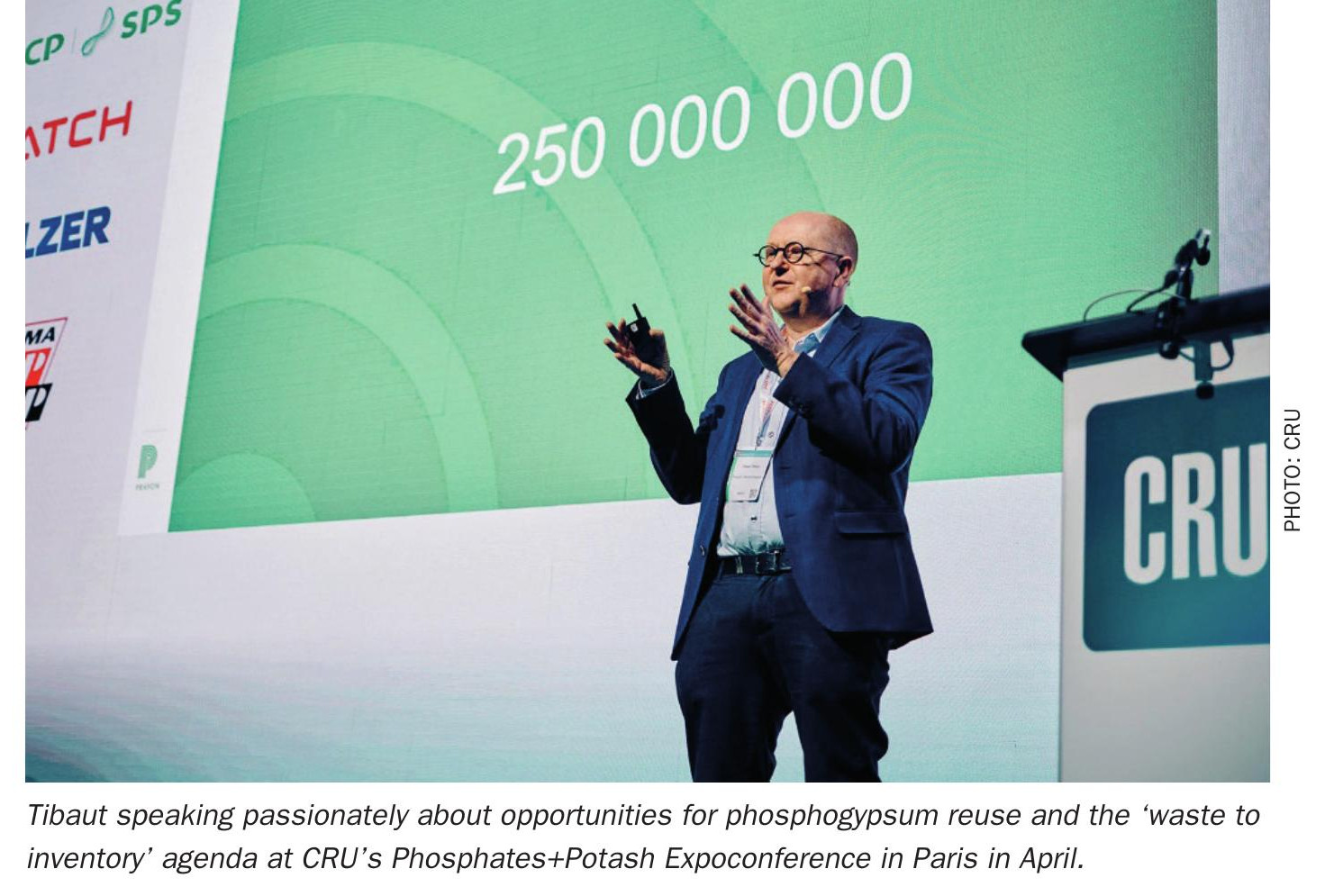
“Really it’s a personal passion about phosphogypsum (PG). I am amazed by all that can be done with PG and how we can valorise it in different ways.
“In India, it’s used a lot as a fertilizer additive – just look at Paradeep Phosphates Limited, PPL. They sell PG at a good price. Once it’s granulated and mixed with other nutrients, it’s a very good fertilizer.
“In Belgium, we generate a very clean phosphogypsum. That allows us to make plaster out of our PG and use it as a retardant in cement and as a soil conditioner.
“What’s also very important about Prayon is that we are a producing company. What we offer our customers – based on 70 years of operating experience in Belgium – is technology by producers, for producers.”
“I believe the decarbonisation roadmap was a brilliant initiative from IFA and the European Bank for Reconstruction and Development (EBRD). It has valuable science-based recommendations about what we need to do to decarbonise our industry – and has also come up with different solutions that can be applied now or in the future.
“What’s really remarkable is that, to some extent, if you want to decarbonise the phosphate and potash industry, there are many things that already exist if you look at current technology.
“Most phosphoric acid producers burn sulphur to make sulphuric acid and generate electricity. So, the industry already has a source of low-carbon electricity. Mining can also be improved by using more electrical equipment.
“If right now we want to build a zero carbon plant to make fertilizers like diammonium phosphate (DAP) and NPKs, without CO2 emissions or using fossil fuels, all the technology exists. Is it feasible? – yes, it can be done. Is it economical? – I don’t think so. The question instead is about the political willingness and the economics.
“There is certainly willingness in the phosphate industry. We want to give the best possible earth to the next generation. The difficulty is how to act on climate change today, without jeopardising business, and have a bright future for our children tomorrow.
“My personal conviction is that we will go much further on sustainability. One of the reasons is profitability. For example, if you look at phosphogypsum globally we generate five tonnes for every tonne of P2O5 . Depending on the location, its quality and usage, this can be sold at an interesting price.
“If you stack PG it costs about $10 per tonne. But, if you can sell it hypothetically at $40, the revenue then becomes $40 minus the $10 disposal cost – bringing the total revenue to $250 per tonne of P2O5 . It’s sustainable and profitable.
“I believe the by-product fluorosilicic acid is going to be the next big thing the phosphate industry will be looking at; we need to do something. While many people right now are neutralising fluorosilicic acid, there are more valuable possible applications, such as valorising it to make hydrofluoric acid (HF), DCP or other products.”
MENA region partnership
The Middle East and North Africa (MENA) region remains a major hub globally for phosphate production and investment. What are the key partnerships for Prayon within the region?
“The majority of the world’s phosphate reserves are in the region, starting in Morocco in this big curve going up to Saudi Arabia. So, definitely, all the Arabic countries are very important for us and the phosphate industry.
“Participating in and presenting at the Arab Fertilizer Association’s Technical Conference is really key to what Prayon is doing. We can have very interesting and exciting discussions with people when we attend.
“We are absolutely convinced that it’s very important to be able to collaborate with the AFA. We are developing together a workshop around phosphoric acid, here in Belgium in December, to present the latest technology and make it a success.
“I would even say it’s an honour for us to be able to work with the top Arabic phosphate producers. It’s our mission to provide them with the best possible technologies to feed the world.”