Nitrogen+Syngas 403 Sep-Oct 2026
16 September 2026
Ammonia demand in the power sector
AMMONIA TO POWER
Ammonia demand in the power sector
While the power sector has been advanced as a major long term source of demand for emerging low carbon ammonia projects, the pace of development in leading proponents such as Japan and South Korea remains patchy.
Ammonia’s potential role in decarbonising power generation is being considered in several forms: as a direct fuel for co-firing in coal plants; as a fuel for dedicated turbines and engines; and as a carrier for imported hydrogen that can subsequently be cracked and consumed in power generation or industry.
However, the current demand picture still has yet to achieve the scale envisaged by numerous project announcements and policy goals. Fertilizer production continues to account for more than 80% of global ammonia consumption, while power-sector demand is largely confined to demonstration units, early procurement mechanisms and development-stage projects. Technology development is progressing, especially in Northeast Asia, but a technically successful demonstration does not automatically produce durable fuel demand. Utility-scale ammonia consumption requires a combination of reliable low-emissions supply, adapted generation assets, emissions control, import and storage infrastructure, policy support, and a commercial framework capable of absorbing a significant fuel-cost premium, and at the moment, only a few of these conditions are met.
Demand routes
Direct ammonia use in electricity generation remains at an early stage. There are so far no cases of widespread, routine utility-scale operation in which ammonia is an established normal fuel for a major power plant. Instead, the market consists of a small number of high-profile demonstrations, test facilities, equipment-development programmes and policy-led offtake initiatives.
The leading direct-use pathway is ammonia co-firing in existing coal-fired power plants. This route has been attractive to governments and utilities, especially in east Asia, because it could displace some coal consumption and reduce carbon dioxide output while retaining existing coal-fired power capacity, avoiding the need to build completely new generation capacity before low-carbon fuel demand can emerge.
Japan
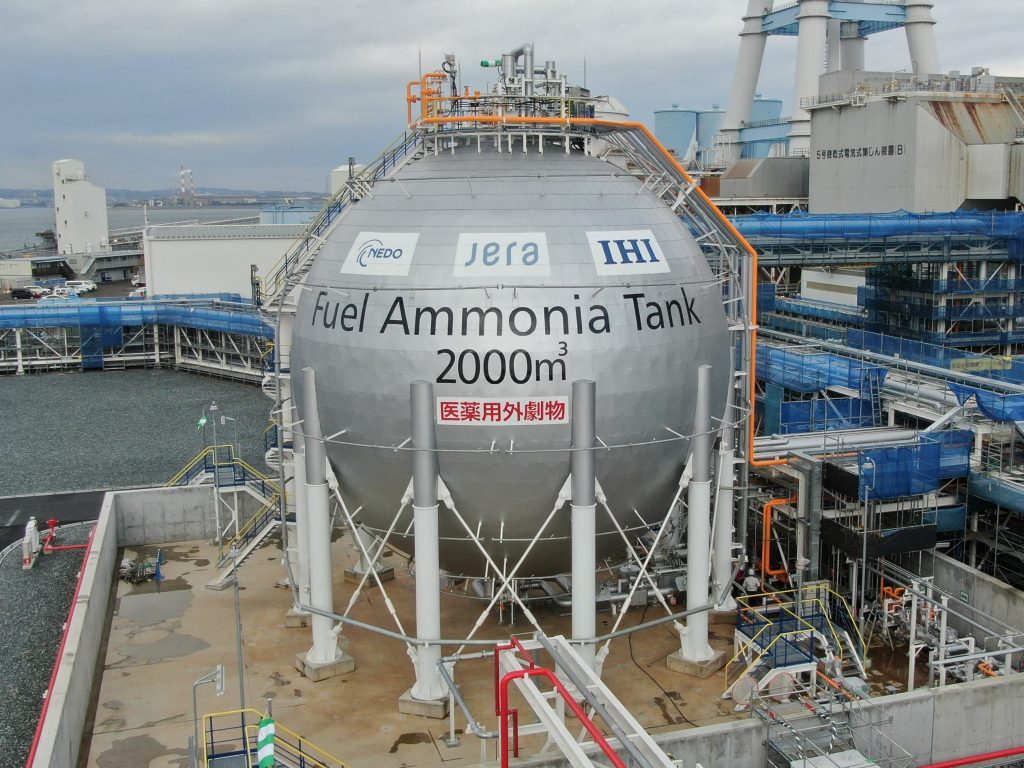
The most important technical milestone to date is JERA’s Hekinan Thermal Power Station Unit 4 in Japan. In June 2024, JERA completed a large-scale demonstration run using ammonia to substitute for 20% of the fuel input at a 1 GW-class coal unit. The company reported that nitrogen-oxide emissions did not exceed the coal-only baseline in the tested configuration, while sulphur-oxide emissions declined with reduced coal consumption. JERA is developing the associated unloading, storage and pipeline infrastructure with an aim of commercial readiness in fiscal year 2029.
That demonstration is significant, but a single successful trial is not the same as large scale ongoing ammonia demand. Full commercialisation would require regular fuel deliveries, secure terminal infrastructure, consistently compliant low-emissions product, plant reliability at varied operating loads, and economics that are acceptable under the applicable power market framework.
Japan is the most advanced market for ammonia as a direct power-generation fuel. Its position reflects energy-security concerns, a large thermal generating fleet, constrained domestic energy resources and coordinated policy support for hydrogen and fuel ammonia. The Japanese approach seeks to develop supply and demand in parallel. Public-sector support, including programmes associated with METI and NEDO, has encouraged work on low-emissions ammonia supply chains, power-generation equipment, higher co-firing ratios and eventual mono-fuel ammonia combustion.
The Hekinan demonstration shows that Japan has tested a commercially relevant co-firing ratio in a large, operating thermal asset. The proposed next stage is to develop the full fuel value chain. JERA has indicated plans for major ammonia-storage tanks, a dedicated unloading jetty, local transport infrastructure and supply arrangements connected with the United States. The scale of the potential investment is a reminder that ammonia power is a logistics-intensive proposition rather than simply a modification to existing plants.
Japan could become a major market if commercial co-firing proceeds after 2029, but this of course remains contingent on continued government support and the availability of low-emissions ammonia at prices that generators can absorb. The country’s policy design is attempting to address this through support for the difference between low-carbon fuel costs and conventional alternatives, but the resulting market is not yet fully established.
There is also significant uncertainty around the ultimate scale of the Japanese market. Higher co-firing rates and dedicated ammonia firing would increase potential fuel demand, but would require more extensive technical validation. Coal co-firing may also face questions over whether it constitutes a sufficiently durable decarbonisation pathway, particularly where power systems have long-term coal-reduction or coal-retirement objectives.
South Korea
South Korea has developed one of the most tangible policy mechanisms for creating ammonia demand in the power sector. But it has also supplied the clearest recent evidence of the gap between policy ambition and commercial execution. The first South Korean clean hydrogen power auction, in 2024, sought to find contracts for 6,500 GWh of generation. But it only received bids for 5,782 GWh and only awarded 750 GWh per year under 15-year contracts. Korea Southern Power was the sole successful bidder and intended to use ammonia co-firing at an existing coal-fired power plant.
The mechanism was notable because it imposed a minimum 20% co-firing blend requirement, with monthly noncompliance affecting contract pricing. This created a direct link between fuel procurement, plant performance and project revenue. It also highlighted the challenges of turning a supported power market mechanism into bankable ammonia demand. A generator unable to secure adequate ammonia volumes or maintain the required technical performance could face an economic penalty.
The following year’s auction was even more disappointing. The 2025 round targeted 3,000 GWh over 15 years but was cancelled before securing any volume. Among the factors which caused this were identify official concern over the extent to which the plans aligned with a planned 2040 phase out of coal-fired power generation in Korea. CRU’s assessment also points to high costs and limited technology readiness as more fundamental constraints.
This does not mean that ammonia co-firing has no future in South Korea. KEPCO (Korea Electric Power Company) has developed hydrogen- and ammonia- co-firing testing capability and is working on technologies for ammonia use in both circulating fluidised-bed and ultra-supercritical pulverised-coal boilers. Korea Southern Power has also undertaken procurement activity for clean ammonia intended for future co-firing. Nevertheless, the auction cancellation weakens expectations for near-term demand, and demonstrates that the creation of a dedicated power sector offtake mechanism is not sufficient by itself. Fuel cost, infrastructure, compliance risk and the strategic future of coal assets must all be resolved before substantial ammonia demand can become durable.
Other markets
Outside Japan and South Korea, direct ammonia combustion in power generation is less advanced or less transparently documented. In China, there have been ammonia co-firing trials, including a 10% ammonia test at Taishan power plant in Guangdong. China is potentially of great importance because of its large coal generation fleet, extensive engineering base and rapidly growing green-ammonia capacity. However, China has yet to become a large, established source of ammonia power demand. The end-use allocation of emerging green ammonia supply is uncertain, with shipping, chemicals, fertilizer markets and exports all competing for volumes.
In Europe, ammonia’s role is more commonly framed as part of a hydrogen-import chain. The region is developing interest in importing ammonia, cracking it back into hydrogen and using the resulting hydrogen in industry, power generation or other applications. Uniper and thyssenkrupp Uhde, for example, are progressing an ammonia-cracking demonstration in Germany. This pathway could create ammonia demand, but it differs from direct combustion. Cracking introduces further capital expenditure, energy consumption, purification requirements and conversion losses. It may be preferred where power systems or industrial users are better equipped to consume hydrogen than ammonia, but it is not yet a major source of ammonia demand in its own right.
The United States and the Middle East are more important at present as prospective suppliers than as identified direct-ammonia power markets. Large planned blue and green ammonia projects could make these regions important exporters into Asian and European energy-transition markets. There are expectations of substantial low-emissions merchant-capacity growth through 2030, but as the accompanying article in this issue notes, there have been setbacks for blue ammonia in the US in particular, as costs increase, and so far much of this supply is not linked to firm power sector demand.
“One of the most important features of the present market is the risk of a mismatch between low-emissions ammonia supply ambitions and the pace of new demand creation.”
Supply mismatch
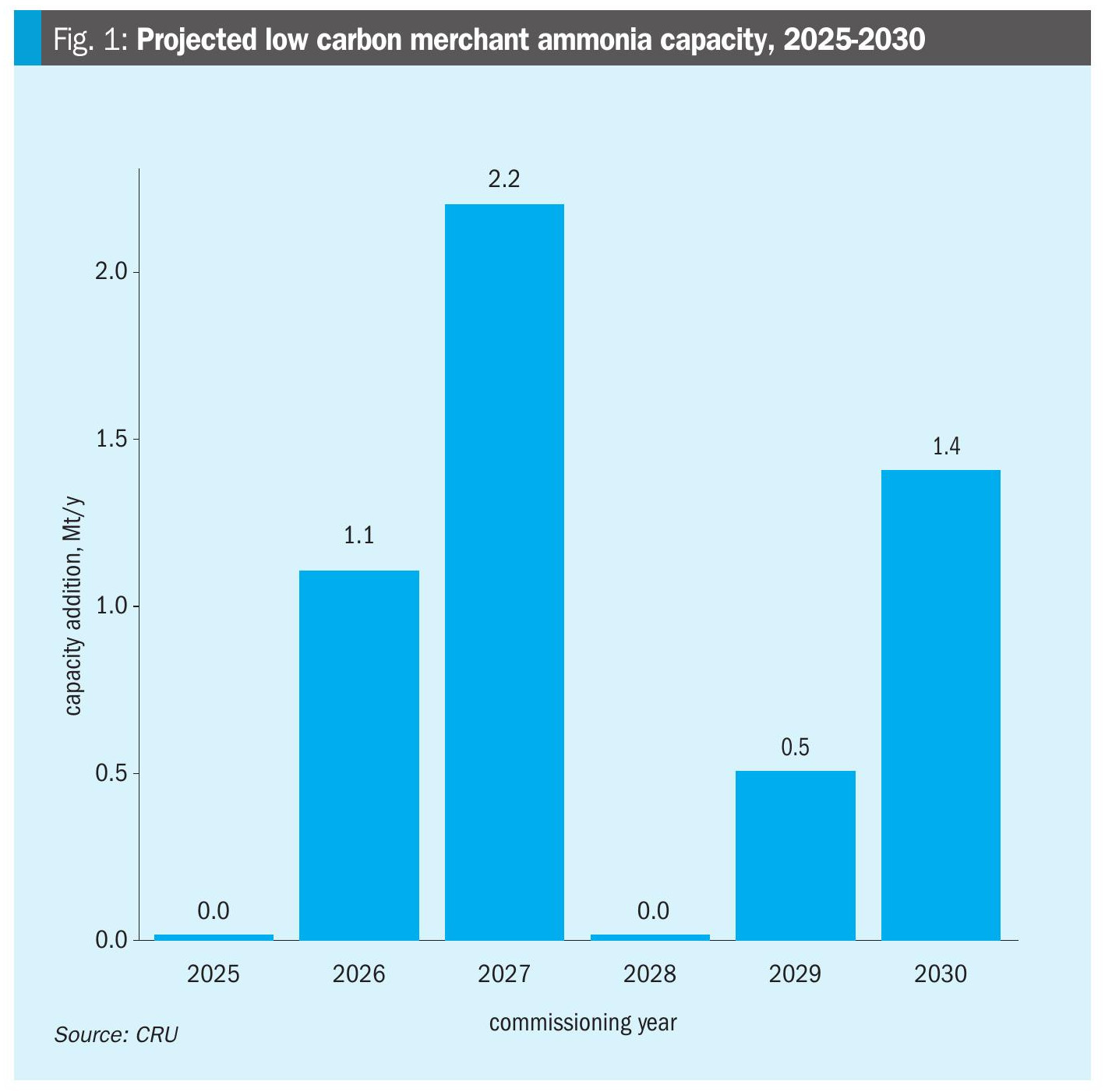
One of the most important features of the present market is the risk of a mismatch between low-emissions ammonia supply ambitions and the pace of new demand creation. CRU expects low-emissions projects to account for 63% of new merchant ammonia additions through 2030. Around 7.2 million t/a of standalone merchant capacity is expected to commission over 2025–2030, materially above the scale of the 2016–2018 merchant-capacity wave. The outlook anticipates structural oversupply from 2027 if demand does not grow commensurately.
This may appear positive for ammonia-for-power projects: greater availability and weaker ammonia prices could reduce fuel-cost barriers. In practice, the relationship is more complex. First, a power plant requires not merely ammonia, but ammonia with a sufficiently low and credibly documented lifecycle carbon intensity. Second, power generators require long-term and reliable delivery arrangements, rather than opportunistic merchant supply. Third, lower ammonia prices do not necessarily close the gap with coal, natural gas, renewables or other low-carbon generation options. Finally, supply projects may sell into conventional fertilizer markets where that offers a more established source of demand. Supply expansion is a necessary prerequisite for ammonia power demand, but not sufficient to create it. A large proportion of prospective low-emissions ammonia capacity could initially be absorbed into existing merchant channels rather than stimulating a rapid increase in utility demand.
Cost
Fuel cost is the central obstacle to significant ammonia demand in power generation. Low-emissions ammonia is generally derived from either green hydrogen or fossil-based hydrogen combined with carbon capture and storage. Both routes remain more expensive than conventional ammonia in many circumstances. CRU expects green hydrogen to remain materially more expensive than grey and blue hydrogen through 2040. In CRU’s illustrative China case, green-hydrogen costs are around $5.2/kg in 2030 and decline to approximately $3.5/kg by 2050. These economics constrain the ability of green ammonia to compete in power markets without policy intervention.
The International Energy Agency has similarly assessed that low-carbon ammonia co-firing can raise generation costs significantly compared with conventional thermal generation. Its analysis of Japan suggests that the cost differential may vary by operating pattern, but that policy support remains important to bridge the gap.
For ammonia demand to grow materially, the sector will need one or more of the following: lower production costs; higher carbon prices; dedicated contracts-for-difference or similar support; capacity-market revenues that reward dispatchable low-carbon generation; or strategic energy-security policies that assign value to fuel diversification.
Certification
The environmental credibility of ammonia power also depends on the lifecycle emissions of the fuel. Direct combustion may reduce stack carbon dioxide emissions relative to coal or gas, but it does not automatically make generation low-emissions if upstream hydrogen production, natural-gas supply or carbon capture are poorly managed. This creates a growing importance for certification, monitoring, reporting and verification. Eligibility for treatment under the European Carbon Border Adjustment Mechanism (CBAM) can differ materially between default values and verified actual emissions data, highlighting the importance of permanent carbon storage and credible reporting arrangements for CCS-based ammonia.
For the power sector, this means that a fuel procurement strategy must look beyond nominal “blue” and “green” designations. Generators and policymakers will increasingly need to specify accepted carbon-intensity thresholds, treatment of methane emissions, capture rates, storage assurance, renewable-power sourcing, certification methodology and chain-of-custody requirements. These requirements can add cost and complexity but are likely to be essential if ammonia-fired power is to qualify for low-carbon support mechanisms and retain public legitimacy.
Technical challenges
The direct use of ammonia also carries meaningful technical constraints. Ammonia is a difficult combustion fuel because of its low flame speed, relatively high ignition temperature and challenging stability characteristics. In coal plants, fuel systems, burners, combustion controls, monitoring and emissions-control equipment may require modification. In turbines and engines, combustor design and operating conditions require careful optimisation.
NOx, N2O and ammonia slip are central considerations. Since ammonia contains nitrogen, combustion can produce nitrogen oxides, while some operating conditions can result in nitrous oxide emissions. Ammonia slip must also be controlled for environmental, safety and operational reasons. Results from Japanese demonstrations are encouraging, but they remain plant- and configuration-specific rather than a universal solution.
Logistics are equally important. Large-scale imported ammonia use requires marine receiving facilities, refrigerated or pressurised storage, pipelines or road and rail distribution, trained operators, leak detection and emergency-response capability. The recent conflict in the Arabian Gulf has also highlighted potential exposure to disruption for supplies from that region. For an ammonia-fired power plant, security of supply and adequate inventory may be as important as the underlying fuel price.
Outlook
The current status of ammonia demand in the power sector can therefore be summarised as early-stage market formation. The technology is no longer speculative: large-scale coal co-firing has been demonstrated, turbine and engine technologies are progressing, and governments have begun to create support mechanisms. But power-sector demand is still too small to materially influence global ammonia balances.
Japan remains the principal direct-combustion market to watch, particularly as JERA develops Hekinan toward commercial readiness. South Korea remains strategically important, but its cancelled 2025 auction illustrates the fragility of emerging demand mechanisms. Europe is more likely to create demand through ammonia-to-hydrogen import chains than direct combustion, while China remains a potentially significant but less transparent market.
Over the next several years, the pace of demand growth will depend less on the existence of announced projects and more on whether the sector can solve five practical problems: delivered fuel cost, certification of lifecycle emissions, reliable supply chains, sustained technical performance, and policy frameworks that can support dispatchable low-carbon generation. Until those conditions are met, ammonia will remain a promising strategic fuel for power systems rather than a substantial source of global ammonia demand.