
Arab Potash Company plans its biggest expansion in 20 years
CRU’s Ashmita Sen and Humphrey Knight assess the largest capacity expansion by the Arab Potash Company (APC) in 20 years.


CRU’s Ashmita Sen and Humphrey Knight assess the largest capacity expansion by the Arab Potash Company (APC) in 20 years.

Average phosphate rock grades globally have been on the slide since the 1970s. CRU’s Maria Gamboa looks at the most recent trends in rock grade and the cost implications for phosphate fertilizer production.
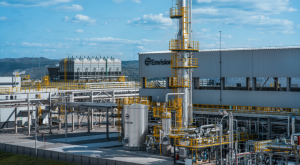
Industry viewpoint: Dr MP Sukumaran Nair of the Centre for Green Technology & Management (CGTM) reviews the fertilizer industry's decarbonisation options.
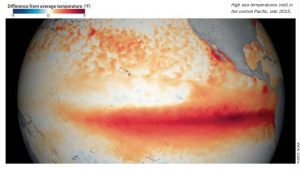
How will the current El Niño affect global fertilizer demand? We look back at the impact of the 2015/16 'Godzilla' event in this article from our archives.

The Ukraine war and associated tariffs and the EU’s carbon pricing system are keeping ammonium nitrate prices high.
The signing of a memorandum of understanding between the United States and Iran on June 17th has provided relief across most markets as both sides agreed to allow ships to transit the Strait of Hormuz, at least in terms of trapped vessels from the Gulf being able to exit.
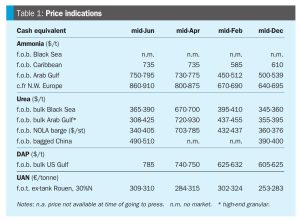
Ammonia values have continued to ease across most regions at the end of June, as the first ammonia vessels begin to exit the Gulf since the Iranian conflict began. Iranian ammonia had also begun to flow to India following the US Treasury’s issuance of a 60-day sanctions waiver on 22 June, allowing dollar-denominated trade in Iranian petrochemical products through 21 August. As a result, Indian bids have been heard as low as $750/t c.fr, as buyers benefit from a widening pool of available supply - Iranian, Chinese and renewed Southeast Asian material are all competing for the same business.
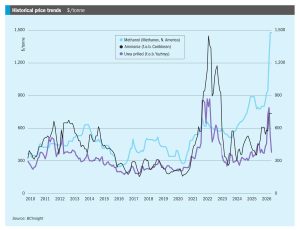
• Ammonia prices are expected to maintain their current downward trajectory, with the pace of correction likely to accelerate as the supply picture improves. Confirmed trades at materially lower levels remain limited, but the direction of sentiment is clearly softer.
• The market has paused as bearish buyer sentiment has not yet translated into lower spot prices. The direction of the next major deal is now the critical test. This will either initiate a downward price correction, validating buyer caution, or force a recognition of the market’s underlying tightness and bring purchasers back to the table at current levels.
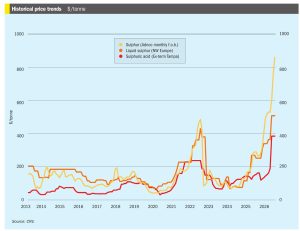
The global sulphur market has entered a holding pattern, as a wave of bearish sentiment has so far failed to move stubbornly high spot prices. The departure of a significant volume of product from the Middle East has emboldened buyers and shifted market sentiment firmly towards bearish, but at time of writing this has so far failed to translate into lower prices. With sellers in no hurry to lower prices and spot availability still tight, the market has stalled as both sides wait for the other to blink first.