Nitrogen+Syngas 401 May-Jun 2026
Price Trends


Price Trends

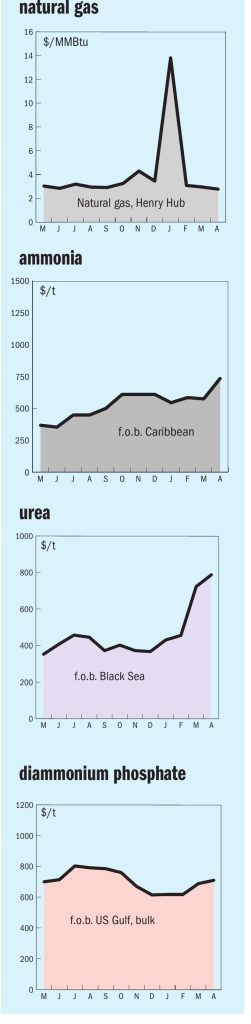
Global ammonia benchmarks pushed to fresh highs in April, with a reported trade from Egypt to NW Europe at $905/t c.fr, marking the highest Atlantic level seen since the Middle East conflict began. The move was driven primarily by tightening North African supply, with Algerian offer levels climbing to $840-850/t f.o.b., and Egyptian availability constrained by EBIC being sold out through June, together with limited prompt tonnage from Abu Qir.
In India, the assessment held at $800-850/t c.fr, though the market remains structurally exposed. April arrivals of approximately 121,800 tonnes – drawn predominantly from Oman, Indonesia and Malaysia – provided some near-term coverage, but the forward pipeline is thin. Chinese loading difficulties reported on two cargoes bound for India added a further complication, with the importer said to be seeking alternative sourcing, some suggest from South Korea. Unconfirmed talk of four-digit offer levels has circulated, though no firm bids at those levels have been reported.

In East Asia, spot offers into Taiwan, China reached $780/t c.fr, tracking higher Southeast Asian f.o.b. levels. South Korea’s April imports of approximately 110,400 tonnes, down 14,000 tonnes for the same month last year, suggests that buyers have been effective at sourcing alternatives, albeit at progressively higher cost, and with fewer options ahead as Southeast Asian availability tightens.

In the US Gulf, exports continue steadily, with GCA, CF Industries and Beaumont all dispatching vessels to Heroya in the same week. The pipeline ahead looks active, with further liftings expected from all three facilities. However, domestic spring demand remains strong and continues to compete with export availability.

The global urea market has been digesting the full impact of India’s record 2.5 million tonne tender award, which is set to draw in supply from all parts of the globe – with the exception of the Middle East, of course. While the market digested the news, prices in most regions held steady. In India, Indian Potash Limited (IPL) issued letters of intent for a total of 2.5 million tonnes following its 15 April tender, meeting its initial purchase volume target. The purchase is likely to have a significant tightening effect on global supply through mid-June.

Activity in the Middle East was again quiet, though one vessel, the Ruby, successfully transited the Strait of Hormuz, having earlier loaded in Qatar. Still, with a little under 1 million tonnes of urea still stranded west of the strait, the supply situation remains unresolved. Prices were again indicated at $910-930/t f.o.b. Oman. In Iran, the National Petrochemical Company (NPC) reversed its export ban for three producers, though this was tempered by the ongoing US blockade of Iranian ports.

West of Suez, African producers saw prices hold at high levels, albeit amid little demand from Europe. In Egypt, Mopco confirmed sales of two cargoes to India at $885/t f.o.b., with other producers targeting $900/t or more. In Nigeria, Dangote sold four cargoes to Ethiopia, while freight enquiries for shipments to Australia emerged. Algerian producers are understood to be seeking $900-910/t f.o.b. for next business.

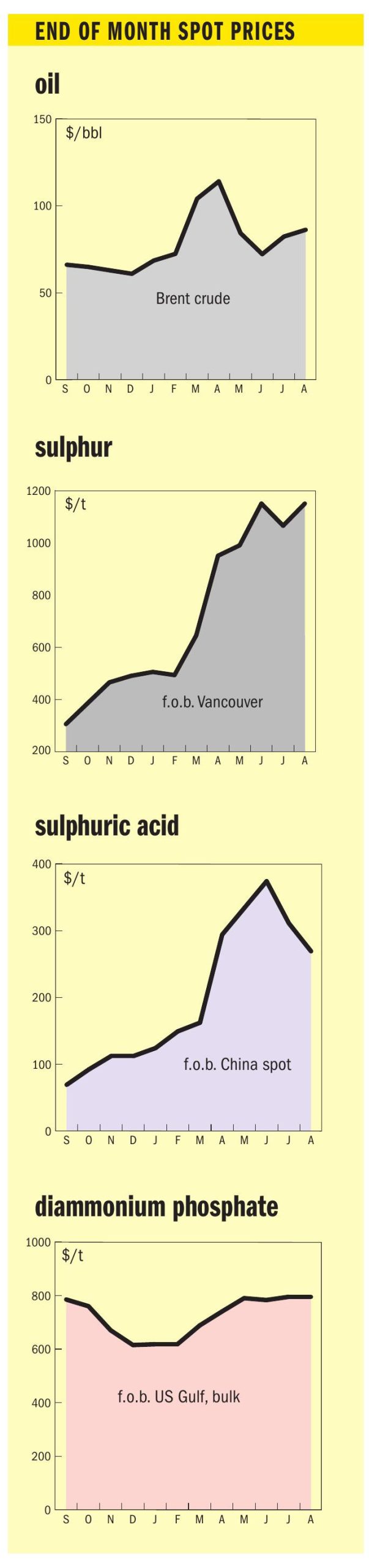
END OF MONTH SPOT PRICES

Latest in Outlook & Reviews

Nitrogen prices peak – for now

The start of May saw urea prices start to decline from the yearly highs seen in mid-April, as buyers from India, the US, and Europe stayed away from the markets. India is not expected to return with another tender before late May or early June at the earliest, after booking 2.5 million tonnes for shipment through mid-June, covering immediate requirements, and with domestic production having improved and stocks at a healthy level of over 7 million tonnes. In the US, earlier concerns over May shipments have eased, with net import figures not as low as initially feared, and even some re-export of cargoes to Latin America where higher prices can be earned. With the potential for China to return to export sales towards the end of May and start of June, there was at least a hope that the worst of the current price spike may be over.