Nitrogen+Syngas 401 May-Jun 2026
20 May 2026

Syngas from biomass gasification
GASIFICATION
Syngas from biomass gasification
For many years confined to pilot projects and feasibility studies, biomass based gasification is seeing rapid take up in China for methanol production and may mark a new era in syngas generation.

As syngas-based industries increasingly look towards lower carbon intensity production, biomass gasification is again seeing increasing interest as an alternative to traditional natural gas-based production. Gasification is a mature technology; coal gasification was the feed for the first ammonia plants, going back to the 1920s. However, cheap and abundant natural gas gradually came to dominate the production of syngas because it was cheaper and avoided the additional capital costs required for feed pre-treatment in a gasification-based unit. The main exception to date has been China, where lack of natural gas and abundant coal has led to a concentration on coal and coke gasification as the main feed for ammonia and methanol plants.
Gasification is also a versatile technology, as it is able to handle the widest variety of types of biomass feedstock, as well as related feeds like municipal solid waste (MSW), and convert them into a variety of downstream applications ranging from a fuel for heat and power, a feedstock for hydrogen production, or an intermediate for manufacturing synthetic natural gas, methanol, and other chemicals.. While gasification still generates CO2 during conversion, it is at least, in theory, from a renewable source which would generate CO2 and even methane (more damaging in terms of carbon equivalent) during the process of natural decay anyway, and which is presumably also drawing CO2 from the air as replacement biomass is planted and grown. When combined with carbon capture and storage, it can even be carbon negative as a technology.
Feedstock properties
Biomass is not a uniform fuel. Its composition – especially volatile matter, ash, and moisture – has a major influence on gasification behaviour. High volatile content tends to increase gas formation, especially at higher temperatures where volatiles undergo secondary cracking and reforming. This can raise the production of gases such as H2 , CO, and CH4 , while also improving the heating value of the product gas. However, more volatile matter can also reduce the H2 /CO ratio and may shift the balance toward CO-rich gas.
Ash is mainly the inorganic residue left after biomass conversion. High ash content can create serious operating problems, including slagging, reactor blockage, and reduced conversion efficiency. In some cases, ash also carries alkali and alkaline earth metals that can act catalytically, helping certain gasification reactions proceed faster. So ash is not simply a disadvantage; its exact effect depends on composition and concentration.
Moisture is another decisive factor. Wet biomass requires more energy to heat and dry, which lowers reactor temperature and reduces overall gasification performance; every kilogram of water requires an additional 2.2 MJ of energy to process. Biomass with relatively low moisture is preferred, and excessive water content can suppress combustible gas formation and increase energy consumption. At the same time, some moisture can benefit steam-related reactions and increase hydrogen production if the process is carefully controlled.
Biomass feedstocks are generally classified into four main groups: woody biomass, herbaceous biomass, marine biomass and manures. Woody biomass and herbaceous plants with low moisture contents are the primary choices because they do not require as much energy in drying to remove the moisture. Agricultural wastes such as bagasse, sugar cane trash, rice husk, rice straw, coir pith, groundnut shells etc are also potential feedstocks, although pulverisation is needed prior to use as feedstock to enhance their bulk density and reduce transportation cost
Pretreatment
Pretreatment can improve feedstock quality, torrefaction and hydrothermal carbonisation (HTC). These methods are used to improve fuel properties before gasification by reducing moisture, lowering oxygen content, increasing energy density, and improving grindability.
Torrefaction is a mild thermal treatment, while hydrothermal carbonisation uses hot compressed water. Both can improve syngas production, but HTC often performs better because it not only removes moisture but also densifies the biomass. In general, pretreated biomass yields more favourable gas compositions and higher heating values than untreated biomass. Combining pretreatment with advanced gasifier designs, especially multistage systems, can improve combustible gas yield.
Gasifier type
Gasifier design matters as much as feedstock choice. There are three main reactor families: fixed-bed, fluidized-bed, and entrained-flow gasifiers.
Fixed-bed gasifiers are simple, low-cost, and widely used, but they generally produce less syngas and often more tar. Updraft versions can tolerate high-ash feedstocks but tend to produce tar-rich gas, while downdraft reactors reduce tar because gas passes through hotter zones that crack heavier compounds.
Fluidised-bed gasifiers offer better mixing, better temperature uniformity, and higher gas production rates. They are well suited to larger-scale applications and can deliver cleaner syngas with lower tar than fixed-bed systems. The downside is greater complexity and higher capital cost.
Entrained-flow gasifiers are the most industrially promising for large-scale operation because they deliver high syngas yield, very high temperatures, and minimal tar. However, they demand finely prepared feedstock and often oxygen-rich operation, which makes them more difficult and costly to run.
Syngas quality is also very sensitive to operating parameters. Higher gasification temperatures generally improve gas yield, increase the concentration of combustible components, and reduce tar. This is because heat promotes endothermic reactions and cracks large tar molecules into smaller gas species. As temperature rises, H2 and CO typically increase, while CO2 and CH4 decrease.
The choice of gasifying agent is especially important. Air is cheap and widely used, but it introduces nitrogen into the syngas, which lowers the calorific value. Steam boosts hydrogen production and usually produces higher-quality syngas, but it adds complexity and cost. Oxygen can also improve syngas quality, though oxygen production is expensive. Mixtures such as air-steam or oxygen-steam can provide better performance than a single agent alone, and the review sees this as an important area for further research.
The equivalence ratio, or ER, is the relationship between actual oxygen supplied and the oxygen needed for complete combustion. ER must be carefully balanced. If it is too low, gasification becomes incomplete and char remains. If it is too high, combustion dominates and more CO2 is formed. In general, an ER in the range of roughly 0.2 to 0.3 is recommended for effective biomass gasification.
Tar formation
One of the major issues with biomass and waste gasification is tar formation. The presence of benzene and other heavier molecular weight compounds in syngas tends to cause problems, leading to incomplete combustion. High molecular weight tars act as promoters of high viscosity, and can cause blockages in fuel pipes and injector lines by condensation. Avoiding tar formation is a key consideration in biomass gasification, and usually requires a fluidised bed gasifier. Feedstock enters the bed and finely ground bed material is fluidised by air or an oxidising agent at a temperature of around 700–900°C. Biomass is thermally broken down into gaseous compounds, and char is produced. The hot char and fluidising bed material cause further reactions to break long-chain hydrocarbons or tars into syngas components. Thus, a syngas product with very low tar content is produced with tar content less than 3 g/Nm3 .
An alternative method is plasma gasification, where the extremely high temperatures help to reduce tars and convert all the organic material into syngas. Tar content as is reported to be up to 0.1% of that of an autothermal gasification process. Arc discharges obtain thermal plasmas from DC or AC current or through radio frequency or microwaves. The oxygen demand in this process is small as compared to conventional gasification as most of the thermal energy comes from an external energy source rather than exothermic reactions between the fuel and oxygen. However, in spite of considerable lab-scale work on this process, a recent survey of plasma gasification found only four commercial installations operational, all smaller scale and dealing with municipal waste. High costs and occasionally a negative thermal balance remain issues for the technology.
Collection
One of the issues for large scale use of biomass gasification is the collection step; generating enough biomass to run a reactor at constant rates. Attention has therefore often focused on the paper processing industry, where large scale collection of trees already occurs. Sweden, Canada and the US, as major pulp and paper producers, have all experimented with gasification of so-called ‘black liquor’, a liquid mixture of pulping residues like lignin and hemicellulose together with inorganic chemicals from the Kraft process such as sodium hydroxide and sodium sulphide, for example. Black liquor is a toxic waste stream which paper producers must treat and dispose of, and so gasification to produce usable products or energy seems a good fit. However, while this remains a promising angle, take-up so far has been limited and only four black liquor gasification plants are currently in operation.
Chinese biomethanol projects
China is rapidly emerging as a global leader in biomethanol production via biomass gasification. China’s latest Five-Year Plan (2026–2030) aims to accelerate the country’s ‘green transition’ with the production of advanced green fuels – like methanol, ammonia and sustainable aviation fuel – identified as strategic, high-growth industries. The country is rapidly growing its methanol production and green fuel capacity, reducing dependence on imported oil and gas. Around 70% of the global project pipeline for green methanol projects is accounted for by Chinese projects, with over 22 million t/a of methanol capacity under development. Major projects are spearheaded by firms like Shanghai Electric, Goldwind, LONGi, and Guangdong Liquid Sunshine., with major facilities located in Guangdong, Inner Mongolia, and other provinces, with a focus on integrating renewable power with biomass. International shipping firms like CMA CGM and Maersk have secured, or are exploring, offtake agreements for Chinese green methanol to decarbonise their fleets. The projects utilise advanced technologies, such as oxygen-blown biomass gasification, often combined with green hydrogen production to create a sustainable supply chain.
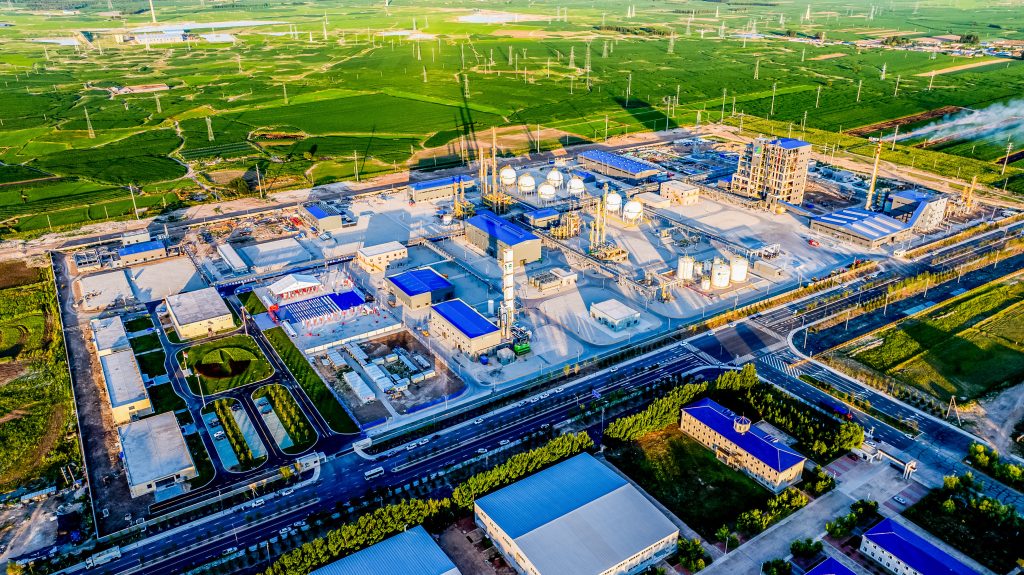
The Taonan plant is China’s first large-scale commercial biomethanol facility, harnessing local wind, solar, and biomass resources to produce 50,000 t/a of low carbon methanol. It uses oxygen-blown biomass gasification and wind-powered hydrogen production to create what the company describes as “a fully integrated green power – green hydrogen – green methanol” system, using agricultural waste as a feedstock. The biomethanol meets international marine standards and holds the International Sustainability and Carbon Certification (ISCC EU). Catalyst supplier Clariant says that the project uses its MegaMax catalysts. The first stage of the project began production in July 2025. The second phase of the project, with a capacity of 200,000 t/a of green methanol and 10,000 t/a of sustainable aviation fuel (SAF), is expected to start production in 2027.
Elsewhere, Johnson Matthey was recently chosen by Liquid Sunshine to provide technology for a new biomethanol fuel plant in Guangxi Province. This project represents JM Catalyst Technologies’ business second green methanol plant license win in China, as part of a growing portfolio. When complete, the first phase – with construction expected to begin later this year-will achieve an annual production capacity of 75,000 /a of biomethanol. If approved, a second phase will see an additional plant use the excess carbon dioxide from the first plant, combined with electrolytic hydrogen to produce low carbon methanol which can be used to help meet e-fuel mandates, including those in Europe. This will increase the capacity for low carbon methanol production at the site without the need to use additional biomass feedstock. The project will be led by Guangdong Liquid Sunshine, jointly constructed with the Tiandong County People’s Government and China Coal Guangxi New Energy, while ECEC will also act as a key project partner in engineering. Johnson Matthey, Liquid Sunshine and ECEC have also signed a memorandum of understanding to collaborate on future projects together.
Liquid Sunshine, as the project developer, is also co-developing the Biomass Dual Fluidised Bed Chemical Chain Gasification Technology with the Qingdao Institute of Bioenergy and Bioprocess Technology at the Chinese Academy of Sciences. This gasification technology will be applied in the project.
Shanghai Electric has achieved a major milestone in maritime decarbonisation by successfully bunkering the container vessel CMA CGM OSMIUM with Chinese-produced biomethanol at Yangshan Port.
This operation, conducted earlier this year, marks the first large-scale use of Chinese biomethanol by a global shipping operator. The bunkering was coordinated over two days, from March 5th to 6th, by Shanghai International Port Group, using a simultaneous loading and fuelling model that streamlined cargo handling and fuel supply. The CMA CGM OSMIUM, a next-generation dual-fuel container ship, was fueled with biomethanol produced by Shanghai Electric’s Taonan facility in Jilin Province.
Other recent developments
German company Spanner Re² claims it has developed a solution that could enable industry to replace fossil natural gas in high-temperature processes with syngas derived from biomass and waste materials in thermal applications, such as gas burner lances in industrial ovens, without prior conversion to electricity. The company says that biomass-to-power pathways can see overall efficiencies fall below 30-40% once conversion losses are accounted for, making them less suited to industrial processes requiring continuous high-temperature heat, typically in the range of 800°C to over 1,500°C. Spanner Re² instead feed syngas directly into industrial burners, enabling on-site heat generation without intermediate conversion. The feedstock is derived from wood chips, pellets, or other waste-based feedstocks. Spanner Re² says that the approach enables decentralised, on-site gas production and can offer a CO2 – neutral alternative to fossil natural gas, depending on feedstock sourcing. thyssenkrupp Uhde was recently selected for a biomass-to-methanol technology integration study for Nova Sustainable Fuels in Canada. Planned capacity is 450,000 t/a of bio-methanol, using Uhde’s high-efficiency PRENFLO gasifier and advanced methanol synthesis technology. With thyssenkrupp Uhde providing both the gasification and methanol synthesis technology, NSF looks to validate assumed benefits in both overall system integration and the future bankability of the project, which aims to produce low-carbon fuels for decarbonising the transportation sector: sustainable aviation fuel and renewable methanol for the shipping industry as well as a building block for other downstream chemicals. These fuels will be produced using a fully integrated clean-energy system that brings together over 1 GW of renewable electricity generated from NSF’s planned solar and wind farms, local sustainable biomass and water. Construction is expected to commence in 2028 after all required permits have been obtained, and the project is expected to be operational in 2031.
Alternative processes
Gasification is not the only process for converting biomass into usable fuels and chemicals. Fermentation is obviously used at a large scale for the production of alcohols from some crop types, and has also attracted interest as a potential follow-up step to biomass gasification. However, several issues remain for the successful deployment of the technology, including conversion efficiency of the gasification and syngas fermentation processes, the effect of some impurities on the bacteria, and the effect of CO:H2:CO2 ratios on syngas composition.
Since current ammonia/methanol processes are geared to use methane as a feedstock, the other major strand of biomass conversion is by using methane generated from biological sources. In this process, biological feeds are broken down by anaerobic bacteria to produce biomethane which can either be fed into a conventional gas grid or used for chemical conversion. Potential nutrient-rich sources can be agricultural waste, food waste, wastewater, and sewage sludge. Biogas production does also generate CO2 in the feed, which can be scrubbed and sequestered to produce net negative carbon emissions.
Ammonia production from biomethane is in the process of being scaled up from lab demonstration units to pilot and demonstrator plants. In December 2024, Yara announced that it has produced ammonia from biomethane at a demonstrator unit in Brazil, using methane from sugar cane waste. BASF has also launched ‘biomass balanced’ ammonia which uses biomethane and some green hydrogen to produce a low carbon ammonia for polyamide production, and OCI Global and Rohm also announced a similar demonstrator run of bio-derived ammonia for low carbon methyl methacrylate production.
References
1. Gao et al, Syngas Production from Biomass Gasification: Influences of Feedstock Properties, Reactor Type, and Reaction Parameters, ACS Omega 2023 8 (35), 31620-31631.