Nitrogen+Syngas 401 May-Jun 2026
27 May 2026
Green ammonia technology in Uzbekistan
Green ammonia technology in Uzbekistan
Decarbonisation of ammonia is increasingly relevant for fertilizer producers that serve export markets with evolving carbon and sustainability requirements. For Uzbekistan, ammonia is strategically important as the key intermediate for domestic nitrogen fertilizers and for planned capacity expansions. This article summarises Uzbekistan’s industrial baseline, historical operational experience with electrolysis, the 2025 green hydrogen pilot at Chirchiq, and the current outlook for scaling green ammonia production.
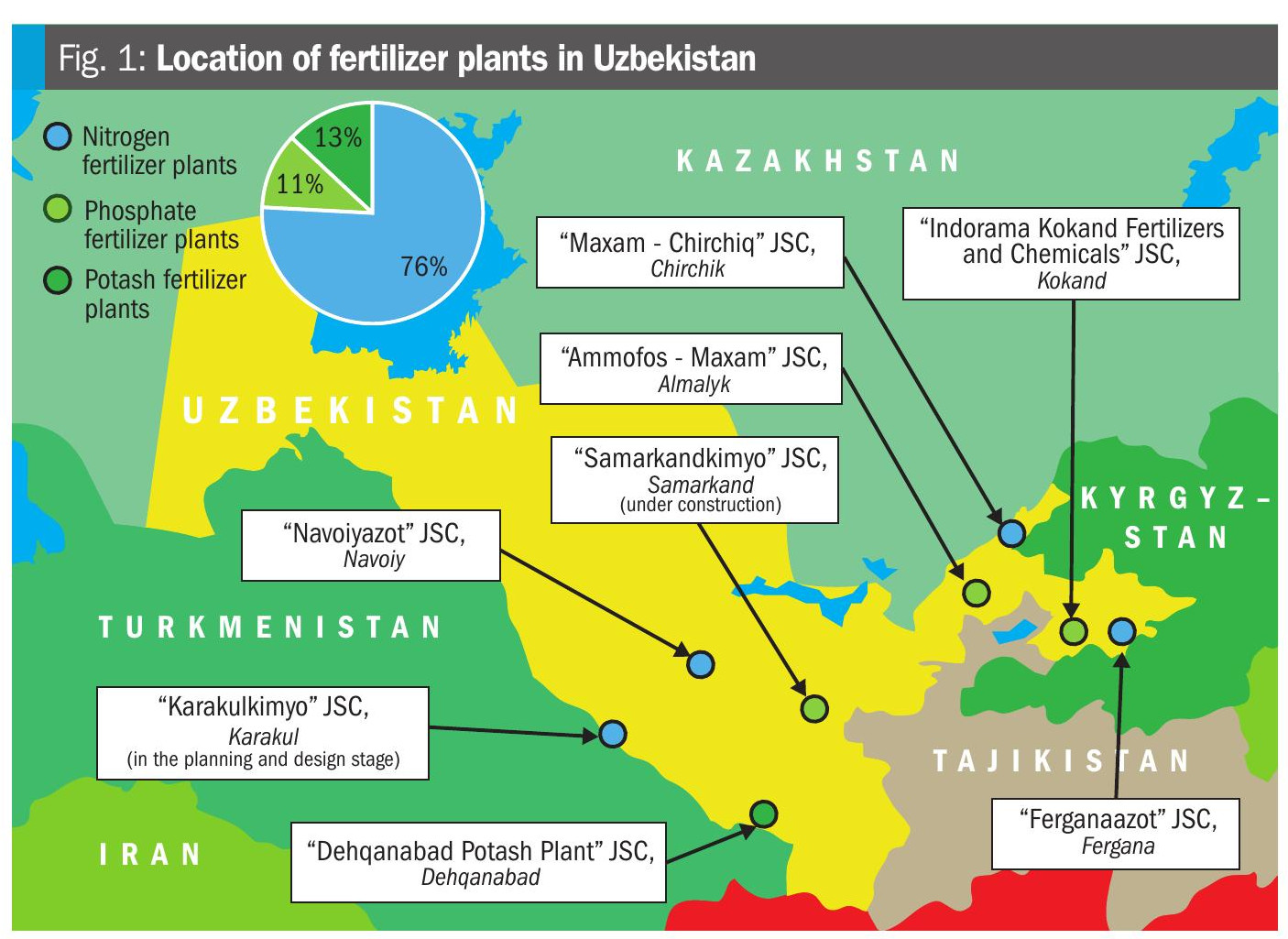
Uzbekistan has an established and diversified mineral fertilizer sector. Fig. 1 shows the main fertilizer production sites and their locations. All three primary categories of mineral fertilizers – nitrogen, phosphate and potash – are produced based on domestic raw materials. The present analysis focuses on nitrogen fertilizers, where ammonia is the core intermediate chemical.
Current nitrogen and ammonia industry
Uzbekistan operates three major nitrogen fertilizer complexes: “Navoiyazot” JSC, “Ferganaazot” JSC, and “Maxam–Chirchiq” JSC (formerly the Chirchiq Electrochemical Plant). In total, Uzbekistan has an annual capacity of about 1.9 million tonnes of ammonia and around 3.5 million tonnes of nitrogen fertilizers.
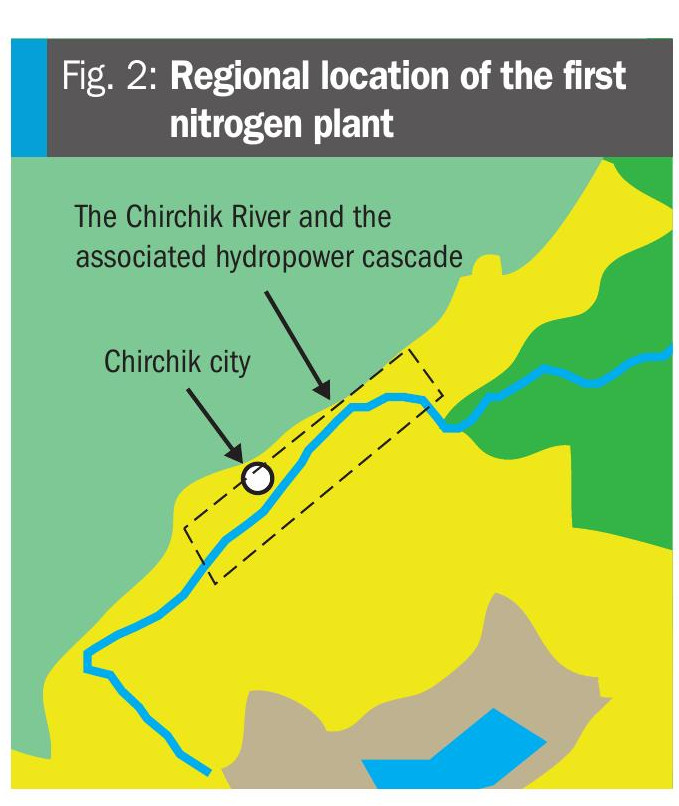
In 1940, Uzbekistan was the first country in Central Asia to build an ammonia plant in Chirchiq (Fig. 2).
In the 1930s, the global ammonia industry relied on coking coal as a raw material for ammonia, an environmentally inefficient technology. However, due to the lack of coking coal deposits in Uzbekistan, the country’s nitrogen industry entered a period of using the electrolysis method.
The plant initially produced hydrogen via water electrolysis powered by nearby hydropower and synthesised ammonia from electrolytic hydrogen, which corresponds to today’s definitions of green hydrogen and green ammonia.
It’s worth noting that at that time, the USSR had no experience of producing hydrogen through water electrolysis. And so, the Chirchiq plant became one of the first in the Soviet Union to launch an industrial electrolyser. The Chirchiq enterprise became a technological pioneer in the 1940s to 1950s, operating large industrial electrolysers at a time when the technology was still at an experimental stage. The original ammonia capacity was about 40,000 t/a and the plant was among the largest electricity consumers in the country, which shaped its operating model. In practice, the plant served as a technological testing ground and played an important role in the early development of electrolyser technology.
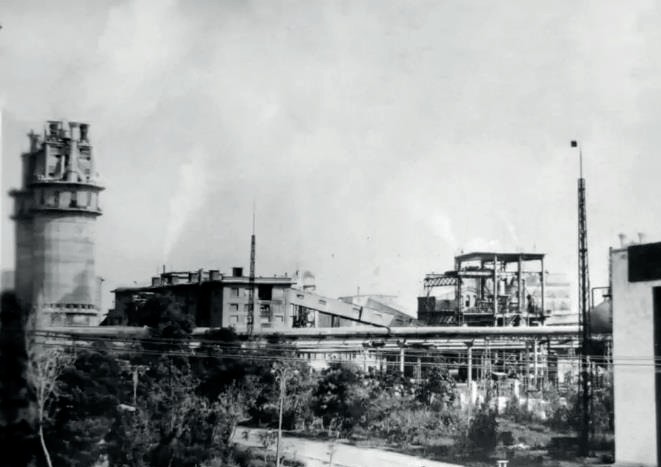
Fig. 3: The Chirchiq electrochemical plant.
Why the first “green period” ended
This early period of “green hydrogen” and green ammonia” production only lasted until the 1950s. The Chirchiq plant was used as a flexible load to balance the power system; during winter peaks and power-system emergencies, power supply to the plant was reduced first. Frequent shutdowns and restarts of electrolysers and compressors increased specific electricity consumption, accelerated equipment degradation, and prevented stable scale-up.
As a result, electrolysers and compressors had to be frequently shut down and restarted. This caused higher electricity consumption, faster equipment degradation and unstable operation. In addition, the electrolyser technology itself was still being developed and had not yet been fully tested. All these factors made it difficult to increase production volumes and to operate the plant efficiently.
This led to the introduction of ammonia production based on coal gasification in the 1950s, until domestic natural gas became available in the 1960s.
Transition to natural gas and modernisation of ammonia production
Uzbekistan began producing natural gas at domestic fields in the early 1960s. Two new nitrogen plants were built in Navoi and Fergana, and the Chirchiq plant was converted to natural gas. In the 1960s to 1970s, ammonia units operated with air separation units (ASUs), using high-purity nitrogen and oxygen. In the early 1980s, additional ammonia units were commissioned at Chirchiq, Fergana and Navoi based on an atmospheric-air process similar to the Kellogg scheme, establishing natural gas as the dominant feedstock for ammonia in Uzbekistan.
Hybrid production experience in Chirchiq
Chirchiq has another very important historical advantage. After the transition to natural gas, the electrolysers continued to operate in parallel for many years, as shown in Fig. 4.
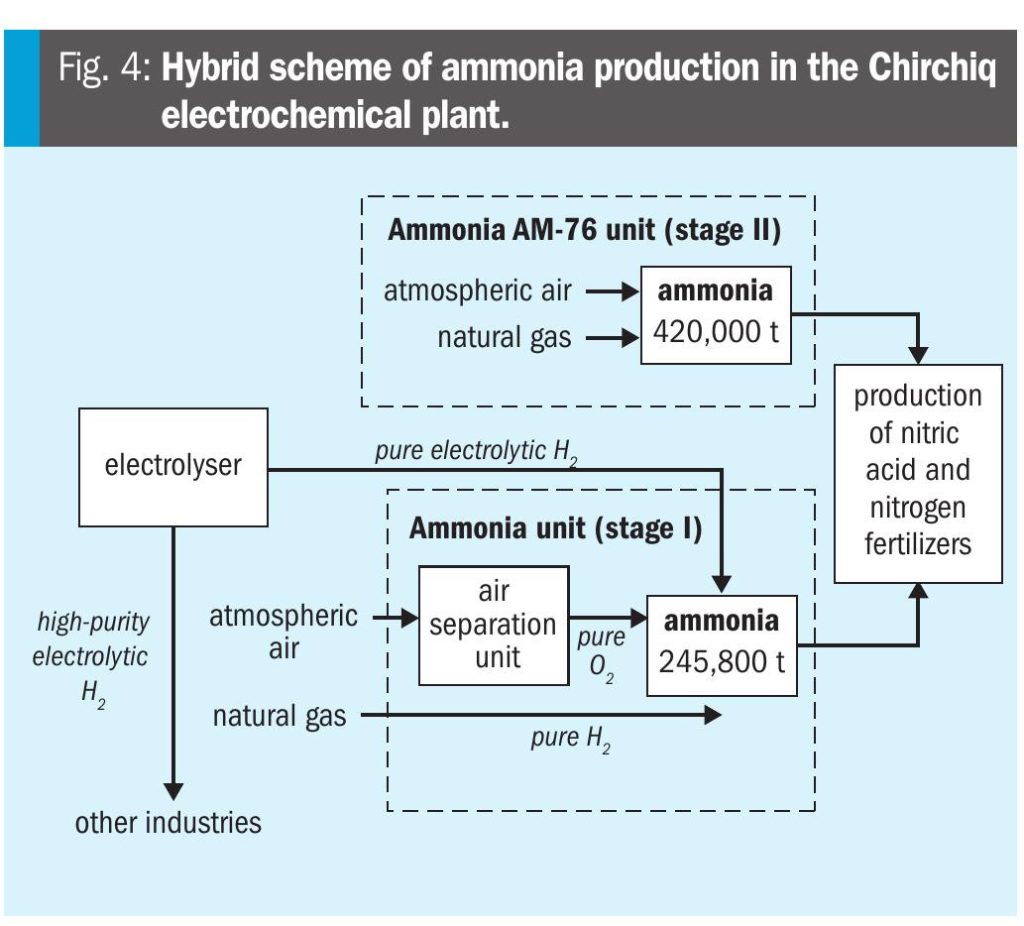
Ammonia was produced using a hybrid configuration, combining electrolytic hydrogen with hydrogen produced from natural gas reforming.
It is worth noting that until 2007 the plant was called the Chirchiq Electrochemical Plant, which underlines the leading role of electrolysis technologies throughout this time.
After the collapse of the Soviet Union, electrolytic hydrogen production was stopped, and since then all ammonia production in Uzbekistan has been based on natural gas. This long operational experience with electrolysis has been valuable for the country’sur current green ammonia strategy.
2025 green hydrogen pilot and the return to electrolysis
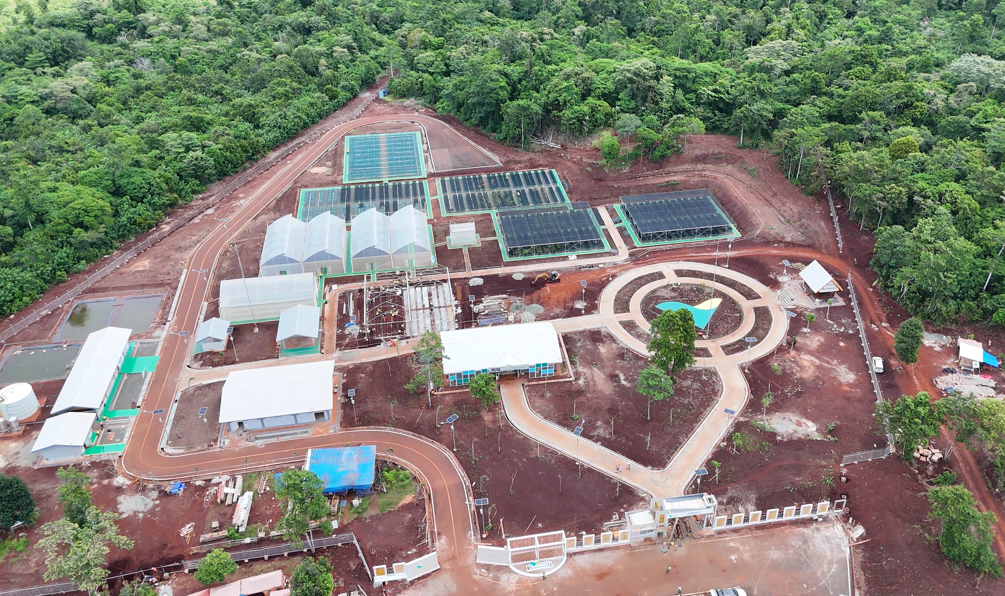
In 2025, a pilot renewable hydrogen facility was commissioned at the Chirchiq site. The “ACWA Power UKS Green H2” project is a joint venture, in which ACWA Power holds an 80% stake. The electrolyser capacity totals 20 MW and is supplied by renewable electricity from 52 MW of newly built wind farms in the Bukhara region. The pilot targets production of green ammonia and green nitrogen fertilizers at the existing site.
The total project cost is approximately $88 million, with ACWA Power and the European Bank for Reconstruction and Development (EBRD) participating in financing. Green hydrogen is supplied to JSC “Maxam–Chirchiq” and converted into ammonia and nitrogen fertilizers.
Certification and export orientation
Certification is being carried out by TÜV SÜD under the CMS 70 standard to obtain a “green certificate”. This is required to comply with the EU Carbon Border Adjustment Mechanism (CBAM) and to support exports of lowcarbon fertilizers to European markets.
Renewable power context and enabling conditions
Uzbekistan is rapidly expanding renewable electricity generation and President of Uzbekistan Shavkat Mirziyoyev has set a policy target to increase the share of renewables in the national power mix to 54% by 2030. In 2025, total electricity generation was reported at 86.7 billion kWh, with 22% from renewable sources including hydropower; wind and solar contributed 10.5 billion kWh, compared to near-zero levels in 2021. This fast growth creates an enabling base for scaling green hydrogen and, consequently, green ammonia.
Future plans
Further options for hydrogen energy use are still under discussion and under study, and no additional projects have yet been formally approved. At the current stage, Uzbekistan considers green ammonia primarily as a feedstock for fertilizer production rather than as an energy carrier. Because Uzbekistan is landlocked, direct export of ammonia as a commodity is not regarded as economically optimal; valueadded exports in the form of certified green fertilizers are the priority.
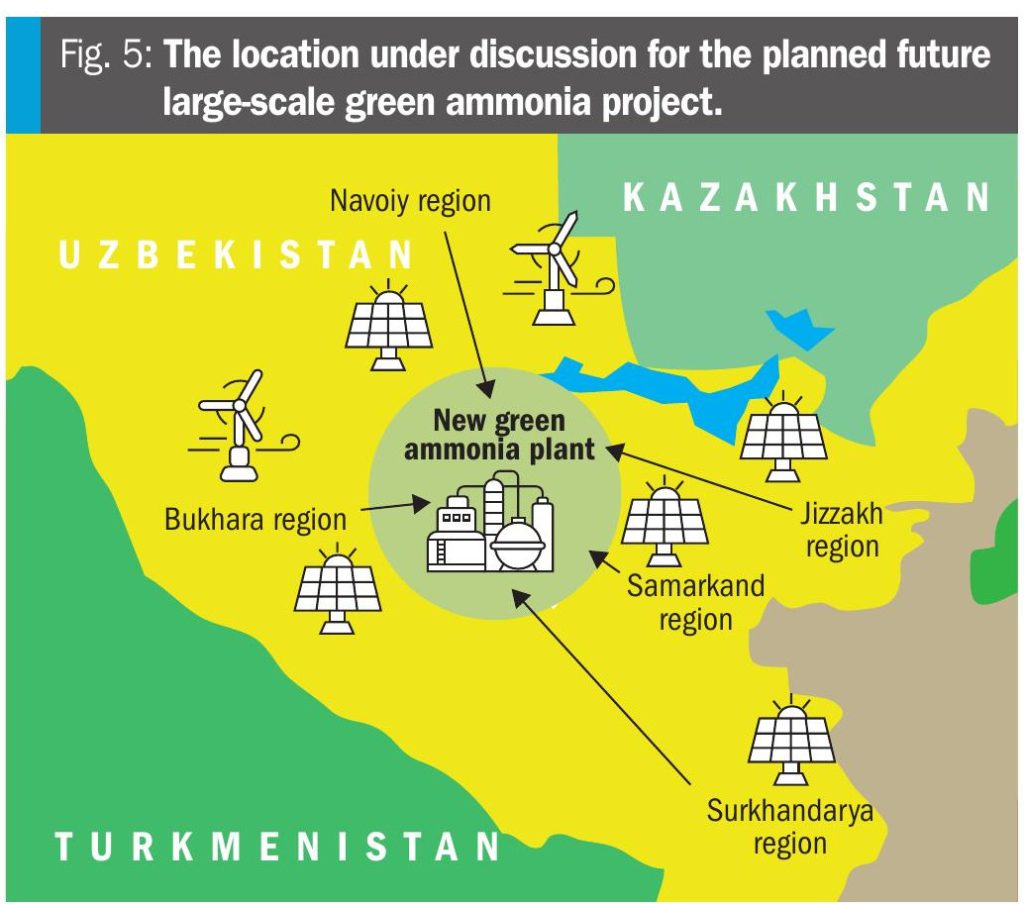
A secondphase project under discussion considers the construction of a new green ammonia unit with a capacity of about 200,000 t/y in the Navoi region (Fig. 5). The required renewable power supply is estimated at roughly 750 MW of solar and wind capacity. To ensure economic efficiency and stable operation, and to meet European requirements for Renewable Fuels of NonBiological Origin (RFNBO), several scenarios are being evaluated: connection to the public grid, direct connection to dedicated renewable plants, development of onsite hydrogen storage, and other hybrid options.
Long-term outlook and conclusion
From a longterm perspective, once Phase 2 is successfully implemented, further decarbonisation may proceed through hybrid configurations that integrate electrolysers near existing natural gas-based ammonia units, blending electrolytic hydrogen with reformer hydrogen. Such hybrid operation can de-risk the transition by maintaining high onstream factors while renewable capacity expands. In the longer term, as green electricity becomes more competitive, these hybrid schemes can be progressively shifted toward green ammonia production.
Uzbekistan’s combination of (i) a mature fertilizer industry, (ii) unique historical operating experience with electrolysis at Chirchiq (iii), and (iiii) fast-growing renewable generation provides a realistic pathway for reducing the carbon footprint of nitrogen fertilizers and building certified green product exports.
References
2. https://gov.uz/ru/minenergy/
4. https://maxam-chirchiq.uz/en/
7. https://mytashkent.uz/2020/10/09/isto-riya-chirchikskih-ges/