Nitrogen+Syngas 402 Jul-Aug 2026
GasPOx driving low carbon molecules from diverse feedstocks


SYNGAS PRODUCTION

GasPOx driving low carbon molecules from diverse feedstocks

Air Liquide’s GasPOx is a catalyst-free syngas platform that enables cost-efficient, low-carbon production from diverse feedstocks with minimal pretreatment. Sayan Dasgupta of Air Liquide Engineering & Construction explains how it lowers capital costs, plant footprint and levelised product cost while delivering high CO selectivity and a raw syngas output that simplifies downstream processing for a range of final products.

The global energy transition represents the defining industrial challenge of this era, driven by the dual mandates of climate action and resource optimisation. This transition relies fundamentally on the rapid, large-scale deployment of low-carbon syngas and its key molecular derivatives (mainly, hydrogen, ammonia, carbon monoxide, methanol) as sustainable energy carriers and chemical feedstocks. To meet this demand, oxygen-based reforming technologies, specifically autothermal reforming (ATR) and partial oxidation (GasPOx) have emerged as the most cost-effective and technically advanced configuration due to their intrinsic simplicity of CO2 capture.

For the most common low-carbon applications – specifically the production of hydrogen or ammonia from clean, natural gas feedstocks with low-impurity levels, such as sulphur – ATR-based configurations offer the lowest levelised cost of product. These configurations are well suited to large-scale projects like power plant or refinery decarbonisation, as well as ammonia or liquid hydrogen production for export. In recent years, Air Liquide has presented such a configuration with proprietary syngas generation and carbon capture techno-blocks, for a range of industrial applications1,2,3,4.

An equally critical emerging market seeks to valorise low-value off-gases, waste streams, or challenging feedstocks by converting them into high-value products. This alternative paradigm presents a distinct set of challenges, requiring syngas production with enhanced feedstock versatility and exceptional flexibility.

Air Liquide’s GasPOx technology is a strategic, catalyst-free syngas platform that offers a breakthrough for cost-efficient, low-carbon production by processing diverse feedstocks with minimal pretreatment. It significantly reduces capital investment, plant footprint, and levelised product cost through maximised hydrocarbon conversion and product yield. GasPOx also delivers the highest CO selectivity among reforming technologies, producing a raw syngas specification that aligns with a wide range of final product requirements and substantially simplifies downstream processing.

GasPOx’s exceptional ratio control can be further enhanced by recycling process-generated CO2 back into the reactor, effectively eliminating direct CO2 emissions while also reducing feedstock costs. This advantage is amplified when external CO2 sources are integrated, effectively positioning the GasPOx reactor as a “CO2 sink” for the production facility. This characteristic makes it an especially attractive and practical pathway for rapid decarbonisation. A brief overview of H2/CO ratio adjustment across different reforming technologies is provided in Table 1.

Air Liquide GasPOx is firmly established as a cornerstone technology for sustainable, high-performance industrial solutions, underpinned by exceptional feedstock versatility. Its reliability is clearly demonstrated by the successful commissioning of multiple plants worldwide over the years, including configurations achieving zero direct emissions.

Air Liquide Lurgi GasPOx

Air Liquide’s Gas-POx reactor is a non-catalytic reactor equipped with a proprietary media-cooled burner. It is designed so that the feed gas stream, shielding steam, and oxygen rapidly mix around the burner, ensuring a stable flame while providing

sufficient cooling of the burner nozzle. The non-catalytic partial oxidation reaction takes place inside the reactor at very high temperatures, reaching up to 1,450°C at the reactor outlet.

The following overall reactions occur:

The reactions within the GasPOx reactor proceed in multiple stages. Once the hydrocarbons reach their auto-ignition temperature, a portion reacts with oxygen according to the strongly exothermic reaction:

In practice, all of the available oxygen is consumed in this stage. The unoxidised fraction of the hydrocarbons then reacts with steam and with the products of reaction (3) according to the following endothermic equations:

With a proven track record of 11 operational GasPOx reactors, Air Liquide’s GasPOx technology delivers exceptional performance and cost advantages. Safe and reliable operation is maintained through close monitoring with thermocouples and infrared cameras. The system is well suited to high syngas capacities, ranging from 500 Nm³/h to 250,000 Nm³/h per reactor, and can process a broad range of gaseous feedstocks.

The inherent flexibility of the GasPOx process allows the configuration to be precisely tailored to the most critical key performance indicators (KPIs), offering a choice between maximising energy recovery and minimising capital investment (Fig. 1). If the priority is maximum energy efficiency, the GasPOx + synthesis gas cooler (SGC) configuration is the optimal solution. This arrangement efficiently recovers heat from the reactor effluent gas, converting it into valuable high-pressure steam. Conversely, where capital investment is the overriding KPI, the GasPOx + quench configuration provides an immediate, cost-effective solution by eliminating the SGC, the single most expensive equipment item. It also significantly simplifies the steam network and reduces the overall plot area. This strategic adaptability enables the plant design to align with the prevailing economic model.


Furthermore, another key advantage and distinguishing feature of GasPOx technology is its ability to eliminate the fired heater. From an environmental perspective, removing the fired heater effectively eliminates direct carbon emissions. From an economic standpoint, this translates into substantial benefits, including lower total capital expenditure (capex) and a reduced plot area requirement. This feature also simplifies the permitting process by supporting a low-carbon footprint and facilitates plant investment without the need to establish a CO2 sequestration infrastructure.

Cost-efficient and low-carbon hydrogen and syngas production

A key technical advantage of GasPOx is its ability to tune the H2:CO ratio in the syngas effluent across a wide range, inherently producing a raw syngas composition that can be matched to diverse final product specifications (Fig. 2). This ratio control can be further enhanced by recycling process-generated CO2 (Fig. 2B) or by integrating external CO2 sources (Fig. 2C), thereby effectively eliminating direct CO2 emissions while also reducing feedstock intake. This self-adjusting capability is particularly important when compared with other reforming technologies.

Steam methane reforming (SMR) and autothermal reforming (ATR), as catalytic reforming technologies, also promote the water-gas shift reaction, resulting in H2 production that is often significantly in excess of CO. As a result, if the target molecule is CO or oxo gas (typically H2:CO = 1:1), the plant must rely on extensive CO2 recycle and/or import, along with the costly management, disposal, or utilisation of excess H2 – a complication that GasPOx inherently avoids. For example, due to its intrinsically higher H2:CO ratio, typically in the range of 3.5 to 4.5, SMR often requires complete CO2 recycling and the combustion of excess H2 or CO to meet project specifications. This leads to higher natural gas consumption and increased syngas throughput across the plant. By contrast, GasPOx significantly reduces, or in some cases eliminates, the need for such costly process adjustments.

In addition, GasPOx technology offers a highly efficient pathway for the co-production of low-carbon H2 and oxo gas – a tailored H2:CO syngas – providing a clear advantage in multi-product energy markets. Depending on the required oxo gas-to-hydrogen product ratio, the syngas can be selectively routed to a pressure swing adsorption (PSA) unit for the production of pure hydrogen. At the same time, a portion of the syngas can bypass the PSA and be blended with the compressed PSA tail gas to produce the final oxo gas stream (Fig. 3a). This configuration enables precise ratio control without molecular losses, ensuring that all carbon is retained in the product stream.

Moreover, the high operating temperature of GasPOx helps meet the inert specifications required for oxo gas downstream applications, eliminating the need for an additional purification step. This scheme can be extended further to the co-production of pure CO instead of oxo gas, by installing a CO cold box downstream of the CO2 removal unit (Fig. 3b).


GasPOx technology for converting unconventional feedstocks to high-value products

GasPOx-based technology is particularly well suited to heavy feedstocks containing unsaturated hydrocarbons, as the high thermal energy of GasPOx rapidly cracks them. In SMR or ATR systems, such feedstocks typically require an expensive upstream hydrogenation and prereforming section to prevent rapid coking and poisoning of the downstream catalyst, thereby adding substantial complexity and capital expenditure.

By contrast, GasPOx readily tolerates high sulphur concentrations, which are common in feedstocks such as semi-coke gas and heavy refinery off-gases. These sulphur compounds can then be managed downstream, for example through a sulphur absorber or sour shift catalysts.

Fig. 4 illustrates a GasPOx process configuration in which a feedstock similar to that described above – characterised by high sulphur, high olefin, and high aromatic content – is routed directly to the GasPOx reactor without any pretreatment. A portion of the syngas effluent then undergoes the water-gas shift reaction in a sour shift catalytic reactor. The shifted and unshifted gas streams are subsequently blended to achieve the optimal molecular stoichiometry, defined as SN = (H – CO2) / (CO + CO2), for methanol synthesis after CO2 removal in the Rectisol unit.

This configuration enables an integrated, low-carbon co-production scheme for H2 and methanol, in which methanol co-production can be maximised at the lowest operating cost for a given hydrogen production target. Notably, the same scheme is also applicable to easier-to-handle feedstocks such as natural gas.

The configuration illustrated in Fig. 5 considers natural gas as an exemplary feedstock, reflecting a real project scenario, and is based on an optimised GasPOx flow scheme for the efficient co-production of CO and methanol. The CO-rich GasPOx effluent syngas can be valorised by purifying and separating a portion as a pure CO stream, while the remaining syngas is adjusted to the molecular stoichiometry optimal for the methanol synthesis loop, defined as SN = (H2 – CO2) / (CO + CO2). This enables the most efficient co-production of low-carbon CO and methanol.

Prior to the CO purification step, CO2 removal from the syngas stream is essential. For high-sulphur feedstocks, Rectisol is the most suitable capture solution.

Fig. 6a and 6b demonstrate that efficient low-carbon H2 production using a GasPOx configuration can be achieved with both light natural gas and feedstocks containing high levels of heavier and/or unsaturated hydrocarbons, as well as elevated impurity levels, such as sulphur.

Reference 1 identified the most optimal process configuration for producing low-carbon H2 from conventional natural gas feedstock as a combination of ATR and Cryocap H2 technology. However, where the feedstock contains high sulphur content or significant amounts of higher hydrocarbons – including olefins, cycloalkanes, and aromatics – GasPOx may be the preferred solution, given the extensive feed pretreatment required by other reforming technologies. GasPOx can also be attractive for light natural gas feedstocks when project priorities include capital investment, plant footprint, simplicity, and operational flexibility.

Moreover, GasPOx operates at the highest temperature among reforming technologies, reaching up to 1,450°C, which enables maximum hydrocarbon conversion. Although the resulting syngas contains more CO and less H2, the water-gas shift reaction ensures near-complete conversion of CO to CO2, thereby maintaining a competitive hydrogen yield. In addition, the higher CO production leads to a greater CO2 concentration in the syngas, increasing CO2 partial pressure, improving capture efficiency, and minimising CO2 capture costs.

The low-carbon H2 produced in this process can be routed to the catalytic ammonia synthesis unit, not shown in the figure, for ammonia production. This low-carbon concept for POx-based ammonia production was previously presented under the POXSYN solution5.

Air Liquide Lurgi GasPOx success stories in greenfield and revamp projects

As global industry accelerates its transition toward decarbonisation, Air Liquide’s GasPOx technology has emerged as a benchmark for high-efficiency, low-carbon syngas production. Recent greenfield references in North America and Asia underscore the global scalability of this platform, demonstrating its ability to align large-scale industrial output with stringent sustainability objectives while highlighting the operational excellence and environmental benefits intrinsic to the technology.

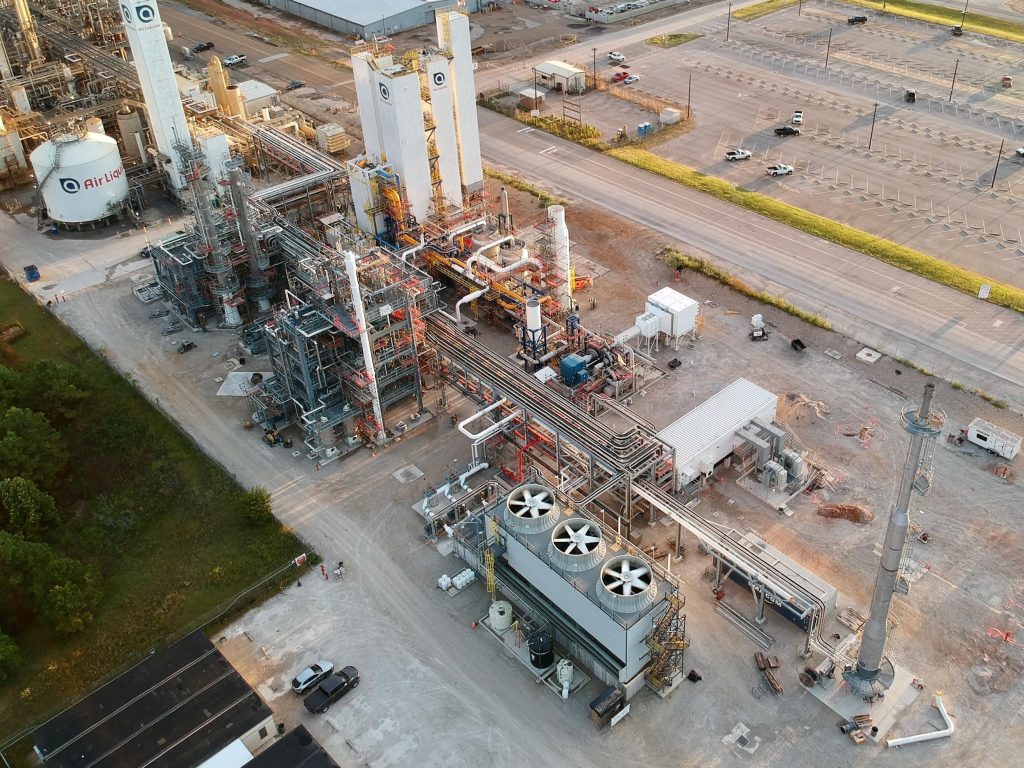
Longview, Texas: A zero-emission milestone

Longview, Texas: A zero-emission milestone.

The Longview, Texas facility features an integrated design in which CO2 is fully recycled back into the GasPOx reactor. In addition, by eliminating the need for a fired heater, the plant achieves zero direct CO2 emissions, setting a new benchmark for environmental stewardship6.

Ulsan, South Korea: Driving global capacity scaling

Demonstrating proprietary technology excellence, Air Liquide supplied the latest proprietary GasPOx burner, reactor, and syngas cooler to support peak operational performance in this recent large-scale deployment of GasPOx technology. The plant was successfully started up in 2024.

Beyond greenfield developments, Air Liquide is driving the industrial transition through the strategic modernisation of brownfield assets. By integrating proprietary GasPOx technology into existing gasification units, the recent revamp projects below demonstrate how established plants can be optimised to meet current environmental requirements. This successful transition shows that existing infrastructure can be revitalised to achieve modern standards of operational efficiency and decarbonisation without the need for entirely new facilities.

Stade, Germany: A blueprint for industrial decarbonisation

In this project, a deep decarbonisation impact was achieved through a reduction of 14,000 t/d of Scope 1 emissions via complete CO2 recycling7. Replacing the existing gasifier with Air Liquide’s proprietary GasPOx reactor significantly improved process efficiency. The installation of a new hydrogen-fuelled fired heater further reduced the facility’s carbon footprint.

Brunsbüttel, Germany: Proven reliability in large scale feedstock conversion

In this project, the 1976-commissioned oil POx unit was successfully converted to high-efficiency GasPOx technology. The facility has operated reliably on natural gas (NG) feedstock since 2013. In addition, a comprehensive reactor and refractory replacement was completed in 2021 to ensure continued peak performance.

Conclusion

In summary, as a non-catalytic fired reactor, GasPOx offers one of the most robust process configurations for feedstock handling, impurity management, and related challenges. In the context of the energy transition – where there is increasing emphasis on valorising diverse feedstocks and producing a range of decarbonised molecules, including H2, CO, CH3OH, and NH3 – the industry presents a highly favourable environment for GasPOx technology.

To support the global energy transition, Air Liquide delivers optimised GasPOx solutions by combining innovative design with proven project expertise. As a leader in GasPOx licensing and operations, the company provides complete EP solutions for both greenfield and brownfield plants. With an extensive track record of successful project delivery and revamps Air Liquide ensures that each design is tailored to meet customers’ specific requirements.

References

Latest in Decarbonisation