Sulphur 426 Sep-Oct 2026
18 September 2026
Price Trends
SULPHUR
Most key sulphur import markets remained stagnant in late August due to weak demand. A premium is being paid for cargoes with guaranteed delivery schedules, driven by ongoing logistical risks in the Middle East. This has firmed prices in North America and Indonesia, but the potential return of supply from Russia and Kazakhstan may add some downward pressure.
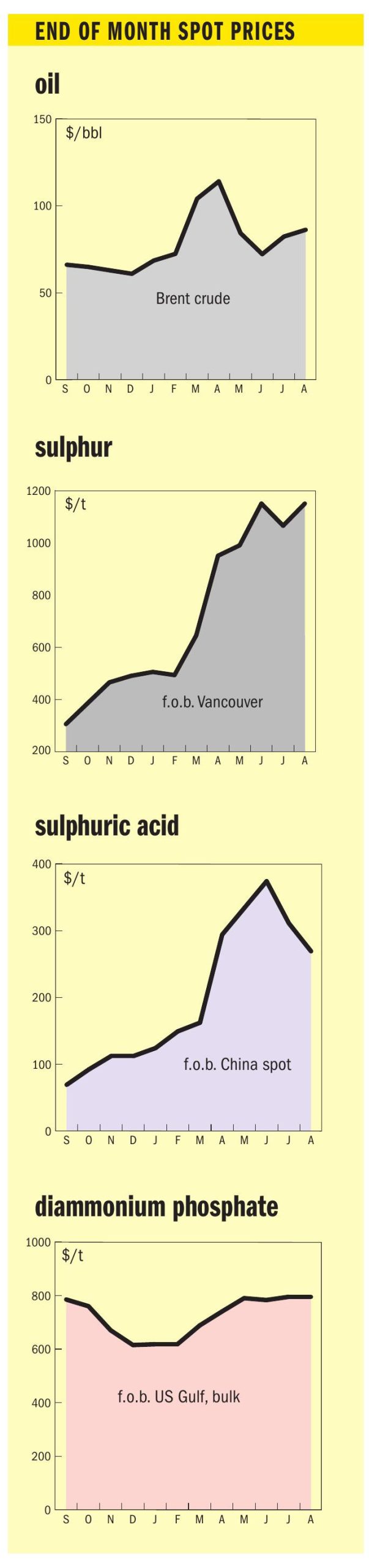
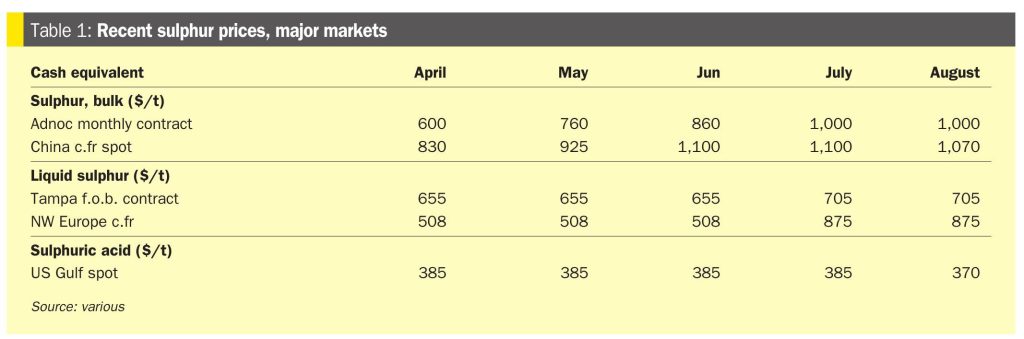
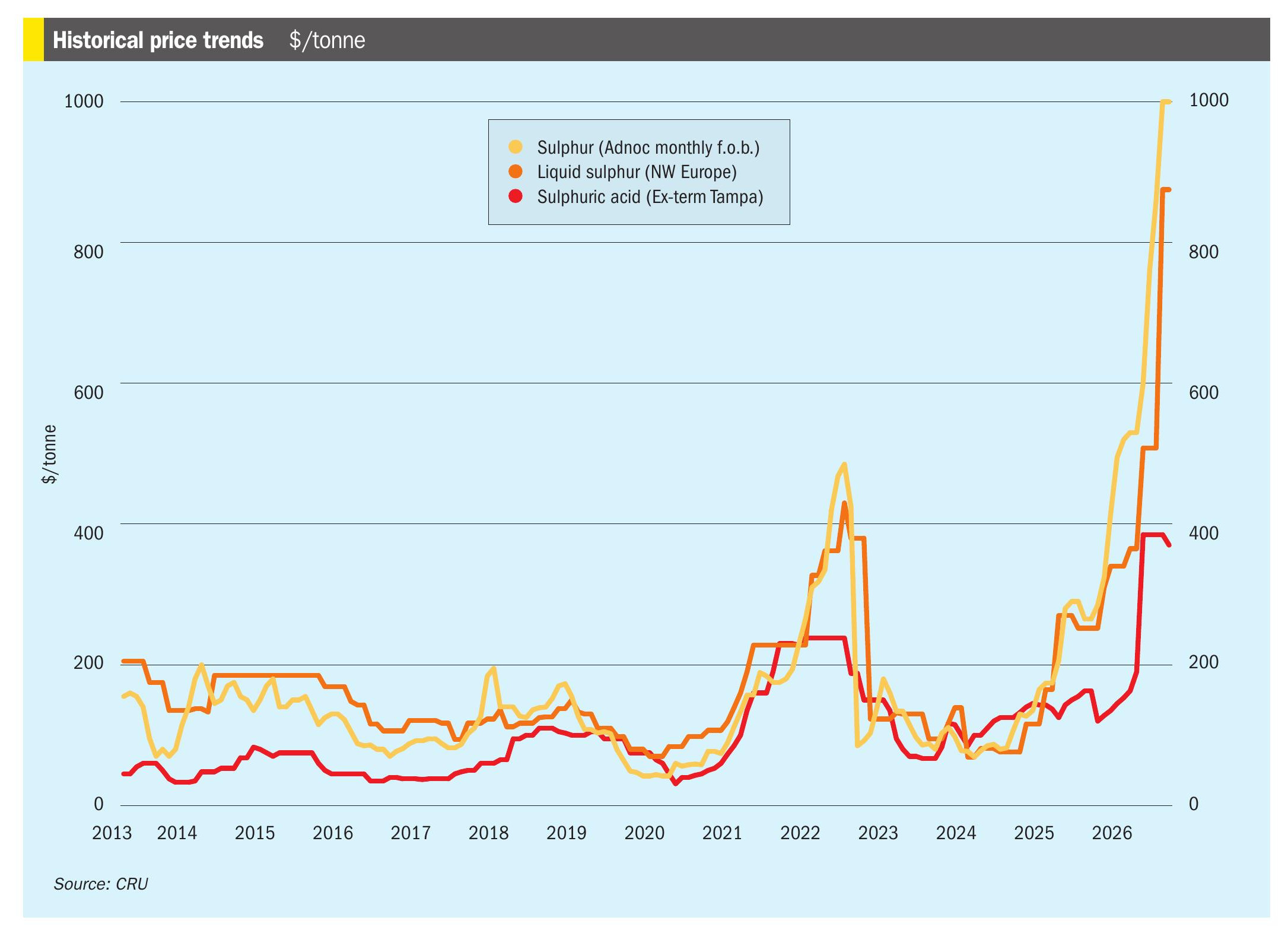
The Middle East spot market was quiet, with prices holding at a three-month low of $865-900/t FOB as severe logistical constraints continue to limit new business. Loaded backlogged vessels totalled around 400,000 tonnes of sulphur. Q3 North African contracts were settled at a record high level of $990-1,010/t CFR. Morocco’s sulphur imports in the first half of 2026 fell 12% year on year to 3.12 million tonnes, representing the lowest H1 volume since 2023. The decrease was largely driven by a reduction in supply from Kazakhstan and lower purchasing activity in the second quarter. Shipments from the UAE, Morocco’s top supplier in H1, fell 19% to just over 1 million tonnes. The most significant drop came from Kazakhstan, with volumes falling 43% to 971,711 t. In contrast, supply from Saudi Arabia rose 24% to 471,512 t. Morocco also continued to diversify its procurement, sourcing significant volumes from Turkmenistan (119,117 t), Kuwait (105,000 t), and the US (96,438 t) during H1.
Potentially offsetting market tightness, however, was the rumoured return of supply from the Baltic. Kazakhstan sulphur is rumoured to be re-entering the market via the Baltic Sea, a month after officially lifting its export ban on 4 August. This follows confirmed reports of Kazakh material moving from the Black Sea port of Poti while the primary Baltic route was closed. Compounding this, Russia has partially relaxed its own export ban, creating a quota for 300,000 tonnes of low-grade material.
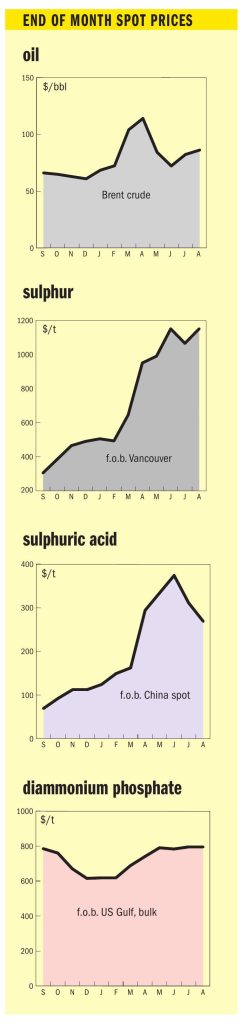
The demand for reliable supply was most evident in North America. The Vancouver assessment firmed $50/t on the upper end to $1,100-1,200/t FOB on a confirmed sale to Southern Africa, as some buyers paid a premium to avoid the delivery uncertainty of Middle East cargoes. This premium, however, was not reflected in all major CFR markets, where weak demand remains the dominant theme. In Brazil, the market remains at a stalemate with prices at a three-month low amid poor phosphate production economics. Similarly, the Indian market has ground to a halt as participants await a government decision on a proposed subsidy. Indonesia was a notable exception, with prices firming to $1,050-1,150/t CFR, driven by a premium for cargoes with guaranteed delivery schedules rather than a surge in underlying demand.
In China, in contrast, the impact of weak downstream demand was stark, leading to a significant drop in domestic port prices. China’s sulphur arrivals rebounded in July, following a temporary easing of transit through the Strait of Hormuz. This came after imports in June hit just 147,104 tonnes, the lowest monthly volume on record. China imported 385,403 tonnes of sulphur in July, a 162% increase from June but still 65% lower than in July 2025, according to Global Trade Tracker (GTT). Despite the monthly rebound, China’s sulphur imports in the first seven months of 2026 totalled just 2.65 million tonnes, down 59% on the same period in 2025 and the lowest level since 2002. Supplies were mostly from South Korea (516,000 t), Oman (472,000 t) and Canada (400,000 t), with Gulf volumes down 60%. The steep decline reflects China’s continued withdrawal from the international spot market, as buyers are deterred by high global prices and logistical risks, leading them to draw from domestic inventories. Chinese port inventories had rebounded to 947,000 t in late August from a low of 730,000 t on July, but remain low by historical standards. Despite tight global supply and low port inventories, sulphur prices at Chinese ports have fallen significantly in recent weeks. This is being driven by weak demand resulting from poor affordability for buyers. China’s weekly average domestic sulphur price reached a record RMB 9,875/t ($1,469/t) on 11 June, but had fallen to RMB 7,625/t ($1,135/t) by late August.
Moving into the start of September, there were indications that sulphur prices might be moving lower due to thin demand, in spite of continued supply disruption, including 600,000 tonnes of sulphur on 13 vessels still waiting to transit the Strait of Hormuz. Fresh Houthi attacks on Saudi energy facilities have added further uncertainty, including reported disruption at facilities in Jazan. Nevertheless, Middle East values were unchanged at $865-900/t FOB, although expectations for October pricing moved into the $800s/t FOB.
Kazakh material is also beginning to return through Ust-Luga, where a third vessel has loaded since late August. These volumes are expected to meet outstanding contractual commitments first, including into Morocco, rather than immediately increase spot availability. OCP is understood to be awaiting Kazakh contract tonnes and has therefore stepped back from spot buying, though this was not confirmed.
SULPHURIC ACID
Global sulphuric acid prices continued to soften at the end of August, with key benchmarks in Europe and Brazil hitting their lowest levels since April. The strong downward momentum seen in recent weeks is now meeting resistance, as prompt spot availability begins to dry up, with market players expecting this to begin to slow the pace of the decline.
In the Atlantic, European FOB prices slid $10-20/t to $300-320/t, its lowest level since late April. The downward pressure stems from offers into key import markets, particularly Brazil. While offers as low as $350/t CFR were reported for October loading, these fall outside the prompt 30-day delivery window. For September delivery, offers into Brazil were widely heard in the $360-370/t CFR range. Based on a freight cost of around $62/t, this supports a prompt European FOB assessment in the low $300s/t. This sustained pressure has dragged down notional prices in other import markets where buying interest is absent. In North Africa, the notional CFR price is now assessed at $330-350/t, down from $350-360/t CFR, based on a freight rate of around $30/t. In the US Gulf, the CFR price has moved down to $345-365/t from $365-375/t CFR, based on a freight cost of approximately $45/t. Prompt Brazilian spot prices reached $370/t CFR, with offers for forward deliveries in October reaching $360/t CFR. Bids fell to $350/t CFR, pushed lower by the result of Bunge’s purchase for Argentina at $350/t CFR. While downward pressure persisted, vessel availability has begun to dry up.
Turkish producers are now understood to be sold out until the second half of October. This comes as Saudi Arabia’s Maaden purchased around four cargoes for delivery from August through October. Prices were reported at $340-350/t CFR, although not confirmed.
Elsewhere in South America, the Chilean market remained in a holding pattern at $370-390/t CFR. Buyers were looking for direction from the TFI conference and, more immediately, the results of Nexa Resources’ tender offering 58,000 t of its 2027 surplus production. No awards were heard at the time of writing.
In Japan/South Korea, prompt FOB prices softened to $310-320/t, with bearishness demonstrated by a forward-dated tender. A sale from South Korea’s GS Caltex for November loading was rumoured to have closed in the high $200s to low $300s/t FOB, sending a clear signal of significant price weakness expected in Q4. Japanese sulphuric acid exports for the first seven months of 2026 rose 1.6% year on year to 1.95 million tonnes, driven by strong growth in shipments to the US and Chile. In the January-July period, volumes to top partner the Philippines rose 4% to 817,332 t. Meanwhile, shipments to second-largest outlet India dipped 10% to 312,520 t, followed by Chile, with exports there up 19% to 234,323 t. Shipments to the US underwent a significant surge of 39% to 169,462 t. The data also show a major realignment away from previous customers, with exports to Saudi Arabia, Mexico, and Morocco falling to nothing from a combined 71,850 tonnes in 2025. These volumes were partly redirected to new markets, including Australia and Papua New Guinea, which took 19,950 t and 10,998 t respectively. For July, total exports stood at 338,021 tonnes, a 38% increase on July 2025 and the highest monthly export level in 2026. The Philippines was the largest single export destination in July with 154,489 t, followed by Chile with 51,279 t. Limited availability in the Asian market, following China’s export ban, has seen Japanese exporters redirecting volumes to meet demand in key markets such as the Philippines and Chile.
This forward weakness is influencing sentiment in import markets. In Indonesia, prices held at $340-350/t CFR, but the market was focused on the outcome of the recent Petro Jordan tender. Unconfirmed reports suggest it was awarded to a trader at a price below the initial $340-360/t offer range, leading many to believe the true market level is now closer to the $330s.
India saw its assessment soften to $370-380/t CFR, highlighting a wide gulf between buyer expectations, shaped by domestic deals around $330/t, and the higher reality of import parity pricing. ■