Fertilizer International 534 Sep-Oct 2026
13 September 2026
Next-generation nitric acid production
FERTILIZER TECHNOLOGY SHOWCASE
Next-generation nitric acid production
The NX Stami™ Nitrates Total Recycle concept represents a significant step forward in nitric acid technology. By replacing air with oxygen and continuously recycling nitrogen, the process simultaneously lowers CAPEX, reduces OPEX, increases steam export and virtually eliminates N2O emissions. Paz Muñoz of Stamicarbon (Nextchem) outlines its key advantages.
Nitric acid producers, like many industries globally, face increasing pressure to modernise their production technology – in pursuit of lower emissions, higher efficiency and reduced operating costs. Stamicarbon, the nitrogen technology licensor of Nextchem (MAIRE Group), has developed a new solution that addresses all three challenges simultaneously: the NX STAMI™ Nitrates Total Recycle concept.
This concept uses pure oxygen and continuously recycles nitrogen, unlike conventional nitric acid plants which rely on atmospheric air as the oxygen source. The result is a significantly simplified plant configuration with lower capital investment, reduced energy consumption, and near-zero N2O and NOx emissions.
Conventional nitric acid production
Nitric acid (HNO3) remains a crucial chemical intermediate in fertilizer production. Approximately 80% of global nitric acid production is dedicated to the fertilizer industry, where it is used to manufacture products such as calcium ammonium nitrate (CAN), fertilizer-grade ammonium nitrate (FGAN) and urea ammonium nitrate (UAN).
Production is based on the well-established Ostwald process. Ammonia is oxidised over platinum-rhodium (Pt-Rh) gauzes in the presence of excess oxygen:

The nitrogen monoxide (NO) formed is further oxidised:

Nitrogen dioxide is then absorbed in water to form nitric acid:

Conventional plants obtain their oxygen from atmospheric air, with a composition of 21 mol% oxygen and 79 mol% nitrogen, a process that inevitably requires the compression of large volumes of nitrogen. This is subsequently decompressed and discharged as tail gas, typically at a ratio of around 3,250 Nm³ of nitrogen per tonne of HNO3 .
Nitrogen is essential at nitric acid plants as both a heat buffer and for safe burner operation. But its continuous compression and decompression contributes significantly to plant complexity and energy consumption, due to the extensive use of energy-intensive rotating equipment.
The Total Recycle concept
The NX Stami™ Nitrates Total Recycle concept (Figure 1) eliminates the need for continuous atmospheric air supply. Instead, the process only consumes two raw materials – ammonia and oxygen – while nitrogen circulates continuously within the system.
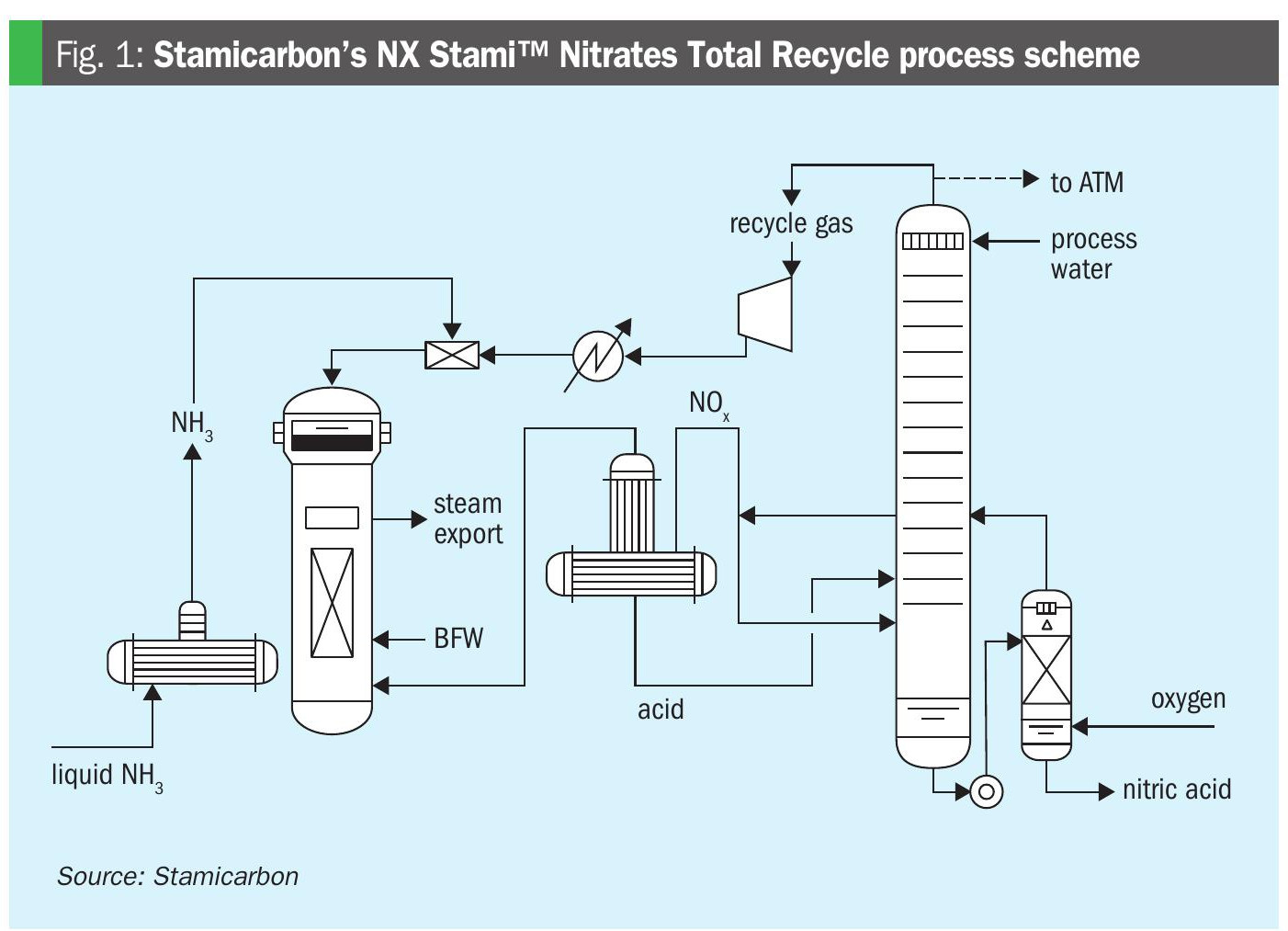
In this concept, nitrogen is added only during startup and then remains in the process loop during normal operation. Importantly, air compressors and tail-gas expanders used in the conventional process are excluded from the design as they are no longer necessary.
One of the most innovative aspects of the Total Recycle process is the introduction of oxygen through the bleaching column. Here, oxygen serves as the stripping medium for removing dissolved NOx from the nitric acid product. The oxygen-rich gas leaving the bleacher is routed back through the process, where it promotes NO oxidation and overall process efficiency.
The recycled gas mixture – which contains oxygen and nitrogen in similar proportions to atmospheric air – is compressed in a recycle compressor, mixed with ammonia, and sent to the burner. Ammonia oxidation then proceeds in the conventional manner over Pt-Rh gauzes.
Nitrous oxide formed on the gauzes is decomposed to nitrogen and oxygen over a secondary catalyst:

Process gas is subsequently cooled with the heat recovered used in high-pressure steam production.
Valuably, the Total Recycle process recovers all the available high-grade process heat as steam. It is no longer necessary to reheat tail gas before atmospheric release – because none is generated. Instead, only a very small purge stream (<0.02 tonnes per tonne HNO3) is required to prevent nitrogen accumulation.
Simpler equipment, lower costs
The key advantage of the Total Recycle concept is process simplification. Several major pieces of equipment can be eliminated or significantly reduced in size, including the compressor train, oxidation/absorption column, tertiary NOx/N2O abatement reactor and tail-gas heating system.
The Total Recycle concept eliminates the need for a compressor train, as neither air compression nor tail gas expansion is applied. Additionally, the oxygen-rich process conditions accelerate NO oxidation to NO2, allowing the oxidation/absorption column to be almost 50% smaller than those used in conventional technologies.
The absence of continuous tail-gas discharge also eliminates the need for a tertiary abatement reactor. At the same time, steam export increases substantially – because process heat is no longer consumed in tail-gas reheating.
Synergies with green ammonia
The Total Recycle concept is particularly attractive when integrated with green ammonia production.
In ‘green’ and ‘pink’ ammonia plants, hydrogen is produced via electrolysis, generating oxygen as a by-product. Much of this oxygen is produced at elevated pressure – and can therefore directly supply the nitric acid plant without additional compression. Additionally, oxygen generated as a by-product from the air separation unit (ASU), used to supply nitrogen for ammonia synthesis, can also be used in the Total Recycle process.
The total oxygen demand of this nitric acid process is approximately 1.04 tonnes O2 per tonne of HNO3 produced.
Near-zero N2O emissions
Nitrous oxide remains one of the most significant environmental concerns in nitric acid production. With a global warming potential approximately 273 times greater than CO2 , N2O emissions carry both environmental and financial consequences. In the European Union, where CO2 emissions are subject to a penalty of approximately €88 per tonne (as per January 2026), emitting one tonne of N2O costs around €24,000.
A conventional nitric acid plant without abatement typically emits approximately 6 kg N2O per tonne HNO3 (100%). Even plants equipped with highly efficient tertiary abatement technology typically emit around 0.120 kg N2O per tonne HNO3 .
The Total Recycle concept addresses the issue differently. Instead of relying solely on end-of-pipe treatment, N2O is fundamentally mitigated at the source through a secondary catalyst positioned beneath the Pt gauzes. Since there is virtually no continuous tail-gas discharge, overall N2O emissions are reduced to near-zero levels.
CAPEX and OPEX benefits
Economic evaluation of the Total Recycle concept has demonstrated substantial savings. These are driven primarily by elimination of the equipment mentioned above, combined with the simplification of piping and civil works. Compared with conventional nitric acid plants, CAPEX reductions, assuming oxygen is received in a pressurised state, can reach:
• 34% compared to a conventional 325 tonnes per day (t/d) mono-pressure plant
• 25% compared to a conventional 1,000 t/d dual-pressure plant
• 26% compared to a mono-pressure plant including oxygen compression
• 7% compared to a conventional 325 t/d mono-pressure plant when a dedicated ASU is required.
“The Total Recycle concept offers a compelling pathway for fertilizer producers seeking both economic and environmental advantages, while supporting the industry’s transition toward a more sustainable future.”
The concept remains financially attractive even in the case where an ASU is fully dedicated to supplying oxygen to the nitric acid plant – showing a lower capital investment than both a conventional mono- or dual-pressure plant.
Operating costs are also significantly reduced. Compared with Stamicarbon’s already highly efficient mono-pressure technology, the Total Recycle concept offers lower ammonia consumption, lower cooling water demand, and steam export exceeding 1,200 kg per tonne HNO3. Electricity consumption is also reduced significantly – cutting this from approximately 85 kWh to 22 kWh per tonne HNO3 for a mono-pressure plant operating with an electromotor, for example.
Overall OPEX reductions of up to 25% are achievable with the Total Recycle concept, when compared to conventional Stamicarbon technologies, with OPEX savings rising to 30% or more compared to other nitric acid technologies available on the market.
Alternative applications of oxygen
In cases where the full Total Recycle concept cannot be fully implemented, two alternative approaches are available. One option is a partial recycle concept, which reduces emissions and enables smaller equipment.
Enriching secondary air, normally used as a stripping agent, with available O2 in the bleaching column is another option. This is a practical route, particularly for plant revamps, as the compressor can be repurposed to supply more primary air to the burner, delivering an increase in plant capacity without significant investment.
Looking ahead
The NXStami™ Nitrates Total Recycle concept represents a significant step forward in nitric acid technology. By replacing air with oxygen and continuously recycling nitrogen, the process simultaneously lowers CAPEX, reduces OPEX, increases steam export and virtually eliminates N2O emissions.
Combined with the growing availability of oxygen from green ammonia production, the concept offers a compelling pathway for fertilizer producers seeking both economic and environmental advantages, while supporting the industry’s transition towards a more sustainable future.