Sulphur 426 Sep-Oct 2026
18 September 2026
Celebrating 120 years of industry leadership
SULPHURIC ACID TECHNOLOGY
Celebrating 120 years of industry leadership
HUGO PETERSEN celebrates its rich history in process plant engineering and construction. Since its foundation in 1906 it has established itself as a technology leader in sulphuric acid and gas purification, consistently setting industry benchmarks, combining technological excellence with the highest standards of quality, safety, and regulatory compliance. Axel Schulze and Mahmoud Salehi of HUGO PETERSEN look back on some of the key milestones and highlight recent innovations.
For more than 120 years, HUGO PETERSEN has developed process plant technologies for sulphuric acid production and gas purification. Its integrated approach combines flexible product configurations, high heat recovery and low-emission performance to deliver solutions tailored to each customer’s operating requirements.
Drawing on extensive expertise in metallurgical and chemical processes, HUGO PETERSEN has contributed to the development of sulphuric acid production technology over several generations. Its proprietary Tower process, for example, represented an important step beyond the formerly prevalent Lead Chamber process. Today, the company continues to develop processes and equipment in line with Best Available Technology (BAT) standards.
HUGO PETERSEN offers a broad in-house portfolio of sulphuric acid technologies, including Dry Catalysis, Wet Catalysis and Petersen Tower Technology, alongside advanced developments such as SUPEROX and SUPERCO. These technologies address a range of feedstocks and applications, from metallurgical off-gases and elemental sulphur to split-acid processes.
At the centre of the company’s approach is Process Integration Network Consulting (PINCHP), which is applied from the initial client consultation. This methodology is used to identify opportunities to integrate new process solutions with existing plant infrastructure and maximise operational value. It is complemented by ENERREC, HUGO PETERSEN’s proprietary technology for energy recovery and utilisation in process plants.
Examples of PINCHP applications include the use of absorption energy in energy-intensive operations such as solution preheating for titanium dioxide production, seawater desalination and district heating. By recovering and integrating energy that might otherwise remain underutilised, these concepts can support lower overall energy consumption and operating costs.
Guided by the objective of working alongside customers to optimise and develop processes over time, HUGO PETERSEN continues to develop sulphuric acid technologies tailored to individual plant requirements.
Case study 1: SO2 liquefaction and sulphuric acid production
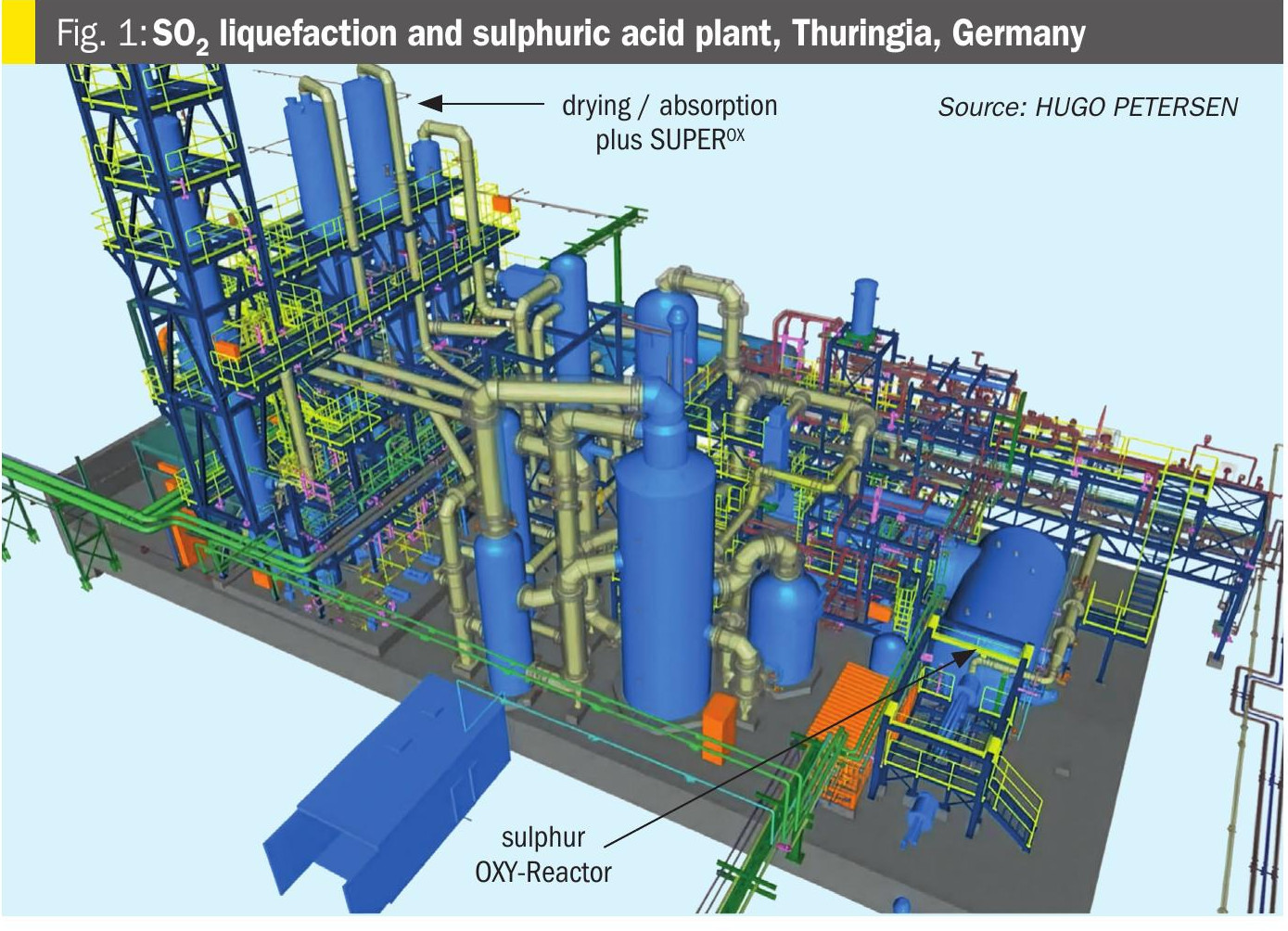
HUGO PETERSEN was commissioned to develop an integrated and energy-efficient process for sulphur dioxide liquefaction and sulphuric acid production. The concept was designed to meet the requirements of Germany’s Technical Instructions on Air Quality Control (TA Luft), while accommodating variable feed compositions and capacity requirements.
The process configuration prioritises flexible operation, energy recovery and low emissions. Integrated heat-recovery measures minimise energy consumption, while the plant design supports emissions performance below applicable TA Luft limits.
Process principle
Partial condensation occurs when a gas is cooled below its dew point, causing part of the vapour to form a liquid. The dew point is the temperature at which a gas reaches its saturation pressure.
For sulphur dioxide, this behaviour differs substantially from water. Water boils at atmospheric pressure at 100°C, whereas SO2 boils at approximately −10°C. At room temperature, SO2 has a saturation pressure of around 3.3 bar. Condensing SO2 therefore requires the removal of energy from the gas, generally through cooling. The energy associated with this phase change is known as the enthalpy of vaporisation.
The HUGO PETERSEN process concept selected uses a high SO2 concentration in the gas leaving the sulphur furnace, known as the HP-OXY Reactor.
Plant flexibility and energy integration
The plant is designed to produce both liquid sulphur dioxide and sulphuric acid at 96 wt-% H2SO4 concentration. It can operate across a sulphur throughput range of 25% to 100%.
Within this operating range liquid SO2 production can vary from 0% to 100% and sulphuric acid production can vary from 40% to 100%.
The production ratio between the two products can be adjusted according to operational requirements.
Process heat is recovered for steam generation. The generated steam is used for sulphur heating, operation of key equipment, powering the absorption chiller and electricity generation. Deep-temperature cooling for liquid SO2 condensation is achieved through recuperators and steam-driven absorption chillers.
SO2 conversion to SO3 is achieved using a high-efficiency, specially shaped V2O5 catalyst in a three-bed converter. Combined with tail-gas scrubbing, this arrangement supports heat recovery and further energy utilisation.
Detailed process description
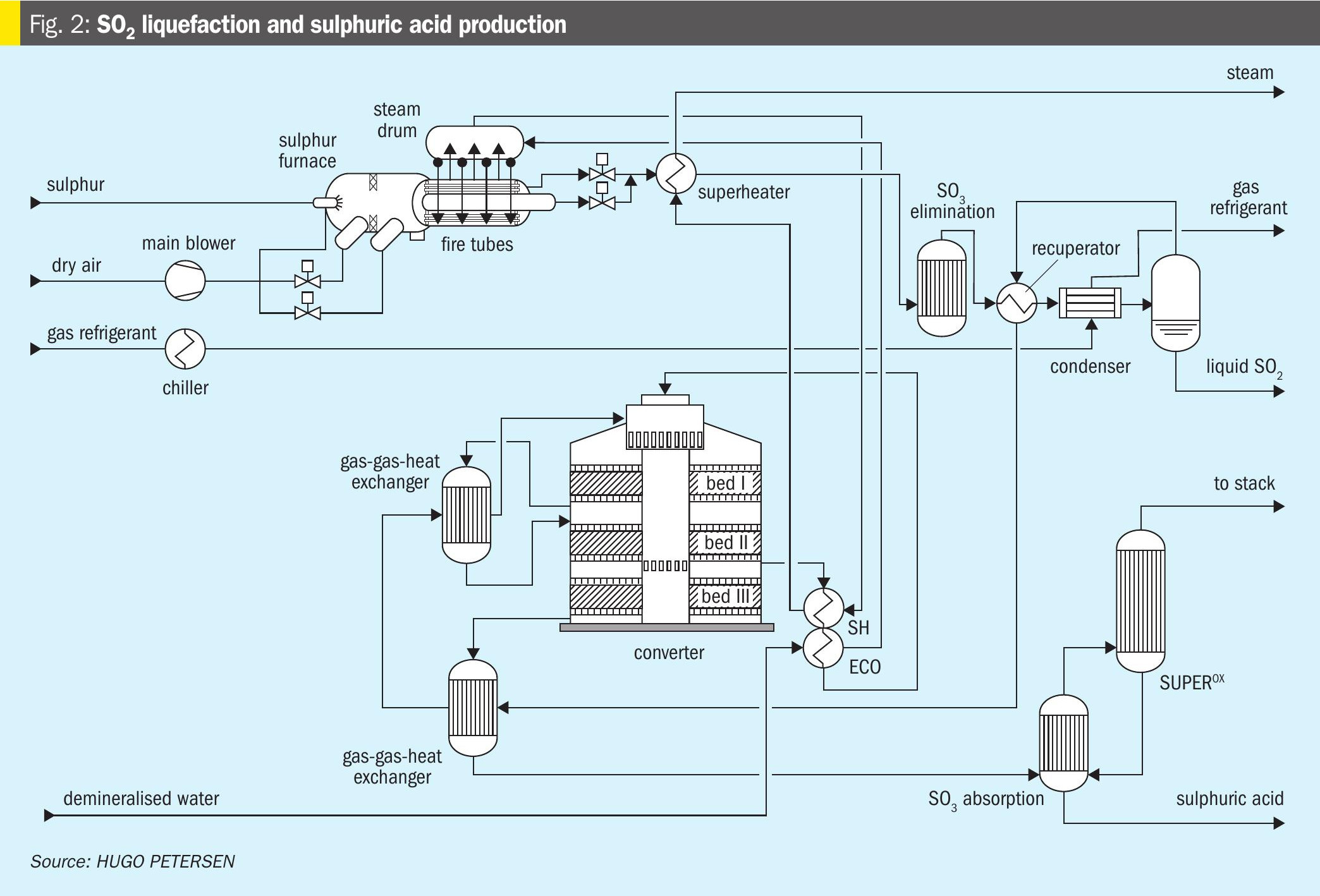
Ambient air first passes through a drying tower upstream of the main blower (see Fig. 2). The dried air is subsequently supplied to the HP-OXY Reactor, where high-temperature sulphur combustion takes place with low NOx formation.
Combustion of liquid sulphur produces a process gas containing approximately 17.5 vol-% SO2 at around 1,450°C. Directly downstream of the reactor, the gas passes through a waste-heat boiler and then a combined superheater/economiser, reducing its temperature to approximately 180°C.
An absorption tower removes SO3 formed through auto-oxidation during sulphur combustion, as SO3 is undesirable in the condensed SO3 product. The gas is then cooled in a recuperator before entering a chilling stage, where its temperature is reduced to below −55°C. This condenses part of the SO3, which is recovered as liquid product and pumped to storage.
The remaining gas is reheated in the recuperator, with additional heat supplied from the first and third catalyst beds. This raises the gas temperature to 420°C or higher before conversion. Dry air is injected upstream of the converter to enrich the gas with oxygen.
The gas then passes through three catalyst beds. Heat generated in the first and third beds is recovered through the gas-to-gas heat-exchange system, while an additional superheater cools the gas before it enters the third catalyst bed. The SO2 conversion rate is typically in the range of 96% to 98%.
Finally, the gas enters the SO3 absorption tower, where sulphuric acid is produced. Remaining SO2 is treated in HUGO PETERSEN’s SUPEROX process, in which SO2 reacts with H2O2 to form sulphuric acid. Resulting emissions are below 50 mg/Nm³.
Despite furnace temperatures of approximately 1,450°C, NOx formation was minimised through use of the HUGO PETERSEN OXY Reactor. The project was commissioned in 2022, demonstrating the combined energy efficiency and low-emission potential of HUGO PETERSEN’s technology.
Case study 2: Sulphuric acid plant with more than 97% heat recovery
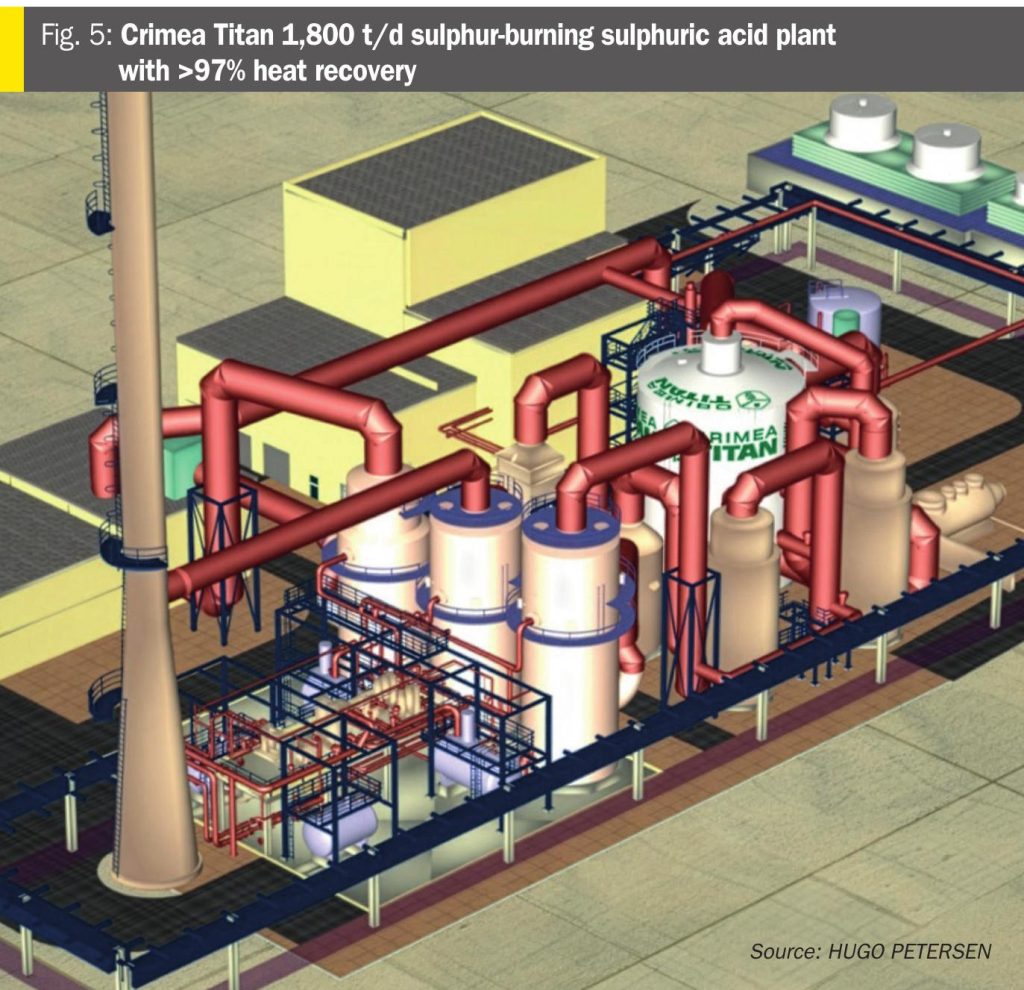
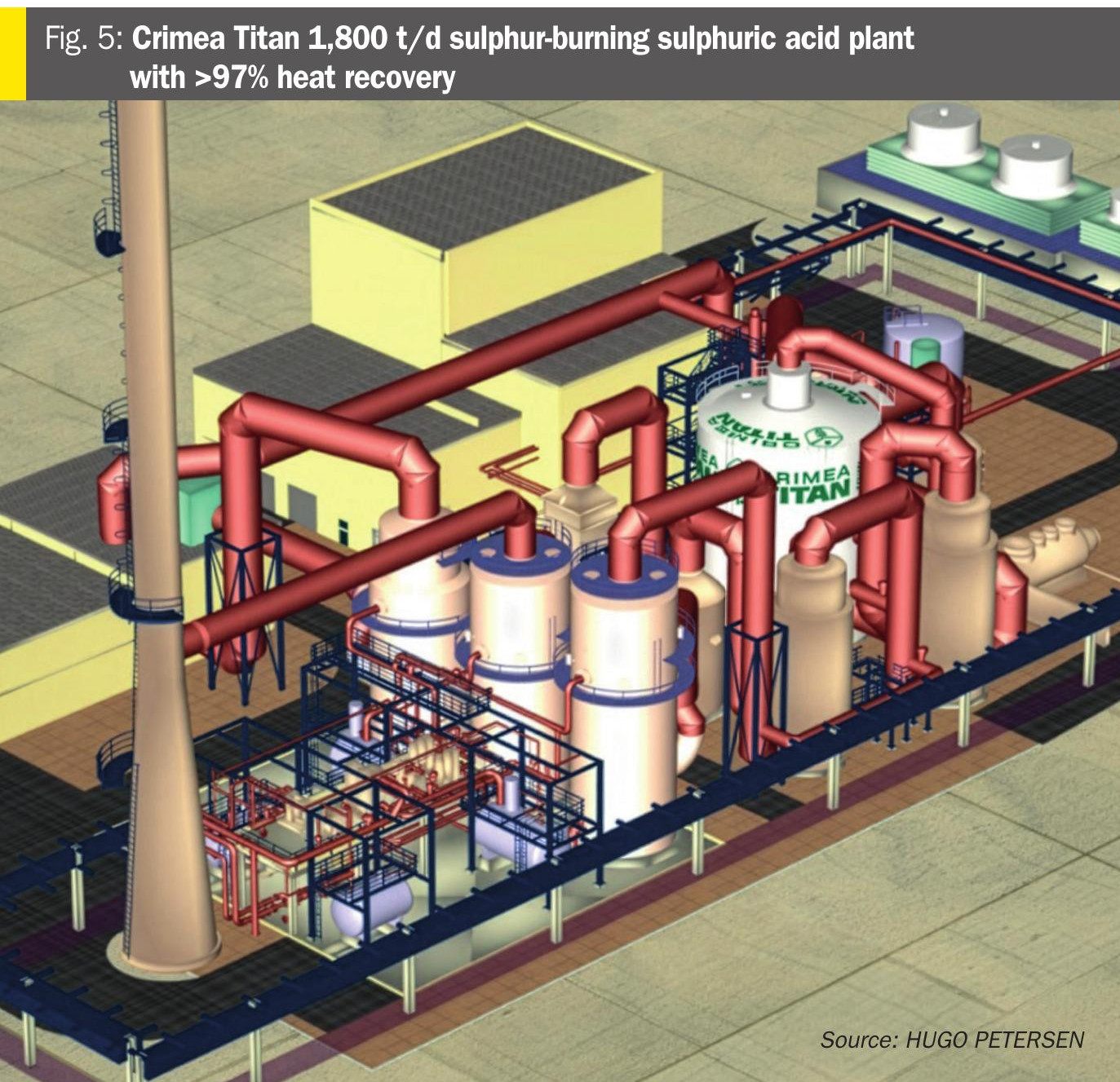
A further HUGO PETERSEN project involved the installation of a 1,800 t/d sulphur-burning sulphuric acid plant for Crimea Titan. The plant was designed to achieve more than 97% heat recovery and utilisation while supplying the full sulphuric acid demand of a three-line titanium dioxide plant.
The client required an integrated utility solution, including:
- high-, medium- and low-pressure steam supply to the plant network;
- multiple process hot-water streams;
- back-pressure and condensing steam turbines; and
- high-pressure steam generation optimised for the site’s energy requirements.
The key design parameters were:
- Acid production: 1,800 t/d, based on 100% H2SO4
- Steam conditions: 440°C at 40 barg
- Measures to maximise steam generation
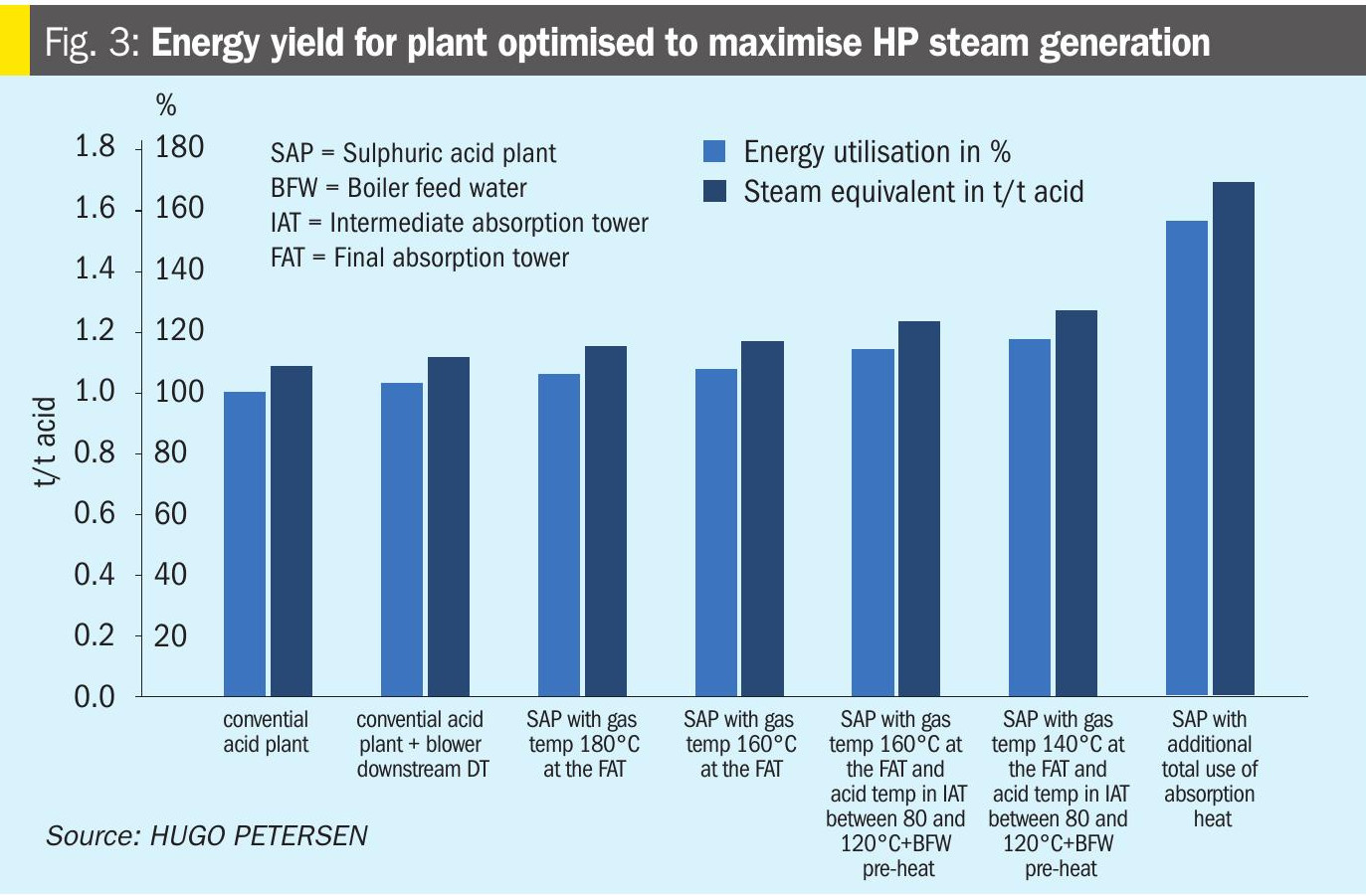
The plant design incorporated several measures to increase steam generation and improve energy recovery:
- positioning the main blower downstream of the drying tower to recover compression heat;
- operating the drying tower with 98% acid to support effective drying;
- maintaining an inlet temperature of 140°C at the intermediate absorption tower/final absorption tower system, reducing energy transferred to the acid;
- reducing the intermediate absorption tower outlet temperature to 80°C;
- preheating boiler feedwater from 120°C using absorption heat; and
- recovering heat from the drying and absorption sections for boiler-feedwater preheating, injection coolers and technical hot-water supply.
The resulting energy yield is shown in Fig. 3.
Energy utilisation
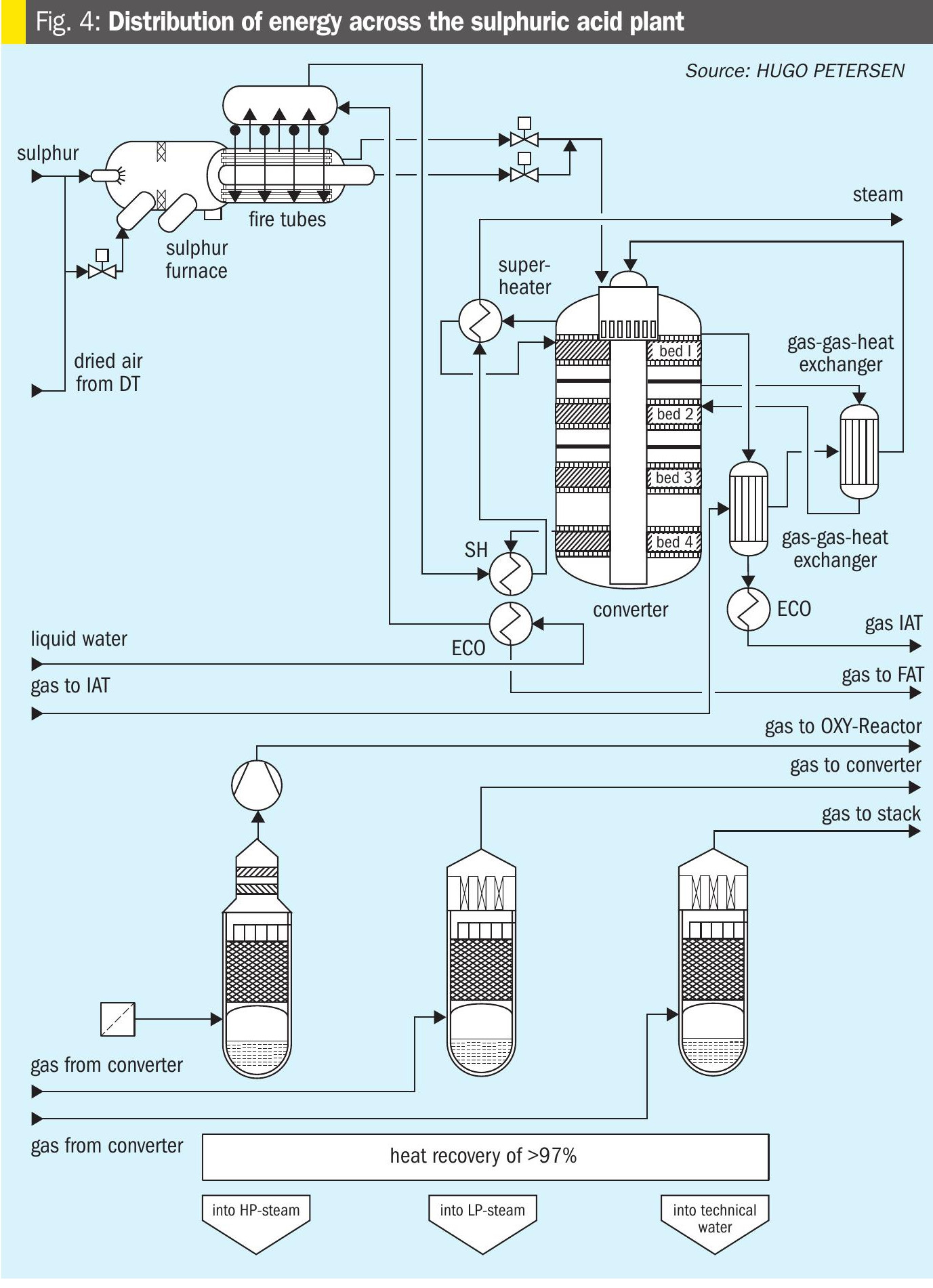
The recovered energy was used across the wider plant network: 22 MWe generated by a condensing turbine;
steam-driven equipment, principally the main blower, powered by back-pressure turbines;
- extraction steam from back-pressure turbines supplied to meet plant-network steam demand;
- low-pressure steam used for sulphur melting; and
- technical hot water supplied to meet wider site demand.
Fig. 4 illustrates the distribution of energy across the process.
The plant (Fig. 5) was commissioned in 2012 and enabled the client to place its central thermal units into emergency idling mode.
The project illustrates how ENERREC can be configured around site-specific energy requirements, integrating sulphuric acid production with steam, power and hot-water demand.