Commodity
23 September 2026
Yara opens Europe’s largest carbon capture project
Written by Simon inglethorpe
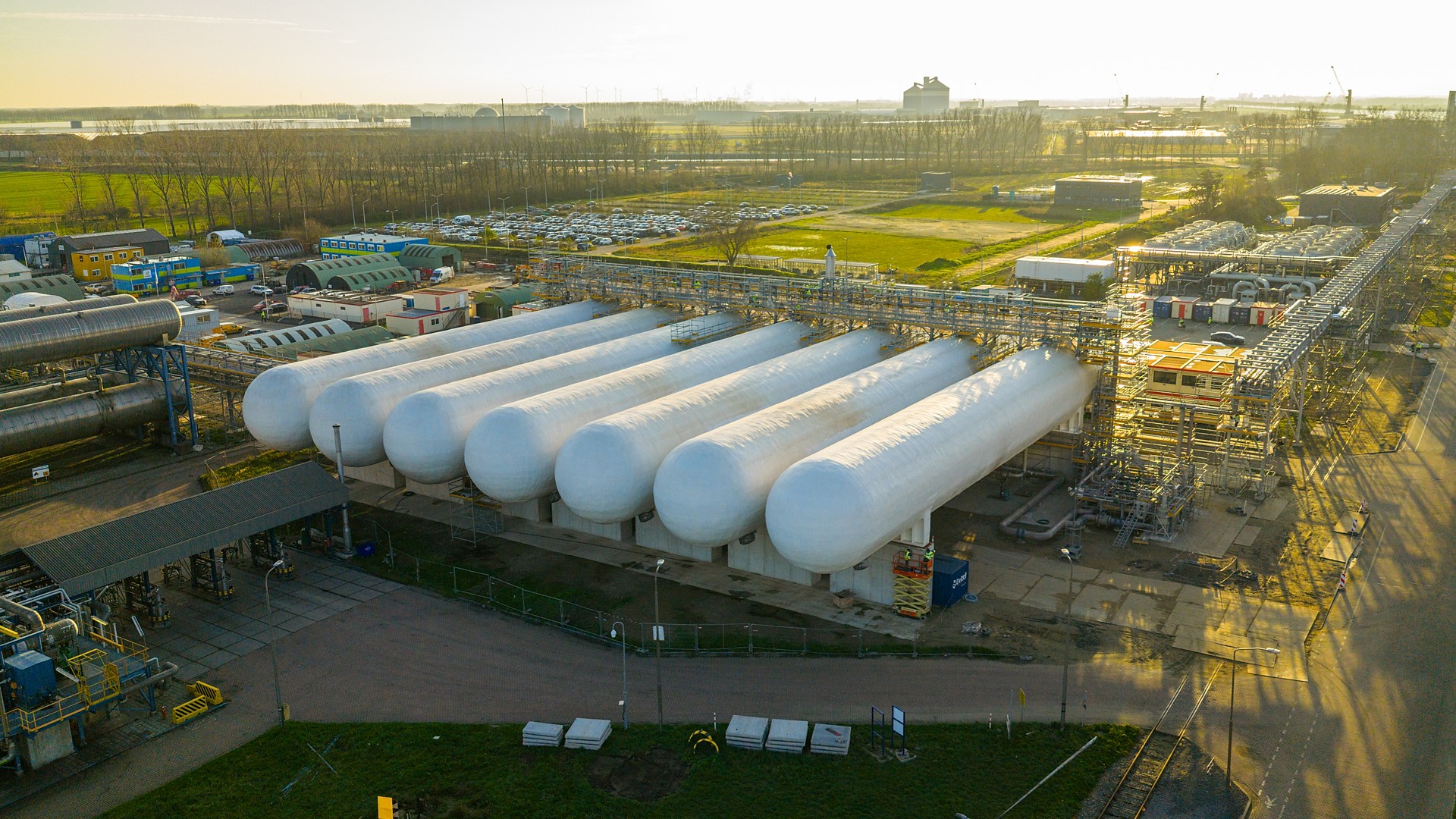
The seven carbon dioxide storage tanks at Yara’s Sluiskil site have a combined storage capacity of 15,000 tonnes. PHOTO: YARA
Yara International began industrial-scale carbon capture and storage (CCS) at its flagship Sluiskil ammonia and fertilizer plant in the Netherlands on 7th September.
The CCS unit at Yara Sluiskil — Europe’s largest ammonia and fertilizer plant — will capture and liquefy up to 800,000 tonnes of CO₂ annually.
This makes Sluiskil Europe’s largest CCS project. It is also the world’s first example of industrial-scale capture of carbon dioxide (CO₂) in one country for cross-border transport and storage in another.
Project partner Northern Lights will ship the liquefied carbon dioxide from the Netherlands to Øygarden on the west coast of Norway, where it will be transferred to onshore storage tanks. The liquefied CO₂ will then be transported offshore via a 120-kilometre pipeline and injected into a saline aquifer 2,600 metres below the seabed for permanent storage.
The CCS project was officially opened in an inauguration ceremony attended by Norwegian prime minister Jonas Gahr Støre and Dutch prime minister Rob Jetten. Svein Tore Holsether, Yara’s president and CEO, and Wopke Hoekstra, the European commissioner for climate, net zero and clean growth, were also present.
“This is an important day for Yara and for European industry. The carbon capture facility in Sluiskil proves that large-scale industrial decarbonization is possible today. As global competition intensifies, Europe must find ways to cut emissions while keeping industry, jobs and critical value chains in Europe. That is exactly what this project is about,” Svein Tore Holsether said.
“Europe needs practical climate solutions that deliver real emissions reductions while strengthening industrial competitiveness. The carbon capture and storage project at Sluiskil shows what is possible when innovation and cross-border cooperation come together. This is exactly the kind of project Europe needs to combine climate ambition with a strong and resilient industrial base,” said Wopke Hoekstra.
“We are proud to start operations together with Yara and to see the agreement signed in 2023 become reality. Together, we are demonstrating that capture and cross-border CO₂ transport and storage is a viable solution for European industry. This is an important step in the development of Europe’s carbon management market and shows what is possible when industry and governments work together to build the infrastructure needed for Europe’s transition,” added Tim Heijn, managing director of project partner Northern Lights.
Yara Sluiskil has been in operation since 1929 and employs more than 700 people. Located on the Ghent-Terneuzen canal, the production complex has an annual product output of 4.5 million tonnes — equivalent to 15% of Yara’s total production volume. The site has reduced its net CO₂ emissions by 63% (3.4 million tonnes CO₂ equivalent per annum) since 1990 while almost doubling its output, according to Yara.
Having made the final investment decision in 2023, Yara now plans to capture and liquefy 12 million tonnes of CO₂ at Sluiskil over the next 15 years at an estimated capex cost of €200 million.
The CCS unit at Sluiskil captures CO₂ from Yara’s world-scale ammonia plant (1.9 million tonnes per annum capacity) using MDEA absorption technology. The CO₂ is then liquefied at up to 125 tonnes per hour and temporarily stored in seven on-site storage tanks with a total capacity of 15,000 tonnes (see photo).
Yara will transfer liquid CO₂ from these storage tanks into ships owned by project partner Northern Lights for onward transport to Norway. These have a CO₂ capacity of 7,200 tonnes each and will operate on a twice-weekly schedule.
Yara’s key equipment suppliers and engineering partners for the Sluiskil CCS project were:
- Linde Engineering — engineering and procurement for CO₂ liquefaction
- Baker Hughes — compressors
- Famet — air cooler banks
- MBG, Ferris, Equans and Fincimec — construction for CO₂ liquefaction
- Geldof — storage tank
- Billfinger — pipe rack
- Wiese — loading arms
Yara says it will use CCS at Sluiskil to produce lower-carbon fertilizers, shipping fuels and ammonia for industrial and energy applications. The lower-carbon Climate Choice fertilizers produced by Yara at Sluiskil using CCS technology will, for example, have a 40% lower carbon footprint compared to conventional fertilizers.