Decarbonisation
4 August 2026
Sustainability in the fertilizer industry: pathways to decarbonisation
Written by Dr MP Sukumaran Nair
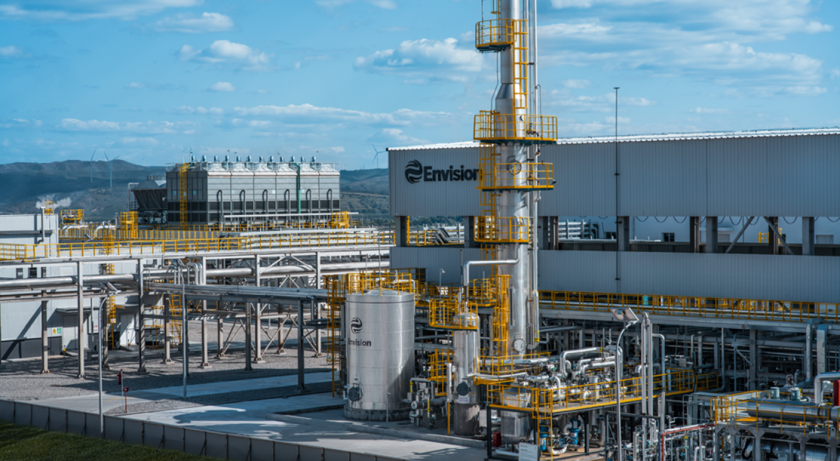
Envision’s wind-powered green ammonia plant, Chifeng City, Mongolia, has been operating since 2024. PHOTO: MARUBENI
Introduction
The fertilizer industry stands at the heart of global food security, supporting agricultural production that feeds nearly eight billion people. At the same time, it is among the most energy-intensive industrial sectors and a significant contributor to greenhouse gas emissions. Modern agriculture is itself a major emitter of carbon dioxide (CO₂), with the manufacture of fertilizers — particularly ammonia — being one of the principal sources.
The challenge before the industry today is unique. While fertilizers are indispensable for ensuring food security, their production must progressively move towards sustainability and ultimately achieve net-zero carbon emissions. Encouragingly, enormous technological progress has already been made, and a number of revolutionary pathways are now emerging.
The production and use of fertilizers, particularly nitrogen-based ones derived from ammonia, account for a significant share of agricultural emissions — roughly 1-2% of global CO₂ equivalent emissions from production alone, with broader lifecycle impacts much higher when including application. Ammonia (NH₃), the basic building block for most nitrogen fertilizers, is especially emissions-intensive.
Although the ammonia molecule itself contains only nitrogen and hydrogen and has no direct carbon content, its industrial synthesis via the Haber-Bosch process relies heavily on fossil feedstocks and energy. The bulk of CO₂ emissions stem from the use of fossil fuels (natural gas, petroleum fractions, or coal) as both feedstock for hydrogen production and as fuel for the energy-intensive process of separating N₂ from air and producing H₂ from water or hydrocarbons. This makes CO₂ an unavoidable byproduct under conventional methods, directly contributing to global warming.
Emissions profile and production landscape
Global ammonia production currently stands at around 180-185 million tonnes (Mt) annually, with approximately 70% used for fertilizers and the remainder for industrial chemicals. Projections indicate growth to about 290 Mt by 2030 and more than 600 Mt by 2050, driven by agricultural demand as well as emerging uses in energy, maritime shipping, and hydrogen transport.
The entire fertilizer sector emits approximately 2.1 billion tonnes of CO₂ equivalent per year, with ammonia production alone contributing around 450 Mt CO₂ annually (direct emissions). Emissions intensity for ammonia averages 1.8-2.9 t CO₂ per tonne, depending on the feedstock (lower for efficient natural gas-based plants, higher for coal).
For phosphate and potash fertilizers, emissions primarily arise from energy use in mining, processing, handling, and storage, often powered by thermal or grid electricity. Phosphate rock processing can emit around 4.5 t CO₂ per tonne of phosphate, while potash mining emits about 0.6 t CO₂ per tonne. Operational efficiencies at advanced plants have reduced emissions to 0.05-0.1 t CO₂ per tonne for downstream products like diammonium phosphate (DAP).
Major fertilizer production centres include the US Gulf Coast, Middle East, EU, Russia, India, China, and Southeast Asia. Governments in these regions have committed to Nationally Determined Contributions (NDCs) under the Paris Agreement, with various action plans underway to curb emissions while maintaining food security.
Technological landscape and efficiency gains
Steam Methane Reforming (SMR) dominates ammonia production, with partial oxidation (POx) and other routes holding smaller shares. Over the past two decades, remarkable advances have occurred in engineering and process technology:
- Significant increase in plant capacities and economies of scale
- Improved equipment reliability
- Major gains in energy efficiency
- Auto Thermal Reforming (ATR) integrating SMR and POx
- Better utilisation of secondary reformer heat to preheat the primary reformer
- Adiabatic pre-reforming to reduce primary reformer duty
- High-performance catalysts with improved activity and longer life
- Advanced active amine systems for CO₂ removal
- Improved methanation, LNG wash and suction chilling to minimize inert gases in the ammonia synthesis loop
- Replacement of conventional magnetite catalysts with ruthenium-containing catalysts, resulting in higher conversion efficiency, increased ammonia yield, reduced circulator loads and lower operating pressures.
These improvements have substantially reduced the carbon intensity of ammonia manufacture.
Modern world-scale ammonia plants now emit approximately 670 kg CO₂ per tonne of ammonia, compared with much higher emissions in earlier decades. Industry projections suggest this can be reduced further to around 470 kg CO₂ per tonne by 2030.
Despite these gains, the industry remains capital-, energy-, and emission-intensive. The Haber-Bosch process itself contributes significantly, with conventional routes emitting ~2.4-2.5 kg CO₂ per kg ammonia.
Pathways to zero-carbon fertilizers
The industry is pursuing multiple options to avoid fossil feedstocks and fuels:
- Carbon Capture and Storage (CCS): ‘Blue ammonia’ captures CO₂ from SMR/ATR processes for geological storage. Many global operators are planning or developing CCS projects; it is seen as essential for near-term deep reductions, though storage costs range from 70-250 Euros per ton of CO₂.
- Green Hydrogen via Water Electrolysis: Powered by renewables, this produces ‘green ammonia’ with near-zero emissions. It is the ultimate long-term solution but currently expensive (green H₂ ~USD 10/kg vs. ~1.5/kg traditional).
- Methane Pyrolysis (Turquoise Hydrogen): Splits CH₄ into H₂ and solid carbon using renewable/solar thermal energy. Routes include plasma (high-temp ~2000°C), catalytic (~900°C), and thermal (~1200°C).
- Electrification of ammonia making: Other innovations in advancing ammonia technology include chemical looping ammonia production (CLAP), electrification of plants (e.g., electric heaters, battery storage for renewables), hydropower, and nuclear options including thorium-fueled small modular reactors or power from nuclear grids.
Urea
Decarbonising modern urea plants relies on reducing steam and energy consumption through advanced stripping processes, improved recycle loops and high-efficiency fluid bed granulation. Specific features include:
- Medium-high pressure (MHP) stripping to recover heat and reduce low-pressure steam demands.
- Improved heat recovery by enabling the high-pressure strippers and condensers to recycle unreacted ammonia and carbon dioxide without extra energy.
- Avoiding complex high-pressure loops to minimise equipment size and power needs.
- Reusing process vapors to pre-heat feeds and concentrate solutions, lower overall utility loads.
- Adoption of proprietary technologies like UFT fluid bed technology to ensure top product quality with near-zero wastewater and minimal dust.
- Building massive single-train granulation units that match high-capacity synthesis loops keep operating costs low.
These developments have improved energy efficiency while reducing emissions.
Progress in the phosphate and potash industries
The phosphate and potash sectors are advancing through efficient mining, process controls, gypsum utilisation, and CO₂-fixing processes like the Merseburg method. Improvements in urea (stripping, recycling, granulation), sulphuric/phosphoric acid production, and advanced mine operations have also lowered footprints. Significant advances have also been achieved in downstream fertilizer production.
Sulphuric acid
Modern sulphuric acid production has transitioned from a basic chemical conversion process into a highly integrated product and power source. A combination of efficient combustion systems, improved waste heat recovery, high-performance plate coolers and better process integration have achieved sulphur conversion efficiencies of more than 99.7%, while exporting massive amounts of clean electricity and steam.
On the combustion side, the use of sulphur burners with micro-atomisation nozzles, pre-dried process air, high insulation refractory-lined combustion chambers and the precise control of the air-to-sulphur ratio have optimised combustion efficiency. Better heat recovery is achieved through optimising high pressure (HP) steam generation, use of proprietary low-level heat recovery systems, cogeneration and export of surplus steam. Modern plate heat exchangers used for cooling concentrated sulphuric acid (98%+) are capable of balancing extreme chemical resistance with high thermal efficiency. Modern plants use advanced DCDA configurations with integrated process equipment, caesium-doped vanadium pentoxide catalysts and digital tools, linking together individual process steps into a seamless, zero discharge, low-emissions loop.
Phosphoric acid and phosphate fertilizers
Modern phosphoric acid and phosphate fertilizer (DAP/MAP) plants rely heavily on advanced chemical engineering principles to maximise efficiency, reduce energy footprints, and guarantee strict nutrient ratios. In phosphoric acid plants, multi-stage digestion via a series of 4–5 continuous mixing tanks, with optimised baffling, allows fine-tuned control of sulphate levels, prevents the blinding of rock particles and ensures conversion rates of up to 98%. Adoption of pipe cross reactors (PCRs) or tubular reactor technology has largely replaced or augmented traditional, bulky tank pre-neutralisers in granulated fertilizer lines. Maximising fluid dynamics inside both the attack tanks (for acid production) and pipe reactors is achieved to prevent scaling, clogging, and uneven reactions. Strict control of the nitrogen-to-phosphorus (N:P) molar ratio is achieved during granulation through advanced process loops, and is necessary due to the steep changes in chemical solubility and slurry viscosity.
The mining, crushing, milling and concentration of phosphate rock emits approximately 4.5 tonnes of CO₂ per tonne of phosphate concentrate produced, while DAP manufacture contributes just 0.05–0.10 tonne CO₂ per tonne of DAP owing to process improvements. Better utilisation of phosphogypsum has also become an important sustainability initiative. Technologies such as the Merseburg process offer opportunities for fixing recovered CO₂ using ammonia.
Potash
The mining, crushing, milling and concentration of potash emits approximately 0.6 tonne CO₂ per tonne of potash produced. Advanced mining control systems and automation are steadily improving energy efficiency.
Carbon emissions in phosphate and potash production
In contrast to ammonia production, emissions in the phosphate and potash industries arise primarily from:
- Thermal power consumption
- Mining operations
- Mineral processing
- Material handling
- Storage and transportation.
Electrification using renewable electricity offers major opportunities for reducing phosphate and potash emissions further.
Key studies and industry targets
Several landmark reports are helping guide the fertilizer industry’s decarbonisation efforts:
- WEF net zero industry tracker (2023 and updates): Tracks progress toward ammonia net-zero by 2050, emphasizing decarbonised H₂ production and demand from new sectors.
- Fertilizer Europe roadmap: Outlines pathways for European climate-neutral production by 2050, with transitional blue and green routes.
- IEA Fertilizers – Breakthrough Agenda Report 2025: Highlights the need for ~70% emissions cuts, provides a cost breakdown (CCS ~30% more, electrolysis 3x) and collaboration needs.
- IFA Reports on Fertilizer Industry and Climate Change: Stresses production efficiencies, use-phase reductions (e.g., better nutrient management to cut N₂O), and overall commitment to Paris goals.
The industry has set well-defined targets for emission reductions, with significant efficiency gains already realized (e.g., 49% reduction in Scope 1 intensity in Europe from 2005-2020 in some metrics).
Investment and Challenges
WEF estimates that a ~USD 1 trillion total investment is needed to decarbonise the ammonia industry, with current projects requiring around USD 36 billion (noting higher actual costs). Electrolysis and CCS are major components. Green ammonia remains costlier, but policy support, carbon pricing, and demand from shipping/power are accelerating projects.
Decarbonisation challenges include high upfront costs, renewable energy scale-up, infrastructure for CCS/hydrogen, and ensuring food security without price spikes. However, low-emission ammonia projects are scaling, with committed capacities growing.
Outlook
The fertilizer industry is at a pivotal juncture. While conventional production dominates, efficiency improvements, CCS, and emerging green/turquoise routes are charting a path to net-zero. Continued innovation, policy support, international collaboration (as emphasised in IEA Breakthrough reports), and the adoption of precision farming techniques will be key to feeding a growing population sustainably. By integrating these technologies and best practices, the sector can significantly reduce its climate impacts while supporting global food security.
This transition demands urgent action but offers substantial opportunities for a more resilient, lower-carbon agricultural future.
About the author
Dr MP Sukumaran Nair is the Director of the Centre for Green Technology & Management (CGTM) in Kochi, Kerala, India. He is a sustainability and chemical engineering expert with over 40 years of experience in government and industry, and a former chairman of Kerala’s Public Sector Restructuring and Internal Audit Board (RIAB).