Africa

15 April 2026
Squeezed margins, sulphur risk and a capital drought
Written by Natalie Noor-Drugan
After a first day focused on the exhibition and technical showcases, the main conference programme at the CRU Phosphates+Potash Expoconference opened in Paris with a clear warning. Margins are under pressure, sulphur has become a strategic constraint, and the phosphates investment pipeline is thin. Simon Inglethorpe, editor of CRU’s Fertilizer International, welcomed delegates and stressed that this is now the only truly global annual meeting point for both phosphates and potash, and that the industry should expect some uncomfortable messages.
Plenary: China’s paradox and the Hormuz shock
CRU Principal Consultant Humphrey Knight opened with the big picture. He first examined the fallout from the closure of the Strait of Hormuz, noting that fertilizers have been hit harder than most bulk commodities. A large share of exportable sulphur and traded urea normally originates in, or passes through, Gulf producers. The effective closure of the strait has squeezed the traded part of these markets, where international prices are set, and pushed benchmarks up sharply.
Knight then turned to China. He set out a paradox at the heart of the phosphate market. Chinese DAP/MAP output is at record levels, above 30 million tonnes a year, yet domestic stripping margins have “completely collapsed”. Domestic DAP prices are regulated and now sit below the implied cost of sulphur, leaving many Chinese producers selling at a loss once imported sulphur and other inputs are factored in.
Beijing’s policy answer has been to tighten exports. In March 2022 China shipped close to 1 million tonnes of DAP/MAP; by March 2025 this had fallen to around 13,000 tonnes. Exports are suspended at least until August 2026. Controls have also been extended to lower grade products such as SSP and NPS which previously supplied buyers in Central and South America and South East Asia. Knight stressed that this is not a capacity issue – China could export more if it chose – but a deliberate policy choice that leaves the rest of the world with far less flexibility to absorb further shocks.
His conclusion was simple: the global phosphate market is structurally tight, and the combination of Chinese export policy and Middle East logistics has pushed the traded segment into a much more fragile state.
Industry panel: trade, food and raw materials
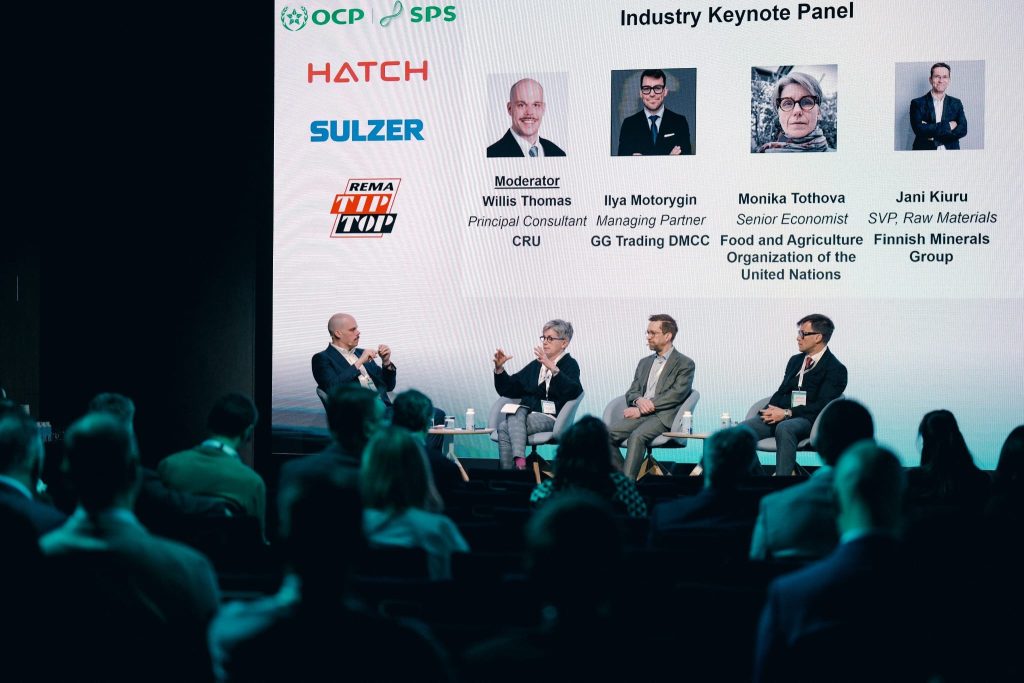
The plenary flowed straight into an industry keynote panel chaired by CRU Principal Consultant Willis Thomas. On stage were Ilya Motorygin, Managing Partner at GG Trading DMCC; Monika Tothova, Senior Economist at the FAO; and Jari Kiuru, SVP Raw Materials at Finnish Minerals Group. Between them they joined the dots from price curves to food security and raw material strategy.
Motorygin set out the trader’s view of the Hormuz shock. In farm affordability terms, he argued, the current episode feels worse than the 2022 Russia–Ukraine crisis. Then, crop prices rose broadly in line with fertilizers, giving growers more revenue to absorb higher costs. Now, fertilizer prices have moved faster than most crop benchmarks, so the affordability squeeze is more severe.
Traders holding pre conflict stocks have been able to sell below replacement cost, softening the initial blow, but this cannot last. Higher sulphur prices, higher freight rates and higher insurance premia must eventually be passed down the chain. Motorygin also highlighted a sharp rise in freight from the Baltic to Brazil – roughly doubling compared with a year ago – as vessels are redeployed away from the Gulf. That alone adds a large increase to delivered costs for Brazilian buyers before the DAP price is even considered. With Saudi tonnes constrained, exporters such as Morocco and Russia enjoy a relative freight advantage, but the overall effect is tighter and more expensive supply.
Tothova then looked at the downstream crop picture. So far, wheat prices have been relatively muted. The timing explains why: most of the current wheat crop in major exporters is already planted, and the first fertiliser applications are made, so nearby prices do not fully reflect the recent shocks. Markets for maize and vegetable oils, which have stronger links to biofuel demand, have reacted more strongly.
She expects more visible impacts as the Northern Hemisphere spring progresses and farmers adjust cropping decisions. In North America, for example, some area may shift from maize into soybeans because of different fertiliser requirements. She emphasised that resilience is highly uneven. Large commercial farms and cooperatives in the US, EU and Brazil can forward buy, carry stocks and use hedging tools. Smallholders in lower income regions typically buy fertiliser only when cash or subsidy allows. They cannot build strategic stocks or manage price risk, even though fertiliser is often their key lever to raise yields and incomes.
On self sufficiency, Tothova warned that chasing national food or fertiliser autarky can be both costly and environmentally damaging. Past attempts to achieve cereal self sufficiency in water scarce regions have led to serious aquifer depletion and had to be reversed. For both food and fertilizers, she argued, predictable, rules based trade remains essential, even if recent shocks and export controls have badly dented confidence.
Kiuru linked the short term shocks back to long term raw materials policy, especially in Europe. Phosphate rock and phosphorus now appear on EU critical raw material lists, but not in the smaller “strategic” category that brings accelerated permitting and dedicated financing tools. That leaves many potential European phosphate and multi metal projects commercially marginal next to imports produced under looser environmental and social standards.
Developers are responding by bundling phosphate with rare earths or other strategic metals in multi commodity mine plans in order to qualify for support that would not be available to a pure fertiliser project. Recycling of phosphorus from sewage and industrial waste streams can add resilience around existing industrial hubs, he noted, but costs and technology gaps mean primary supply will remain essential.
The panel’s shared conclusion was that the industry is shifting from “just in time” to “just in case”. Producers, traders and some larger farms are starting to hold more inventory of both finished fertilisers and key inputs such as sulphur. That brings higher working capital and storage costs throughout the chain. Resilience, they agreed, is necessary – but it will not be free.
Sulphur: tight but not “gone”
In the commercial stream, CRU sulphur and sulphuric acid analyst Viviana Alvarado drilled into the feedstock that now sits at the centre of the squeeze. Her keynote posed a simple but provocative question: is the world running out of sulphur?
Her answer was that the world is not short of sulphur geologically, but that the market has moved into a structurally tighter operating range. A decade of stricter environmental regulation on refineries, slower oil demand growth and limited new desulphurisation investments has flattened sulphur supply growth. At the same time, demand from fertilisers and metals has risen steadily.
Sulphur prices had already been climbing for more than a year before the latest Middle East escalation. In some regions, benchmarks have effectively doubled from their post 2022 lows, reaching record or near record levels. The closure of the Strait of Hormuz removed a large share of Gulf sulphur exports from the seaborne market, where price discovery takes place, pushing prices higher again.
Alvarado emphasised that a disproportionate share of “price setting” sulphur flows is Gulf linked. When those tonnes are disrupted, the impact on global benchmarks and on phosphate stripping margins is immediate. Today, sulphur can make up a larger share of DAP/MAP cash costs than at almost any point in the last two decades, particularly for net importers in Asia and Latin America.
Her conclusion was clear. Sulphur has become a bottleneck for phosphate growth. Projects based on plentiful, cheap sulphur now face much higher risk than they did a few years ago. Without a structural change in refinery behaviour or a technological step change, sulphur is likely to remain a major source of price volatility and margin pressure for fertiliser producers.
Cost and capital: Mosaic and Roc
The cost picture at producer level was laid out by Andy Jung, Vice President of Market and Strategic Analysis at The Mosaic Company. Jung showed that Mosaic’s 2025 phosphate revenues reached $4,577 million, with adjusted EBITDA of $917 million. Operating earnings, however, were just $135 million – a vivid demonstration of how higher sulphur, ammonia, energy and freight costs have eaten into profitability.
By the fourth quarter of 2025, Mosaic had brought its cash conversion cost down to $112 per tonne, a 16% improvement from the peak earlier in the year. Yet that progress has been undermined by the escalation of the Iran conflict and a fresh surge in feedstock prices. Jung contrasted January 2021 and April 2026 prices: DAP at NOLA has roughly doubled, but ammonia and sulphur have risen several fold over the same period.
The result is benchmark stripping margins near five year lows. Jung reported that US offshore phosphate imports are already sharply lower year on year in early 2026. On the demand side, there are some positives – including strong growth in soybean use and an expanding soybean area in Brazil – but global phosphate shipments remain below pre 2022 trend levels. His closing view was that “price volatility and uncertainty could be the new ‘normal’” for the sector.
On the investment side, Roc Global Director of Analysis Ryan Chou described what he called a structural “phosphate financing gap”. Despite high prices, exploration has collapsed from several hundred drill holes a year at the last cycle’s peak to only a small fraction of that today. At the same time, the average lead time from discovery to first production has stretched from roughly six and a half years in the 1990s to close to eighteen years in the last few years, reflecting tougher permitting, community scrutiny and more cautious capital allocation.
Chou warned that, unless the investment model changes, the sector risks repeating the rare earths experience: underinvestment in new supply outside a few countries, and a gradual concentration of market power in the hands of those willing to invest under looser conditions. Africa already accounts for more than half of global phosphate exports, he noted, and most of that volume moves through the Suez Canal and the Strait of Hormuz – both in or near active conflict zones.
He suggested that partnership models in which large diversified miners back early stage explorers with modest grants and options could give majors low cost exposure to future phosphate supply while helping to restart exploration and project development.
New pathways: decarbonisation and technology
Afternoon sessions turned to decarbonisation and new technology. An EBRD‑commissioned Low‑Carbon Roadmap for the Global Phosphate and Potash Fertilizer Industry was presented by Stephen Bell of the International Fertilizer Association and Daniel Saxton of ERM, a global sustainability and environmental consultancy. Nitrous oxide from fertiliser use accounts for a large share of the sector’s value chain emissions, so agronomy, product innovation and on farm practice will be as important as energy efficiency in plants.
On the resource side, John Passalacqua, CEO of First Phosphate Corp., used the Bégin‑Lamarche igneous project in Québec to show how low‑cadmium rock can serve both fertiliser and LFP battery markets via purified phosphoric acid. Timothy Cotton, CEO of Novaphos, then challenged the dominance of the Wet Acid Process, outlining an alternative route that uses low‑grade rock without sulphuric acid and produces no phosphogypsum, cutting both sulphur dependence and environmental liabilities.
Cotton summed up the mood neatly, arguing that the industry needs to change “not just for volume, but for supply security”. From Inglethorpe’s opening remarks to the last slide, that theme ran through the day: a phosphate sector operating under intense margin pressure and facing sulphur and logistics risks on one side, and a capital drought on the other – but also starting to assemble the technologies and business models needed to rebuild resilience.