Sulphur 424 May-Jun 2026
Hormuz closure is business opportunity for Ivanhoe


DEMOCRATIC REPUBLIC OF CONGO

Hormuz closure is business opportunity for Ivanhoe

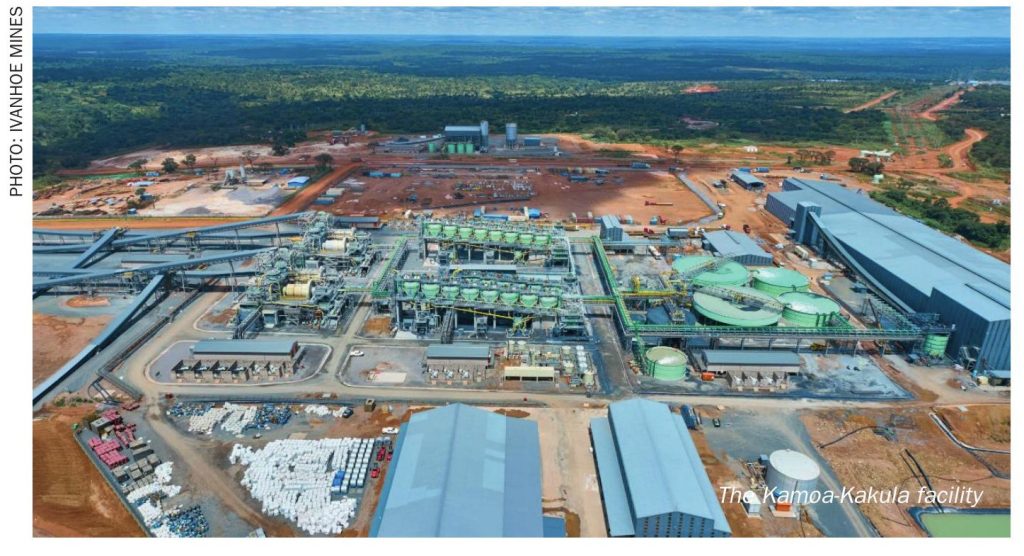
Canada-based Ivanhoe Mines stands to benefit from any sulphuric acid shortage caused by prolonged closure of the Strait of Hormuz now that the company is running a copper smelter, according Co-Chairman Robert Friedland. The 500,000 t/a direct-to-blister smelter at company-operated Kamoa-Kakula mine in the Democratic Republic of Congo produced its first anodes at the turn of the year.

“Kamoa-Kakula is ideally positioned as a producer and seller, and therefore not a consumer, of sulphuric acid … which we sell to oxide copper mining operations in the DRC Copperbelt,” he said. Commenting on a wider impact of the Strait’s closure during war in the Middle East, Friedland said it is likely to have a profound effect on global supply chains. “Therefore, contingency plans have been drawn up across Ivanhoe’s operating sites to sustain their operations, including advanced diesel purchases. Our mine-site managers are prudent, and optimistic that we are well-positioned,” he added.

“If the closure of the Strait of Hormuz continues, we are especially concerned about the availability of precursor materials necessary for the mining industry to continue operating. A second, derivative effect will be on global copper production due to the shortage of the world’s most important industrial chemical, sulphuric acid. Approximately 20% of global copper supply relies on a process that uses sulphuric acid to leach copper from oxide ores. With approximately 50% of the global seaborne sulphur supply cut off, sulphur and sulphuric acid markets are becoming extremely tight.”

Friedland made his comments in Ivanhoe’s Q1 production report. Kamoa-Kakula’s smelter produced 63,671 tonnes of copper anodes and 117,871 tonnes of sulphuric acid during the quarter. The on-site smelter is targeting production of around 850 t/d, equivalent to an annualised rate of 300,000 tonnes of copper, which is 60% of design capacity.

“Further ramp-up of the smelter is constrained by concentrate feed. Management is currently evaluating the purchase and toll treatment of local third-party copper concentrates to further advance the smelter ramp-up and improve margins,” the company said. The mining complex is 39.6% owned by Ivanhoe Mines, 39.6% by the Zijin Mining Group of China, 20% by Gecamines, the DRC’s state-owned mining company, and 0.8% by Crystal River Global.

Latest in Africa

Electrolyser contract signed for green ammonia project

Chinese companies Sungrow Hydrogen and CRRC Zhuzhou say that they have secured electrolyser supply contracts for the first phase of a geothermal-powered hydrogen and ammonia project in Olkaria, Kenya, developed by Chinese firm Kaishan Group. Kaishan signed a steam supply agreement with state utility KenGen in October 2025, under which KenGen will supply steam from existing geothermal wells for Kaishan to generate 165MW of electricity to power the electrolysers. Chinese firm Wuhuan Engineering is serving as engineering, procurement and construction contractor. Works on the site began in November 2025.

MoU for green ammonia hub

Abu Qir Fertilizers & Chemicals, Alexandria Fertilizers, Orascom Construction SAE, and Green Hydrogen Development Holding, a subsidiary of China’s United Energy Group (UEG), have signed a memorandum of understanding (MoU) to explore the development of a Mediterranean green hydrogen hub in Alexandria. The proposed project would centre on a large-scale green hydrogen facility powered by wind and solar, with output integrated into existing ammonia infrastructure in the region. Under the agreement, UEG and Orascom will lead feasibility studies covering 500 MW of renewable energy generation and green hydrogen production, while Abu Qir and Alexfert will assess integration into ammonia operations and support access to local infrastructure.

Green ammonia project advances into FEED phase

Egypt’s $873 million green ammonia project in New Damietta has entered the front-end engineering and design (FEED) phase, with pre-FEED studies for the marine jetty and hydrogen plant already completed, Zawya reported 7 April, citing a statement by the Egyptian Petrochemicals Holding Company (ECHEM). The project is being developed by Damietta Green Ammonia (DGA), a joint venture between Norway’s Scatec, ECHEM and Misr Fertilizers Production Company (MOPCO). FEED work on ammonia export facilities is ongoing, while major permits and financing arrangements are still being finalised.