• Skip to main content

    Nitrogen+Syngas 389 May-Jun 2024

    Price Trends


    Price Trends

    The ammonia market reverted to recent norms at the end of April, with prices more or less unchanged in the east, and several benchmarks west of Suez moving downward in line with May’s Tampa settlement. Following a trio of high-priced c.fr spot deals many wondered whether such business would be replicated in Asia, but the hype did not live up to the expectation, with the majority of tonnes continuing to move on a contract basis into the likes of South Korea and Taiwan, China. The $430/t c.fr concluded into China has been attributed to both supply uncertainty and an uptick in domestic demand, though several inland prices declined this week, rendering price direction difficult.
    In Southeast Asia, it was much of the same story, with exports continuing to move out of Indonesia at a steady rate, though a degree of tightness could begin to kick in Malaysia, where Petronas will commence a 16-day turnaround at its 450,000 t/year Bintulu facility as of 4th May.

    Further west, exports out of the Middle East may suffer further delays after Ma’aden announced that its one-month planned shutdown at its MWSPC II unit would now commence in mid-May, with additional rumours of output woes at Sabic AN, prompted by delays to loadings at Jubail, potentially casting a further shadow over the Eastern hemisphere market. In Turkey, news of a result in Igsas’ latest 8,000-10,000 t purchase tender is awaited, amid talk of sanctioned material offered between $390-430/t c.fr.

    West of Suez, producers in Algeria continue to push for business in the low-$400s/t f.o.b., though potential buyers remain unwilling to bite for the time being. Import demand into NW Europe remains limited on the spot front, with more stable natural-gas prices continuing to reflect more desirable costs of production by comparison to import cargoes.

    In urea markets, with few buyers showing interest, prices are still under pressure. There is little interest in Europe to buy again and producers in Egypt now seem to be faced with looking further afield to place May tonnes. A sale to Turkey was reported to net as low as $280/t f.o.b., but other players in the market think it may achieve $285/t.

    Offers from the Middle East were seen at $280-285/t f.o.b., but when SIUCI tested the market for an early-June cargo out of Oman, the best number it could find was understood to have been $275/t. Indonesia continued selling following its 22 April tender and finally placed about 190,000 t at $305.69/t with Australia taking 90,000 t. A prilled tender closes 3 May to test buyer interest.

    New Orleans had a quiet end to the month. Rain hampered business and weakness in the global market is not encouraging any unnecessary purchases. First-half May dipped to $295/st and full May saw $280/st f.o.b. NOLA trade. Brazil proved to be volatile and gains seen of late seem to have been swept away with trades as low as $290/t c.fr. Some May cargo may secure a higher price for non-sanctioned material but plentiful supply from Venezuela and Iran saw sales for the month at $290/t c.fr and buyers withdraw from offers of non-sanctioned at $310/t c.fr.

    Table 1: Price indications

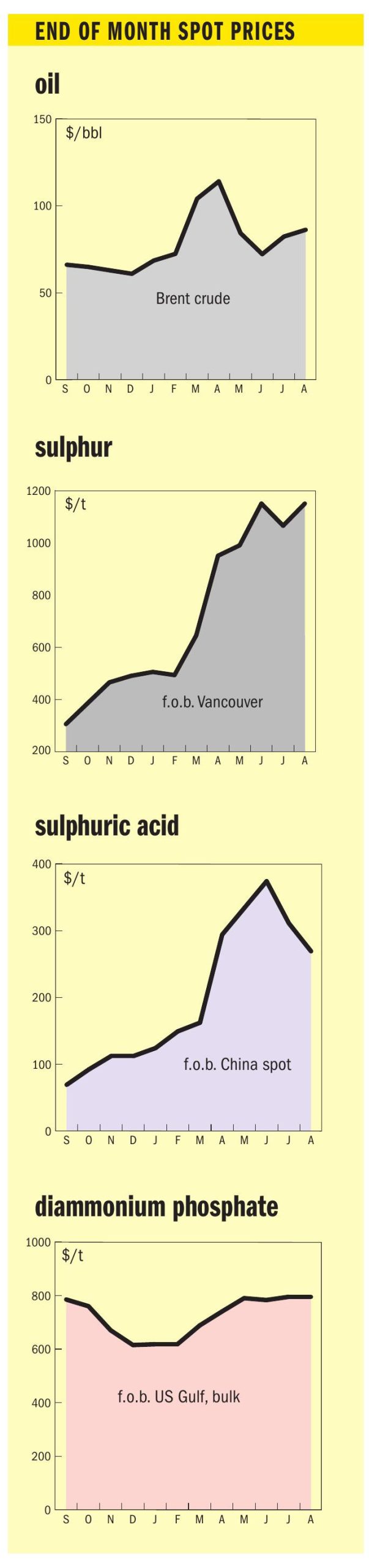
    END OF MONTH SPOT PRICES

    natural gas

    ammonia

    urea

    diammonium phosphate

    Latest in Outlook & Reviews

    Uncharted waters

    The fragile ceasefire between the United States and Iran broke down at the start of July, just three weeks after the signing of the June memorandum of understanding, after Iran fired at several vessels who had failed to notify them of their transit of the Strait of Hormuz, and the US retaliated with a missile barrage. While the two month negotiation period it had specified to solve all of the outstanding issues between the two parties had always seemed over-ambitious, market participants had at least expected to have that grace period to arrange for new cargoes and tranship them through the Strait. Now that the ceasefire has ended early, markets are truly entering uncharted waters.