Nitrogen+Syngas 383 May-Jun 2023

31 May 2023
Black Sea deal in danger
“Reopening the Togliatti-Yuzhnyy ammonia pipeline… has been one of Russia’s key demands”
Last year, in the wake of Russia’s invasion of Ukraine and the associated disruption to fertilizer and grain exports from both countries, there were dire predictions of the impact upon global food supply. That the worst of these predictions have not so far come to pass is in no small part due to the deal brokered by the United Nations and Turkey in July 2022 to allow exports of grain and fertilizers from Black Sea ports. According to the UN, since last July, some 29.5 million tonnes of grain and foodstuffs have been exported from Ukraine via the Black Sea, including nearly 600,000 tonnes in World Food Programme vessels for aid operations in Afghanistan Ethiopia, Kenya, Somalia and Yemen. Before the war, Ukrainian grain fed the equivalent of up to 400 million people worldwide, and the deal ensured that Ukrainian grain exports ‘only’ fell by 5 million t/a over the past year.
Now, however, the deal seems to be unravelling. Russia has stopped approving new vessels in order to put pressure on negotiations ahead of a May 18 deadline. Russia is seeking easier export of its own grain and fertilizer as a condition for allowing the flow from Ukraine to continue. In particular it is seeking the readmittance to the SWIFT international payments system of its state agricultural bank, and the lifting of individual sanctions on persons involved in the trade, such as fertilizer tycoon Dmitri Mazepin. It’s often said that a negotiation with Russia is not a serious one unless one side threatens to walk out, but were that to happen, insuring vessels trading with Ukraine would effectively become impossible and the trade would stop. This comes at the same time that landward export routes via Poland, Hungary and Slovakia have been curtailed by new import restrictions designed to protect local farmers from a collapse in prices caused by a flood of cheap Ukrainian produce, causing much consternation within the EU.
Food price inflation has been an issue worldwide since the war. With fertilizer production disrupted by gas shortages, European food prices have risen by 7-20%, depending on location. But the situation is at its direst in the world’s poorest countries. In Lebanon the figure is 140% according to the World Bank, in Venezuela it is 160%, and in Zimbabwe 285%, in spite of a $30 billion support package by the World Bank and the World Food Programme. Global food stocks remain tight, and the closure of grain exports from Ukraine would revive the fears of a devastating impact upon low and middle income countries.
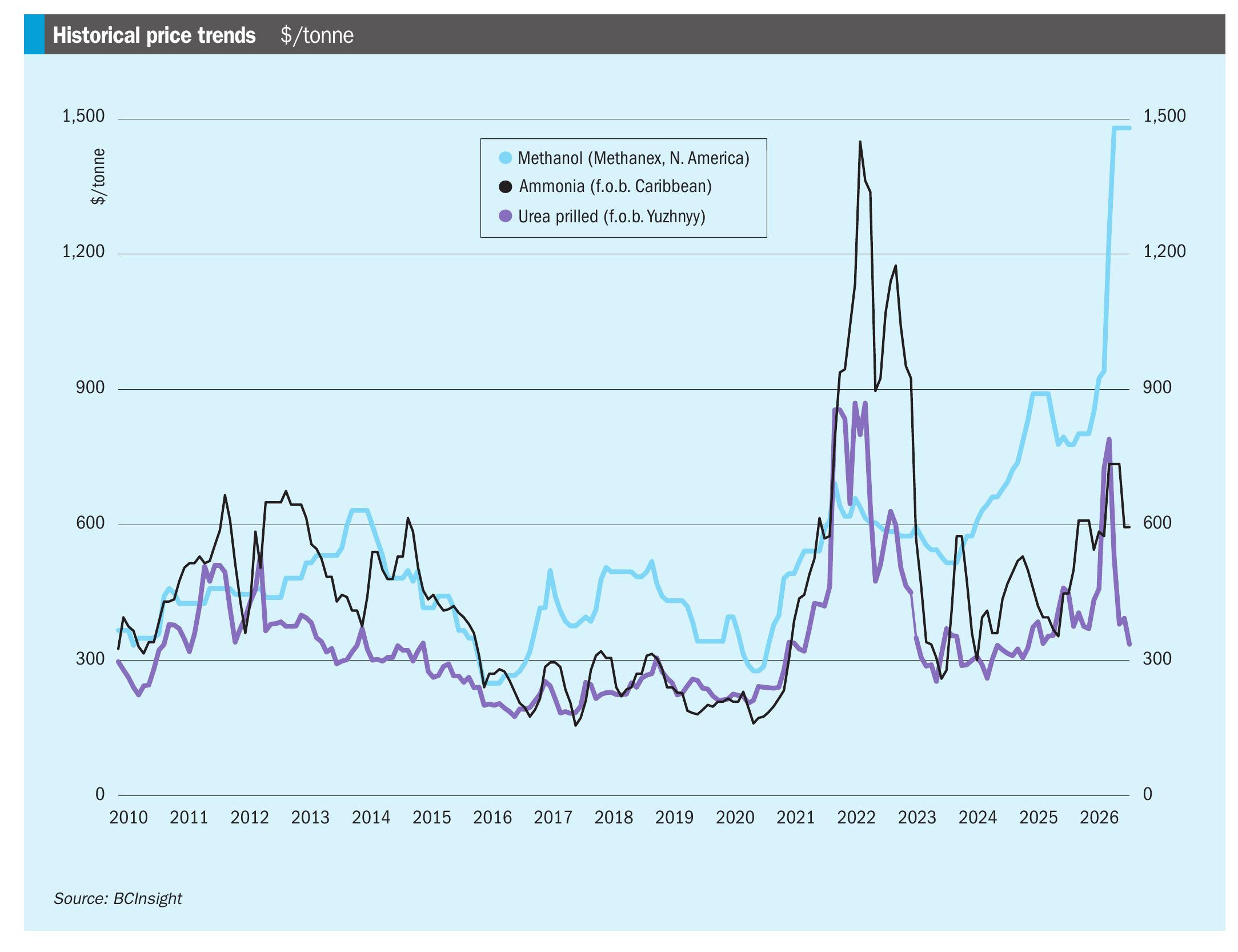
One of Russia’s key concerns in the current negotiations is to ensure continued export of ammonia, and there are plenty of voices in the west arguing that in order to calm food markets, Russia’s exports of fertilizer should be allowed to resume, via Yuzhnyy/Odessa and Riga. The reopening of the Togliatti-Yuzhnyy ammonia pipeline, which used to carry 2.5 million t/a, has been one of Russia’s key demands going into the current Black Sea Grain Initiative talks. But the omens are not good, with Ukrainian and Russian delegates to the Assembly of Black Sea Economic Cooperation actually physically coming to blows last week.
In the meantime, TogliattiAzot has begun work on a new export terminal at the Russian Black Sea port of Taman, on the Kerch Strait by Crimea. It aims to have 2 million t/a of ammonia export capacity up and running by December 2023, increasing to 3.5 million t/a of ammonia and 1.5 million t/a of urea by 2025, though how practical this timeline is remains to be seen. For now, much hinges on the talks to save the Black Sea Grain Initiative, with the stakes for the whole world remaining very high indeed.