• Skip to main content

    Category: Products

    Agreement for renewable fuels production

    Topsoe has entered into an agreement with Texas-based sustainable fuels and chemicals technology company BioVeritas to unlock advantaged feedstocks for existing infrastructure. The agreement will enable fuel producers to license Topsoe’s HydroFlex® technology alongside the Bio-Veritas Process™ to produce renewable fuels from second-generation feedstocks, such as woody biomass, corn stover, wheat straw, and similar waste and residual biomass. The BioVeritas Process™ converts second-generation feedstocks to advantaged intermediates, called KEY-Tones™ that can be processed by Topsoe’s HydroFlex® technology to unlock production of renewable fuels using second-generation feedstock.

    Supply crisis worsens

    It is two months on from our previous issue, and almost none of the news has been good from sulphur and downstream markets. Only three sulphur cargoes are confirmed to have transited the Strait of Hormuz since the US and Israeli strikes on Iran began, all loaded at Ruwais, with destinations in India, Tanzania and Morocco, carrying a total of 160,000 tonnes. It is believed that a couple of Iranian vessels with a total of 75,000 tonnes may also have left covertly. But in spite of some Middle Eastern sulphur making its way to Saudi Red Sea ports or Duqm on Oman’s Indian Ocean coast, around 700,000 tonnes is still trapped on ships stranded in the Gulf, and coupled with production cuts in the region, it is estimated that over 1.2 million tonnes has so far been removed from the market.

    Price Trends

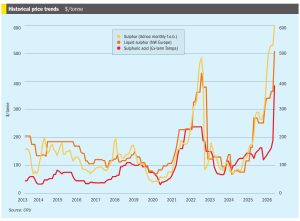
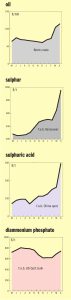
    Sulphur continued to break historic records in most key international markets at the start of May as the scarcity of spot supply propelled prices higher, which triggered production cuts at some downstream markets, and increased costs in other industrial sectors. The effective blockade of the Strait of Hormuz, which halted the flow of Middle East supply, has forced desperate buyers to compete for the limited available spot cargoes, primarily from North America. Although fresh transactions were limited, export and delivered prices climbed higher, and market sentiment remained jittery. QatarEnergy hiked its sulphur price to $740/t f.o.b., a new record high for this contract since its inception in August 2013.