• Skip to main content

    Europe

    Lifosa reportedly halts as Kazakh sulphur cut off

    Written by Natalie Noor-Drugan


    EuroChem has reportedly suspended operations at its Lifosa phosphate fertilizer plant in Kėdainiai, Lithuania, on the back of high raw material sulphur costs, CRU reported on 10 August. The producer has not directly confirmed the shutdown, but according to market sources and reports all product lines are said to be offline

    Lifosa’s problem is understood to be a supply-origin shift, not a supply-volume shortage. Trade data via Global Trade Tracker (GTT) show Lithuania’s sulphur import volume held roughly stable year on year at 142,507 tonnes. What changed is where it came from.
    “Effectively all sulphur imports previously came from Kazakhstan, but export restrictions have meant that no sulphur has moved from Kazakhstan to Lithuania this year, with supply instead coming from Saudi Arabia, the US, Poland, and other origins,” CRU said. “This has likely left Lifosa more exposed to spot price volatility as opposed to the relative stability of sulphur contract prices.”

    Kazakhstan formally suspended all sulphur exports on 27 June 2026 under Order No. 1363, signed by its Ministry of Energy, with an exemption only for shipments to Russian railway stations. That move followed Russia’s own 24 May decision to halt rail transit of Kazakh sulphur through Russian territory to seaports and border checkpoints — the primary logistical route by which Kazakh sulphur from the Tengiz and Kashagan fields reaches European buyers. Russia lifted its rail-transit restriction on 24 July 2026, but Kazakhstan’s export ban remains in force until further notice, blocking Lithuania from returning to its main historical supplier. Russia’s own sulphur export ban, in place since November 2025, has been extended to 31 December 2026.

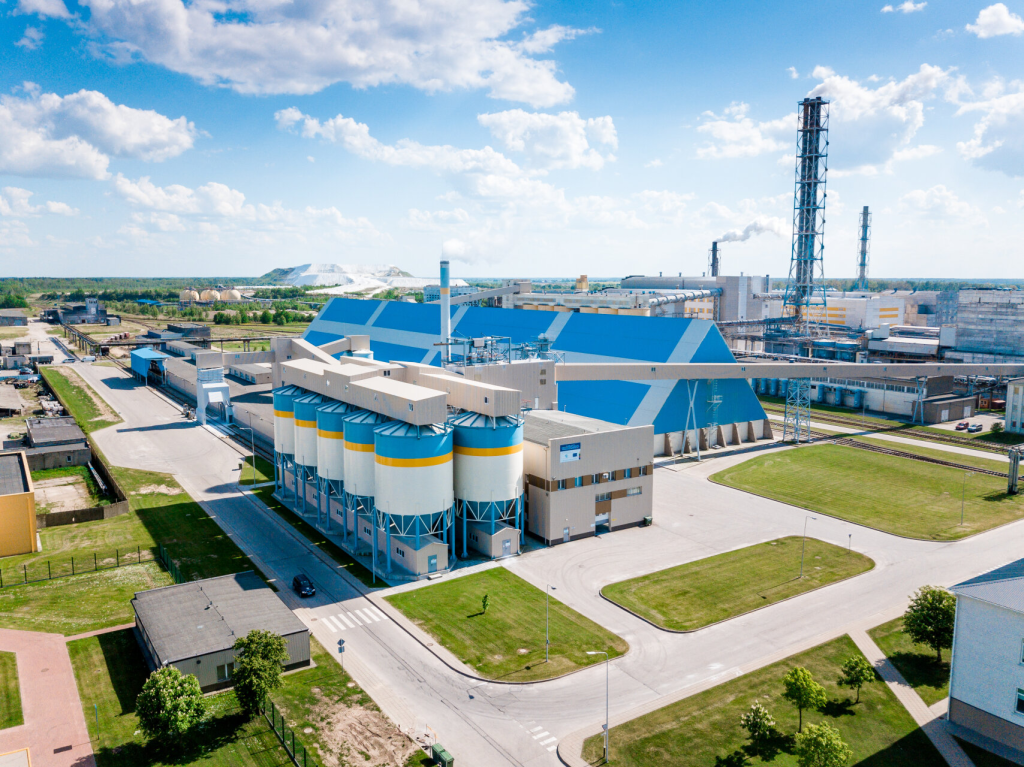
    Lifosa’s Kėdainiai complex, in central Lithuania, is one of the European Union’s largest phosphate fertilizer sites. Annual production capacity, according to CRU data, stands at 989,000 tonnes DAP, 430,000 tonnes NP, 469,000 tonnes P2O5/year of phosphoric acid and 1.35 million tonnes/year of sulphuric acid. The plant also produces around 200,000 tonnes/year of monocalcium phosphate (MCP) feed phosphate and 35,000 tonnes/year of technical MAP (tMAP). EuroChem acquired the plant in 2002.

    If confirmed, the halt would mark another disruption for a producer that has spent most of the post-2022 period offline or running below capacity. Lifosa resumed operations in June 2024 after a hiatus of more than a year, and output reached 440,925 tonnes in 2024 — more than three times its 2023 volume.

    Ownership and operational control at Lifosa remain distinct. Lifosa is 100% owned by Swiss-registered EuroChem Group AG, which is not itself sanctioned in the European Union, the United Kingdom or the United States. Day-to-day operations remain overseen by Lithuanian-appointed temporary administrator UAB Valnetas, headed by Gintaras Adomonis, whose approval is required for board and shareholder decisions. Lithuania’s Financial Crime Investigation Service (FNTT) removed Lifosa itself from the country’s sanctions list on 1 July 2024, on the condition that the temporary-administrator regime remains in place. Valnetas was confirmed as still acting in a January 2026 Lithuanian court filing.

    Lifosa’s chief executive is Andrey Savchuk, a former EuroChem executive appointed with the temporary administrator’s approval in October 2022. In August 2025, Valnetas approved a corporate restructuring under which two other EuroChem-controlled Lithuanian entities — freight and shipping agent Eurochem Logistics International and the Lithuanian arm of Russian coal group SUEK, SUEK Baltic (in liquidation) — will be merged into Lifosa, with Savchuk continuing as its chief executive.

    EuroChem’s most recent public announcement, dated 27 May 2026, covered the launch of a new sulphuric acid plant in Kazakhstan — the same origin market Lithuania has lost access to for sulphur imports. The group’s continued investment in sulphuric acid capacity elsewhere in its network underlines the pressure the same raw material is reportedly placing on its Lithuanian subsidiary.

    Latest in Europe