Sulphur 426 Sep-Oct 2026
18 September 2026
China export halt reshapes acid trade in 2026
CRU INSIGHT
China export halt reshapes acid trade in 2026
In this insight, Viviana Alavardo, CRU Sulphur and Sulphuric Acid Analyst, examines the impact of China’s suspension of sulphuric acid exports, which has removed an estimated 2.8 million tonnes from the traded market in 2026 and compounded an already acute shortage of sulphur. While prices have eased from their record highs in May as importers reduce requirements and reallocate supply, they remain historically elevated amid limited scope for replacement volumes.
To preserve domestic acid supply amid the acute global sulphur shortage, Chinese authorities unofficially announced the suspension of all sulphuric acid exports from May until year-end. China’s withdrawal from the market added substantial pressure to an already tight global market, driving prices to unprecedented levels in May. As no alternative origin can fill the gap left by these volumes, importers have had to adjust by cutting back on requirements, thereby easing pressure on prices.
Sulphuric acid prices reach new records in 2026
The acute sulphur shortage, caused by the ongoing Middle East conflict and the closure of the Strait of Hormuz, has led Chinese authorities to suspend all sulphuric acid exports to protect domestic supply. The market was already tight, as China had initially implemented a quota system for January–April, capping exports at 700,000 t – just over half the volume shipped during the same period last year.
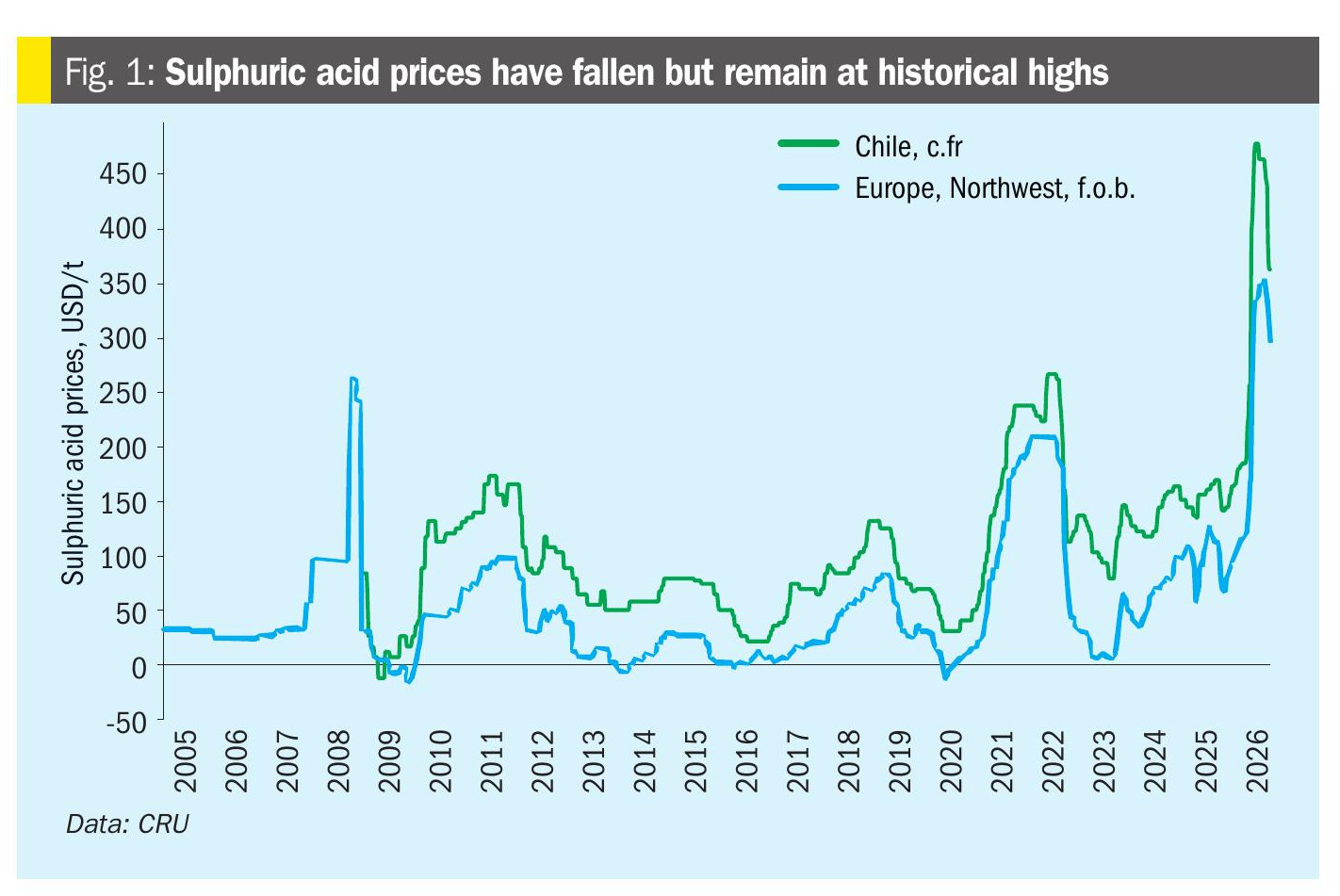
Sulphuric acid prices had been on an upward trend since 2025 Q4, supported by constrained availability from key exporting regions, renewed demand from major consumers and elevated sulphur prices. China’s unofficial announcement further accelerated acid price increases, pushing prices to all-time highs. As a result, delivered prices in Chile rose from $190/t c.fr. at the start of the year to $500/t in May (see Fig. 1). Prices in exporting regions mirrored this upward trend, with f.o.b. prices in Northwest Europe and Japan/South Korea reaching $350/t in May.
Chinese exports have boomed over the past decade
The announcement of China’s withdrawal proved highly disruptive. China increased its annual acid exports to 4.6 million tonnes in 2025 in response to global supply disruptions, raising its share of the traded market to 27% (see Fig. 2). Chinese cargoes have consistently filled a structural gap in the traded market over the past several years, with limited scope for other origins to compensate.
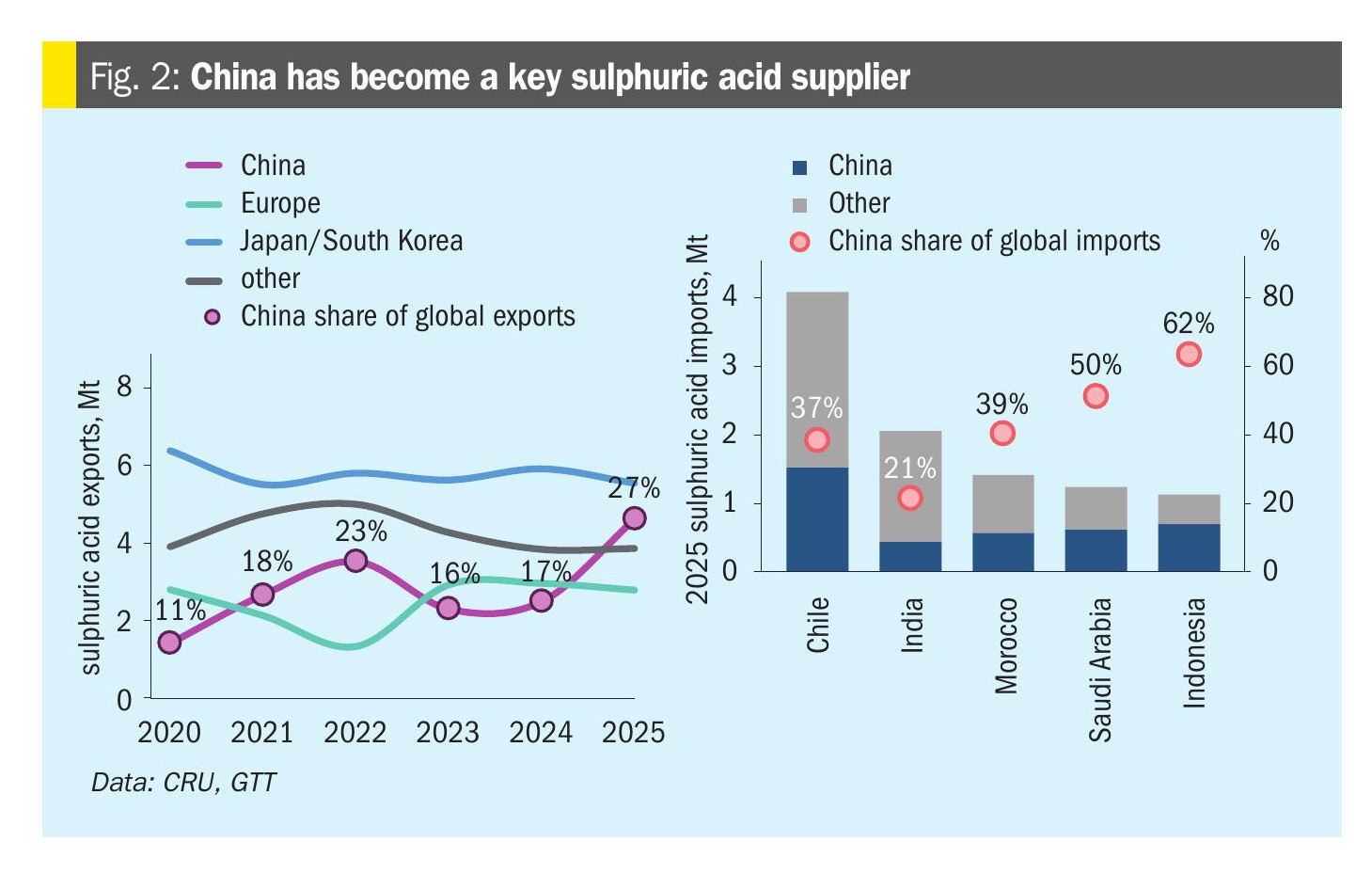
On the demand side, China’s role in supplying acid has been significant. Chile, the largest sulphuric acid importer, sourced almost 40% of its requirements from China in 2025. India, Morocco, Saudi Arabia and Indonesia imported smaller volumes, but their reliance on Chinese supply was even higher.
With limited scope for alternative exporters to increase supply, the market has had to adjust to tight availability through demand reductions and the reallocation of import flows. Consumers have already responded by curbing their acid requirements, discouraged by high prices and limited availability. The resulting demand reduction has removed support for acid values over the past two months. Delivered prices into Chile declined to $380/t c.fr. in late August, down $120/t from their peak in May. This downward pressure has also been mirrored in exporting regions, with average f.o.b. prices in Northwest Europe and Japan/South Korea declining to $310/t from $350/t over the same period.
Consumers have already adjusted to tight availability
Buying activity among major consumers has shown mixed signals throughout 2026 (see Fig. 3).
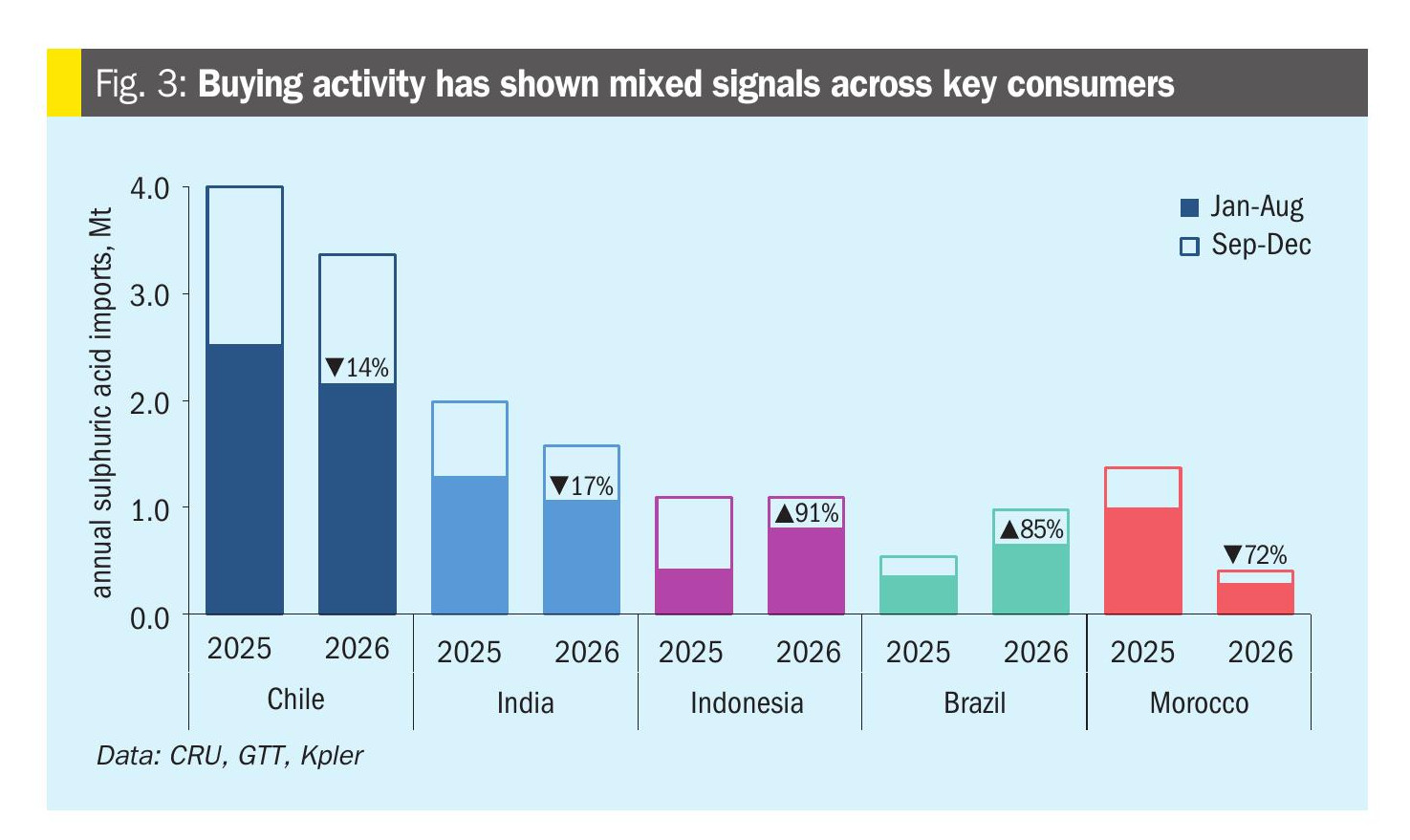
Chilean buyers reduced their import requirements by 14% y/y through August, as mining consumers, including Capstone, adjusted production plans to reduce acid consumption. In early August, following a revision to its Mantoverde mine plan, the company announced that it would halt all spot purchases for the remainder of 2026, with its remaining acid requirements for the year fully covered by existing contracts. As a result, total annual imports are expected to decline to 3.3 million tonnes in 2026.
In addition, a copper producer and a Chinese smelter finalised an acid-for-concentrate swap in July, widely understood to involve the supply of 100,000 t of acid. The conclusion of this deal has significantly reduced spot-market pressure from one of Chile’s major consumers ahead of Q4 procurement.
By contrast, buying activity in Brazil remained surprisingly strong through August, despite affordability constraints in the phosphate sector. Acid purchases increased by 85% y/y and have already surpassed the total volume sourced in 2025. This frenzied buying has resulted in a temporary glut, which has also supported the downward price trend in the region. Buyers have paused acid purchases, but total annual imports are expected to increase to almost 1 million tonne in 2026.
Other phosphate-consuming countries, including Morocco and India, have curtailed their acid requirements. Import demand in the two destinations declined by 17% and 72% y/y through August, respectively. The prevailing global sulphur shortage, rising cost pressures and limited acid availability have discouraged buyers from securing acid as an alternative feedstock. Annual import demand from both countries is expected to be lower than in 2025.
Conversely, Indonesian buyers have remained active in the market, as the acute sulphur shortage has prompted them to secure acid as an alternative feedstock for nickel operations. As domestic sulphuric acid supply from smelter operations has not ramped up as initially expected, buyers have temporarily shifted towards imported acid, with purchases through August increasing by 91% y/y. As a result, total annual imports in 2026 are expected to remain broadly stable compared with 2025, at around 1 million tonne.
China’s decision to halt acid exports is expected to remove around 2.8 million tonnes of supply from the traded acid market in 2026. As no alternative source of supply can compensate for a loss of this scale, market tightness will persist for the remainder of 2026. In response, the market has adjusted through lower import demand, which has in turn entrenched bearish sentiment and pushed prices lower. Although prices have fallen considerably over the past two months, they remain at historical highs, as the ongoing shortage is preventing a sharper decline.
Under typical market conditions, tight acid availability would be addressed through increased sulphur burning. However, given the current geopolitical environment and the ongoing closure of the Strait of Hormuz, this route has not been a feasible option. Improved sulphur availability would provide some acid buyers with greater flexibility, removing further support for prices. However, a resolution to the Middle East conflict would not necessarily ease the persistent supply tightness in the acid market.
About the author
Viviana Alvarado is a Sulphur and Sulphuric Acid Analyst at CRU.
Email: Viviana.alvarado@crugroup.com
Tel: +44 20 7903 2055