Fertilizer International 534 Sep-Oct 2026
13 September 2026
Royal EMT – the family company with a truly global reach
COMPANY PROFILE
Royal EMT – the family company with a truly global reach
European blending, bagging and handling equipment company EMT became Royal EMT in July this year. The ‘Royal’ designation was granted to the company in its 100th anniversary year by King Willem-Alexander – in recognition of EMT’s outstanding contribution to the economy of the Netherlands and its international standing. Zico Zeeman, Royal EMT’s Commercial Director, talks to Fertilizer International about what’s been a proud and momentous year for the business and his family.
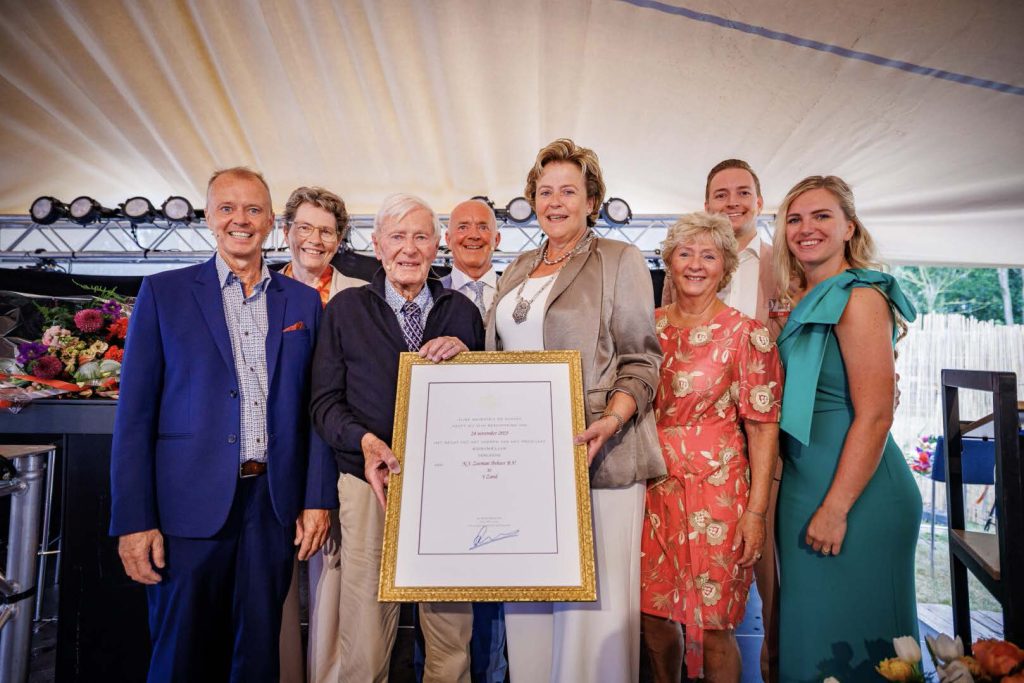
Three generations of the Zeeman family receiving the ‘Royal EMT’ designation from the local mayor at a special event in July. PHOTO: ROYAL EMT
Royal EMT is celebrating a special milestone in 2026: the 100th anniversary of the official registration of the Zeeman family business. A business that started in 1913 with a grain mill in the small town of ’t Zand in the province of North Holland, the Netherlands, has since grown into one of the global fertilizer industry’s leading machine manufacturers.
This evolution has been overseen by five generations of the Zeeman family (Fertilizer International 491, p14). A focus on innovation, international markets and satisfying its customers needs, says Royal EMT, has enabled the company to continue growing over the decades while remaining a true family business.
The family’s 4th generation, brothers Gustaaf and Janco, joined NJ Zeeman Diervoeders as directors in the mid 1970s and went on to found European Machine Trading (EMT) in 1989. Zico Zeeman became the 5th generation of the family to enter the business when he joined the company in 2016.
Both local and global
Royal EMT – which is today still located in ’t Zand in the Netherlands – specialises in the development, manufacture and installation of blending, bagging and handling equipment for the fertilizer and other bulk industries. The company has installed over 650 machines in more than 85 countries worldwide.
Royal EMT is proud of its 35+ years of Dutch manufacturing excellence, with extensive capabilities ranging from standalone machines to complete and fully-automated blending plant installations. The company’s equipment portfolio notably includes its custom-built flagship Weighcont continuous blender.
Recently, we sat down with Zico Zeeman, Royal EMT’s Commercial Director, to discuss the 100th anniversary year, the history of the family business – and the future of both the company and fertilizer blending, bagging and handling.
Proud of its past and ready for the next 100 years
Firstly, Zico, CRU and Fertilizer International magazine would like to congratulate the Zeeman family and Royal EMT on reaching its landmark 100th anniversary and its prestigious royal designation. How did the designation come about and how did you celebrate?
“We received the Royal designation, which is an incredible honour for both the family and the company, as a crown on what we do. We have now also completely updated our logo – a new design with the crown included – so that’s really nice.
“It is, of course, a hugely proud moment, both for the family and employees. The reactions we’ve had from suppliers and customers have been really heartwarming as well.
“You don’t just get a royal designation by being around for a 100 years. You have to do a lot of work upfront to apply for it. We had to prove to the king’s team we were a good quality company, responsible for a lot of business here in the Netherlands, and were internationally known as a trustworthy partner and an advocate for the country – a lot of our customers abroad wrote recommendation letters.
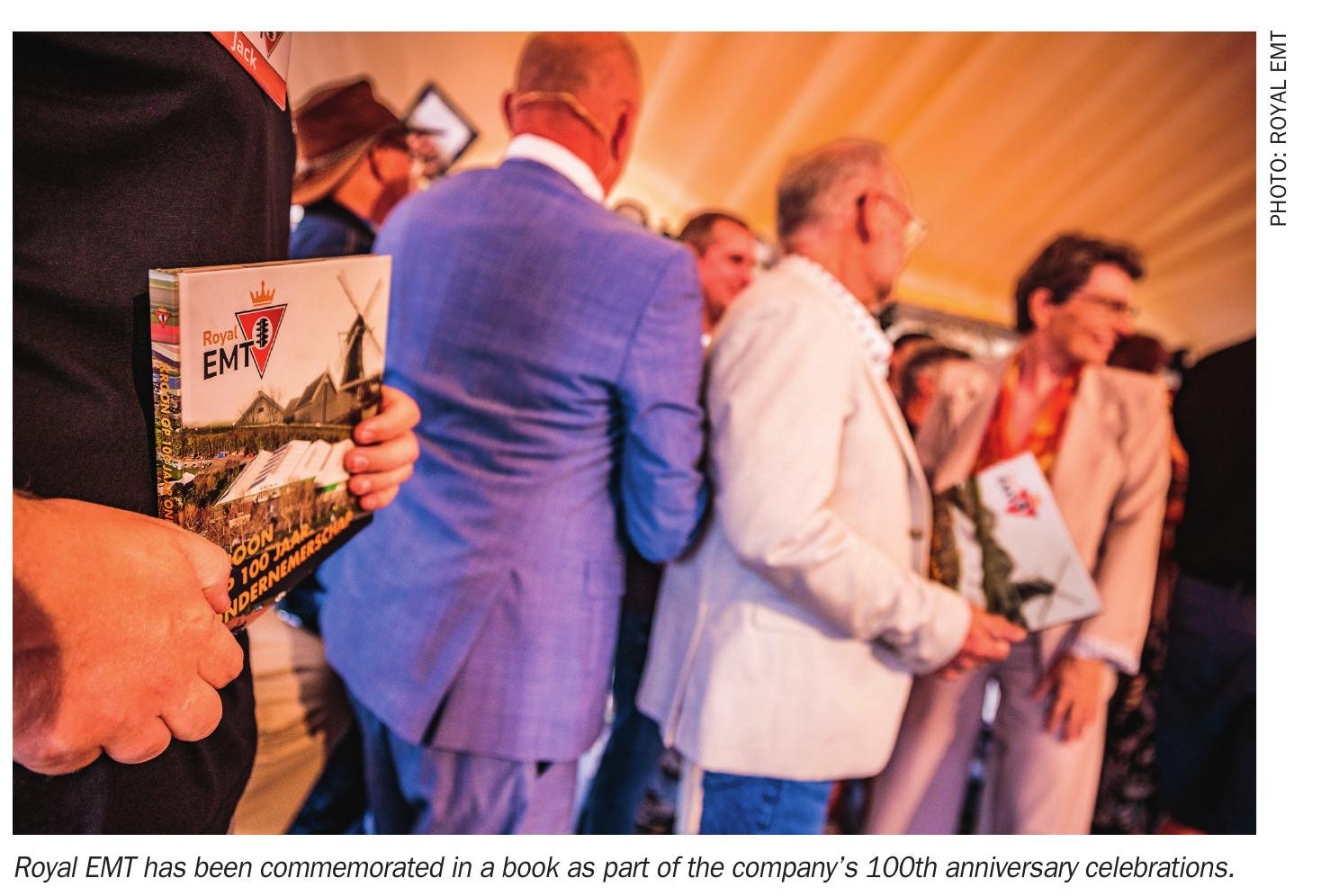
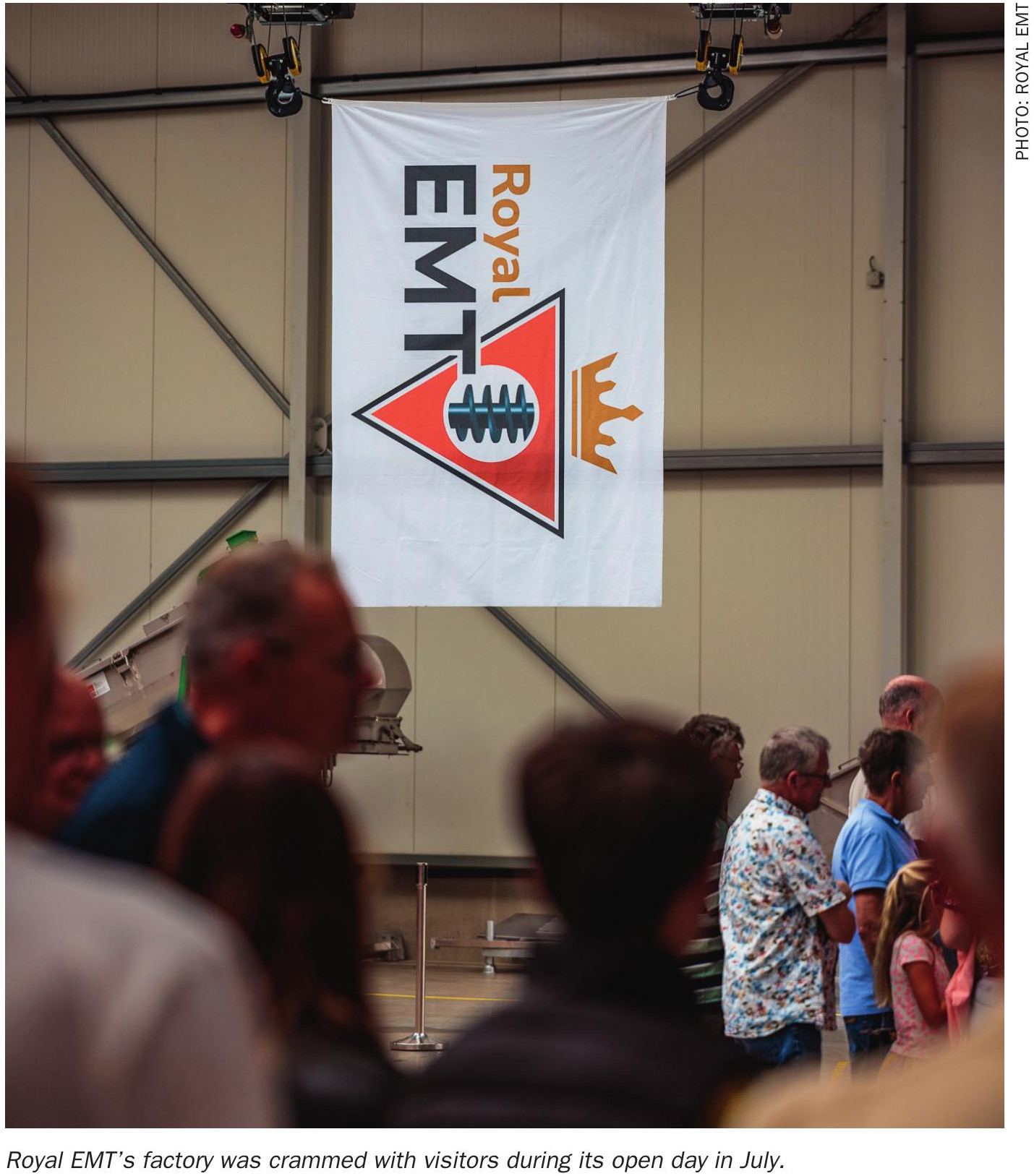
“To celebrate, we had the open day in July so everybody could visit the factory. We showed our production process from sales all the way through to software, electrical and mechanical engineering.
“Afterwards, we had a big ceremony where the mayor of our municipality came. We got all the family and the workers on stage and, as a kind of celebration, everybody got a book we’d written about 100 years of the Zeeman family business and EMT.”
Five generations of transformation and growth
Royal EMT’s home is the North Holland community of ’t Zand (‘the Sand’) within the municipality of Schagen. This is part of the world-famous tulip-growing heartland of the Netherlands – a traditional landscape of open fields, waterways and windmills (Fertilizer International 436, p20). Could you explain to our readers the amazing origins and history of the company?
“We were founded in 1913 by my great-great-grandfather, the first generation, who bought a windmill already located here in ’t Zand to mill grain and wheat for farmers and for bakers. He also started production of animal feed. That windmill was really the basis of our company.
“In 1926, his son came into the business, registered it as an official company and mechanised the windmill. From 1926 onwards, we put a diesel motor on the milling equipment so we didn’t have to rely on the wind anymore. We went from supplying farmers and customers around our area and started to expand and expand.
“The Royal designation is, of course, a hugely proud moment, both for the family and employees. The reactions we’ve had from suppliers and customers have been really heartwarming as well.”
“Later on, my grandfather came into the company in 1952. He was really an entrepreneur and led the company for almost 40 years. In 1987, he took two dictionaries, a Dutch-English and an English-Dutch dictionary – because he didn’t speak much English – and went to the United States to visit three blending equipment manufacturers.
“That’s where our partnership with Doyle started. From there, we started to develop our own high-speed blending and bagging machines. In 1988, we had our first sale with Doyle, and became their European partner, later their African partner, and we also started European Machine Trading.
“Because we had 100s of electric motors running in our animal feed factory, we had lot of experience in the production of machines, as well as being knowledgeable about fertilizers. We combined all that and started to introduce our own blending and bagging machines into the market – next to machines from Doyle whom we still represent– and from there started to grow.
“Later on, we renamed our factory ‘EMT, Manufacturer of Blending, Bagging and Transport Equipment’. We started to grow our market, first into West Europe and then East Europe after the fall of the Berlin wall. African sales also started early on, and we are in Asia, South America, Australia and New Zealand as well.
“Royal EMT is now a global supplier all over the world. At the moment, we have more than 650 machines installed in more than 85 countries worldwide.
“Gustaaf and Janco Zeeman are like the fathers of EMT. Together they really built up the machine manufacturing business. They are actually the first generation machine manufacturers and I’m the second generation. Gustaaf focused more on the sales side and Janco on the technical side.
“We stopped animal feed production, grain storage and fertilizer selling about 10-15 years ago and completely refocused the company on machine manufacturing. We shifted away from being a local animal feed and agri-dealer to being the global agricultural industry equipment producer we are today.”
Blending gets bigger, more automated and precise?
Going back to the early 1990s, a typical EMT machine had an average capacity of 30 tonnes per hour. Today, blending units with ten times that capacity are available. This has been accompanied by increasing adoption of ‘Big Bags’ (FIBCs) in markets such as Europe. High volume blending and bagging has also become increasingly automated. Precision agriculture and demand for site-specific NPK formulations also require increasingly customised blends. Royal EMT has been at the vanguard of many of these advances in blending over the last 30 years – what have been key trends in your view and how has the company innovated in response to these?
“Our machine company has really been based on continuous development, continuous improvement and, by speaking with customers, making new machines to suit their requirements.
“We see a big shift in Europe – and we also see that coming up in Africa and South America too – towards more coating of fertilizers. In Europe now, urea with an inhibitor coating is almost standard.
“We’ve been really focused on adapting and improving our machines for fertilizer coating. That includes making portable coating machines, small skid-like units, that are easy to move and can be placed at different locations. That means you can move the machine to your product instead of moving the product to your machine.
“In-line coating is also interesting. It’s quite a new development where we add liquids onto one type of product before it is blended.
“With in-line coating, there’s one-time handling of the product. It goes from coating into the blend and then into the bag. So, there’s a lot less deterioration of your product and dust accumulation.
“We’re also doing a lot of retrofitting of existing machines. Big steps have been made in the last few years to improve output and blending accuracy.
“We have machines that are 25-30 years old now that are still working correctly mechanically. We can upgrade these with the newest software and by installing add-ons like in-line coating units. That gives us a blending and bagging machine capable of meeting today’s requirements, instead of what it was bought for 30 years ago.
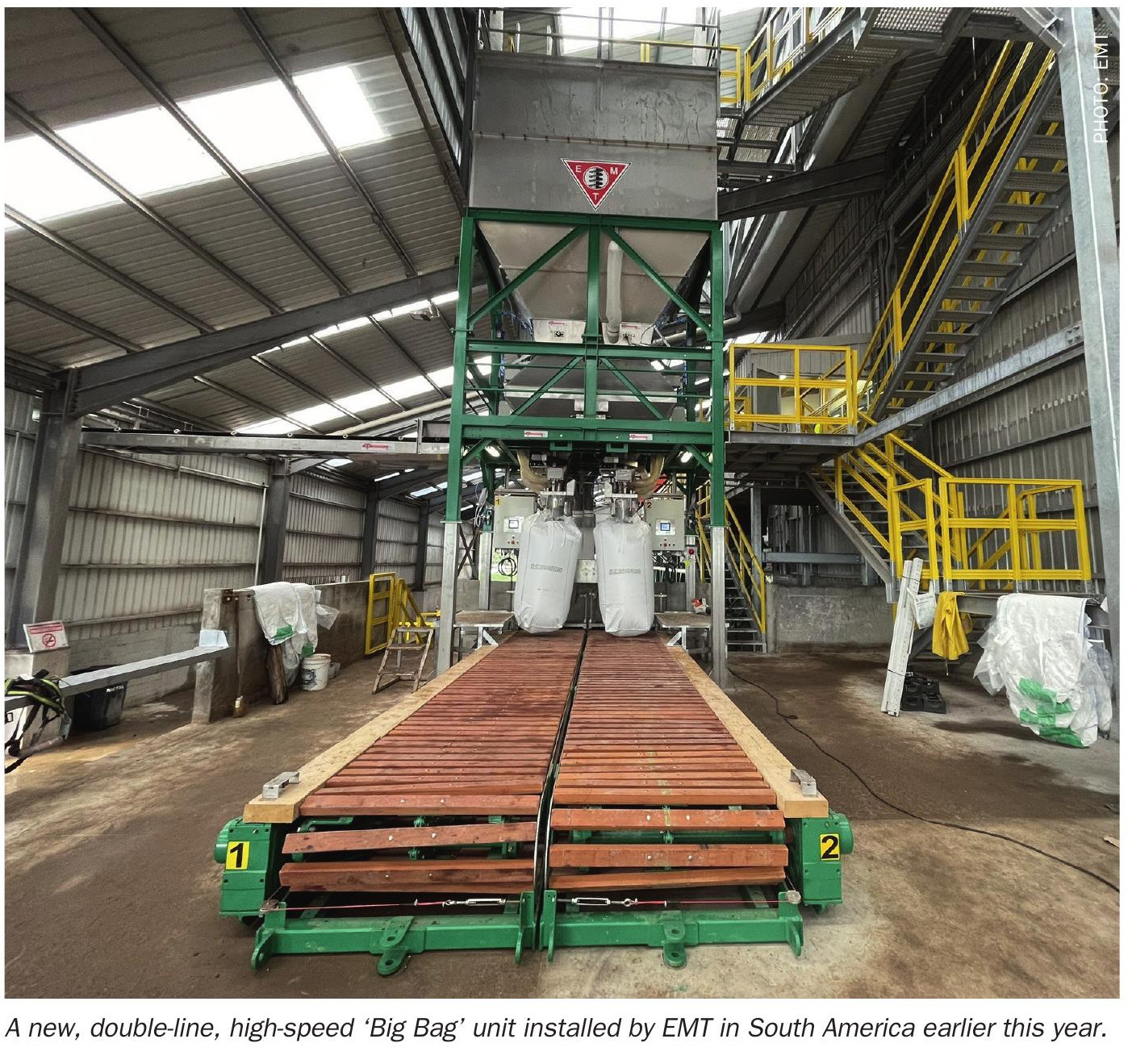
“We also see more projects coming up with higher capacities. For example, the last project we did for Koch in Australia is a 300 tonnes per hour blending line with liquid adding, screening, then bulk handling and truck filling capabilities.
“We’re seeing more centralised blending points, with ‘Big Bag’ handling and a higher output capacity. We have increased our machine design to match those larger capacities, with blending lines of up to 400 tonnes per hour, for example.”
Made in the Netherlands
Royal EMT has stayed true to its roots by remaining a proud Netherlands-based equipment manufacturer. How has machine manufacturing at your ’t Zand base changed in recent decades and has this required investment and expansion of your local fabrication capabilities?
“In the last five years, we’ve built two new production halls. This has doubled our production capacity.
“We are a European manufacturer. There are challenges that come with that. But, by staying a local, family-owned company, we can ensure that we have minimal personnel changes. Almost everyone at our factory works here for a long time – it’s a good professional team – and that keeps the in-house knowledge we have.
“Some people working here have more than 30 years experience in manufacturing and production. That’s very important for us. But there’s also young talent coming in, especially in our engineering department where in 10 years we’ve moved from two to eight staff.
“Royal EMT is now a global supplier all over the world. At the moment, we have more than 650 machines installed in more than 85 countries worldwide.”
“In recent years, we bought a new laser cutting system to cut our own stainless steel and a new, easier metal bending system with less welding. That enhances our production capabilities by increasing the speed of people’s work and enhancing the factory’s efficiency.
“If we can manufacture efficiently, we can also stay price competitive. Our main focus at the factory is therefore to enhance efficiency and ensure we have the right processes for speed of manufacturing. That’s something we’ve got really good at, and is one of our major qualities, I would say.
“Plus, we now design all our electrical panels and software ourselves, all the fabrication and design are completely in-house. We don’t have external contractors putting margins on top of our equipment.
“Keeping everything in-house also makes the quality of the machines very easy to control. If there’s an issue it’s easy to improve because we are all working in the same building.”
The complete package
With its in-house team of mechanical, electrical and software engineers, Royal EMT provides producers worldwide with reliable and flexible machines. All systems are assembled and tested in the Netherlands, with international installation and remote services provided by the company’s own technicians. Looking back at previous articles, is the delivery of complete turnkey blending plants becoming an increasingly important part of Royal EMT’s business?
“In turnkey installations, it’s not just the blending and the bagging that we focus on. It is the complete handling of fertilizer in a building. It starts from intake systems, where you have ships, trains or trucks coming in with bulk or bagged fertilizers.
“How are your raw materials coming in, what quality do you need, how do you unload, do you need to have some conditioning, screening or breaking? From there, you move into warehouse filling systems, loading equipment, the type of blending and all the handling up to bagging. Then, how does the blended product go out – is it in bulk, is it in ‘Big Bags’, is it in small bags? It’s that complete package.
“Dust protection systems are also becoming more common to protect people working in the factory. With our experience of complete handling facilities, we can also assist with that.”
New markets, new innovations
Royal EMT has always been a very forward-looking business. As well as being an innovator in blending and bagging machines, the company has pioneered new markets, having been heavily involved in the development of the African fertilizer industry, for example. Over the next decade where do you see market growth potential – and what will the blending plant of 2036 look like in your view?
“We see big improvement possibilities in Africa. The lowest fertilizer use per hectare is in Africa – so, there’s still big growth potential for African countries. Some big players are investing in Africa at the moment and we’ve got a couple of big projects for various African countries on our hands.
“We have 25-30 years old machines that are still working correctly. We can upgrade these to give us a blending and bagging machines capable of meeting today’s requirements – instead of what they were bought for 30 years ago.”
“Africa is mapping the soil and, because customers then know what they want, the targeted supply of fertilizer blends is growing there. We therefore see possibilities to expand in Africa as well as in South America.
“In Europe, there’s a lot of centralisation, larger companies setting up major hubs, and, of course, the move into coated fertilizers with a lot of coating machines. These are either standalone coating machines or coating machines connected to blending units. That’s a trend all over the world.
“I think there will still be a market for small, local blending and bagging equipment close to the farmer, especially with more market uncertainty about the availability of fertilizer products.
“Blending is still a hot topic. I think it will remain so because of growing knowledge about crop requirements and soil nutrients. That makes blended products of even more interest to farmers.
“Machine wise, there’s a shift to more autonomous control and smart software systems, These are highly efficient and precise in their blending recipes with very high quality output. That’s something we’re continuously improving.
“We are using AI in the factory now with a dedicated server for in-house AI development of our machines. We’re also using AI for the development of the control software of our machines, allowing them to acquire the correct data, learn and make decisions. That’s going to be more important in future.”