Fertilizer International 532 May-Jun 2026
Trading in a time of seismic supply shocks


INDUSTRY LEADERSHIP

Trading in a time of seismic supply shocks

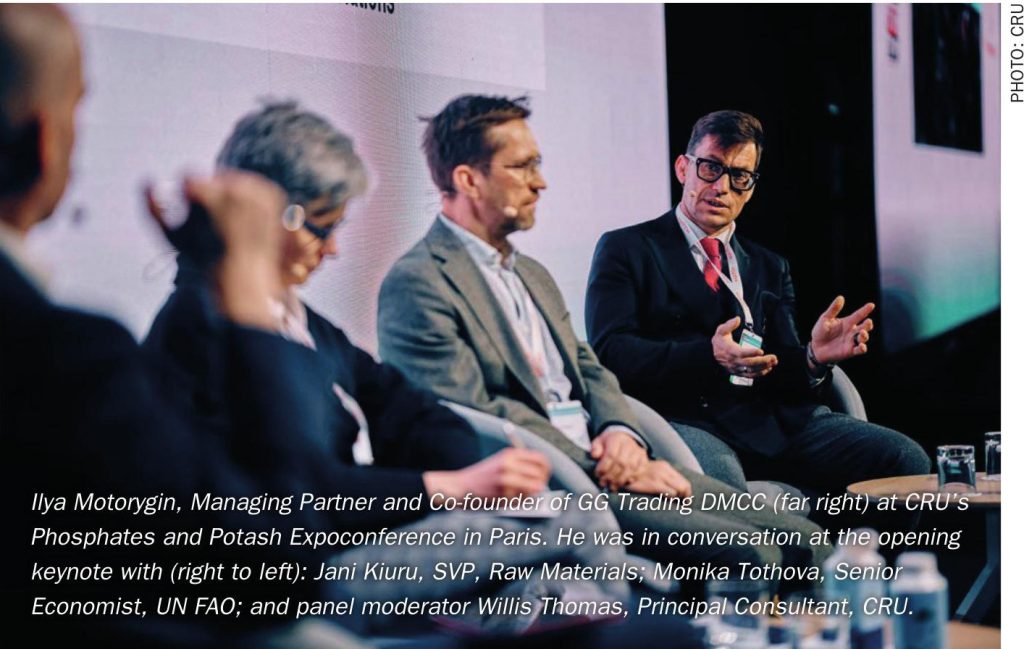
Fertilizer International spoke with Ilya Motorygin of GG Trading DMCC on the sidelines of CRU’s recent Phosphates+Potash Expoconference in Paris. In a wide-ranging conversation, he explained how fertilizer trading continues to perform an essential function by helping a market faced by supply earthquakes stay solid.

Ilya Motorygin is the Managing Partner and Co-founder of GG Trading DMCC, a Dubai-based trading house active across Europe, Asia, Latin America and the Middle East. With three decades of hands-on experience in international fertilizer markets, Ilya has helped build a business that spans commodity trading, logistics, and financial services. Before co-founding GG Trading, he spent seven years as Senior Trader at NF Trading AG, accumulating experience across the supply chain – working with producers, traders and end-consumers alike. Motorygin holds an MBA and an economics degree, and is widely recognised for his market expertise in contract negotiation, risk management, paper derivatives and cross-border trade flows.

Outside the trading floor, Ilya holds a black belt in Brazilian Jiu-Jitsu, a discipline that – much like navigating today’s fertilizer markets – rewards patience, precision, and the ability to spot an opening before anyone else does. We caught up with Ilya on the sidelines of CRU’s recent Phosphates+Potash Expoconference in Paris.

Sulphur, the hidden market driver

Ilya, how do you see sulphur and other key inputs shaping phosphate price formation – in response to the Middle East conflict and current geopolitical constraints?

“Obviously, when we speak about phosphates, most people still look at the finished products – DAP, MAP, TSP and the whole spectrum of phosphates – and they try to explain the markets from there. But to me, the phosphate market starts at a much earlier stage. Sulphur is one of those key hidden drivers, just because it sits literally at the base of every cost curve, through sulphuric acid.

“What has been different now, for almost the last two years already, is that sulphur is no longer a cheap by-product story. With all the disruption in oil and gas production that we’ve recently seen, and the price escalation, it’s now about sulphur: its price, the logistics, the geopolitical risks in the Middle East, and its availability. It became, all of a sudden, very tight and very volatile.

“Over the next 12 to 18 months, I don’t expect sulphur to return to normal quickly. Even with energy markets stabilising, the infrastructure and capacity that has been damaged or delayed – and we will only know the full extent of that after the conflict is over – will take quite a long time to recover. And if you add on top of that all the problems you potentially have with ammonia, freight, and financing, it all remains very unstable. The fertilizer market, fertilizer pricing, is no longer just demand-driven. It’s a whole combination of a cost-push market and multiple unstable variables. That’s how I see it.”

Biggest supplier and biggest importer

China’s export policy and India’s import behaviour are arguably the two most closely watched variables in global phosphate markets right now. How does that dynamic create risk – or opportunity – for market participants?

“We are addressing two elephants in the room simultaneously – the biggest supplier and the biggest importer of phosphate fertilizers.

“On China, the question is no longer whether exports happen, but when and under what conditions they will happen. We see that China has moved to a policy-driven model – export windows, quarterly quotas, domestic price controls, all things controlled by the government. My base case is that this will continue, and I believe this year will see quite reduced export availability from China.

“On India, almost all fertilizers are subsidised, which means the government has to allocate quite a bit of money – but at the same time, India is very well aware of the possibility of a shortage and tries to avoid it by any possible means. We just recently saw a new tender for DAP and TSP. I believe India will remain a high-paying market, which will make it very interesting for traders. We will see quite active purchasing behaviour from India in the near term, and rather limited availability from China – unless and until the current conflict comes to an end. I think China will prioritise its domestic market regardless of international prices.”

Understanding customers

From a trader’s perspective, where is genuine value being added in the phosphate supply chain today? And which parts of the traditional trading role do you think really are at risk from digital procurement platforms?

“Let me start with the digital question. There is quite a lot of talk about platforms spreading around the market, but it’s not something new – they first appeared maybe six or seven years ago. Yet we still see quite limited volumes being traded through them, because to me this is a very person-to-person market. You have to know your customer, you have to understand them, you need to know how reliable they are – and there are a lot of questions that we still cannot answer with digital programmes.

“Don’t get me wrong – I’m a big fan of everything related to AI and digital, and I believe there is a future there. I also believe in the future of crypto payments. But it will take time; it will probably take a couple of generations before digital platforms take a really significant share of the trade.

“Coming back to the traditional trader’s role: I see us as a kind of buffer. What we can do – and what perhaps no one else can do – is shuffle around trading routes and paths, manage financing, storage capacity, and buffer stocks. Especially now, when we see how routes are changing, it is the traders who are keen to switch and swap directions who keep things moving.

“On top of that, we take on quite a lot of risk, international risk. We don’t do it back-to-back – we normally take positions. The trader community is the one still allowing business to continue, because in a situation where it’s purely producer-to-receiver without a trader, it would fall apart. We are a buffer, and that buffer helps this market stay solid, even with the earthquakes we are facing at present.”

Arbitrage is about logistics, not price

For phosphates, given the tariffs and sanctions affecting fertilizer flows into Europe, which trade routes or arbitrage opportunities do you expect to see reshaped in future?

“You’ve come to my favourite topic! CBAM is probably one of four words that everyone in this industry knows now – and then there are the sanctions on top. Flows into Europe are being reshaped quite substantially by tariffs against Russian suppliers, by CBAM, and by various sanctions. This is effectively pushing traditional suppliers to redirect their volumes into Africa, Latin America, Asia, and Australia, which is a big chunk. At the same time, the Middle East and North Africa are gaining a relative advantage due to proximity and cost – but they are also exposed to their own geopolitical risks.

“The key point I’d make is that classical arbitrage is no longer purely price-driven. I keep repeating this – it’s not demand-driven, it’s not price-driven. It’s about logistics, it’s about policy, and it’s increasingly about risk adjustment. That’s a combination. And sometimes the routes which appear open on paper are closed in reality.”

Warning signs

Looking ahead to the next major supply shock – whether from new environmental rules, geopolitics or project delays – what early indicators do you watch most closely, and how should producers and buyers translate those signals into contract and logistics decisions?

“The next shock will not come as a surprise event – the signals are already there, but they are often ignored.

“The main indicators I watch are sulphur flows and stock levels, ammonia availability and pricing, port congestion and freight behaviour, and policy signals from China and India. Any delays in new projects or maintenance shutdowns at key producers are equally critical, because spare capacity in this industry is limited.

“For producers and buyers, the implication is simple: contracts need flexibility, logistics optionality becomes critical, and relying on just-in-time supply is increasingly risky.”

A system-constrained market

As someone who closely watches physical flows, what’s the single most misunderstood thing about the phosphates market right now that you think the industry should be talking about?

“The biggest misunderstanding is that people still think this is a demand-driven market. It is not a demand-driven market anymore. It’s now a system-constrained market, where you have to put together logistics, geopolitics, financing, input availability and definitely shipping. With an increase in the oil price you get an increase in freight, which is part of your risk. People still try to explain price movements by looking at consumption patterns, but in reality it’s not just consumption. It’s also the price of sulphur, energy, freight, policy – everything that was hidden before now comes to the surface.

“Put it this way: take the example of Brazil trying to switch from the more expensive MAP to the relatively cheaper TSP and SSP. But at the end of the day, you need twice as much SSP as you need MAP to deliver the same quantity of phosphate units – which means twice as many trucks. That’s the kind of thing you have to put together to see the full picture. More details, more small parts – not simply supply, demand and the price of agricultural commodities.

“And of course, as a trader nowadays, you need knowledge of agronomics, politics, trade flows, shipping, and what governments are actually planning – what’s really driving China, for example. And yes, you also have to follow President Trump’s posts, because that is now a major element in everything we are seeing.” ■

Acknowledgement

Interview by Natalie Noor-Drugan, Senior Editor, CRU Communities. Both questions and answers reflect market condition at the time of the conversation in mid-April 2026.

Latest in Commodity