Fertilizer International 532 May-Jun 2026
27 May 2026
Innovar Ag – perfecting the agronomic, economic and environmental trifecta
INDUSTRY LEADERSHIP

Innovar Ag – perfecting the agronomic, economic and environmental trifecta
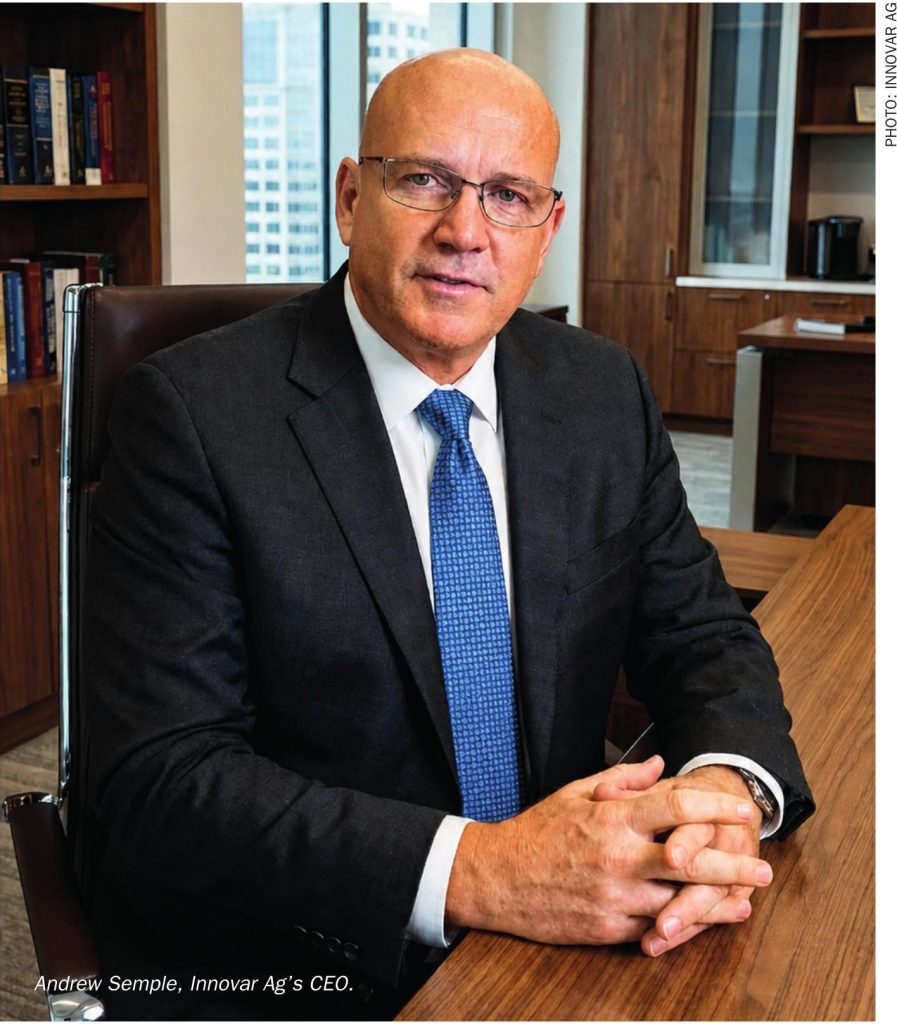
Andrew Semple, the CEO of Innovar Ag, talks to Fertilizer International about his long career in helping develop and grow the agricultural market for enhanced efficiency fertilizers – and the valuable lessons learnt along the way.

Industry pioneer
Andrew, a real pleasure speaking to you. Your career began with Pursell Technologies in the 1990s, with a focus on specialty products for the turf and ornamental market. You were then part of the team at Agrotain International that helped pioneer the use of enhanced efficiency fertilizers (EEFs) in global agricultural.
Is it correct to say that your whole career has focused on improving the efficiency of fertilizers?
“I was originally northern sales manager for Pursell Technologies bringing polymer-coated fertilizers into the US Midwest and the northeast Canada. At that time, about 70-80% of the nitrogen products in the turf market had some sort of EEF technology, methylene urea, urea formaldehyde, sulphur-coated urea or polymer-coated urea. The turf market evolved, adopting enhanced efficiency fertilizers throughout the 70s, 80s and 90s, so EEFs were almost the default.
“I then joined Agrotain International as their first employee in 2000. Mike Stegmann of Lange-Stegmann, my Pursell customer at the time, told me he was going to start up an agricultural EEF company and wanted me to lead the international side. Mike had secured the Agrotain business from IMC [now Mosaic] under license.
“At that time, the US and Australia were the only two countries where there had been sales. During the first week, an Australian customer called and said, ‘We want you to take back this Agrotain, as there’s no place for it here, and if you don’t we’re going to throw it in the landfill.” So that was a tough first week!
“Agrotain in Australia was then about a hundred bucks a gallon and the price of urea was a hundred dollars a tonne. So you can figure out why – using a gallon per tonne – people had a ‘we can’t sell this!’ attitude. With enhanced efficiency fertilizers, we were selling basketballs to people that didn’t even know basketball existed. That was the biggest challenge.
“The first few years at Agrotain International were fun, yet weren’t easy. But in the second year we licensed Agrotain technology to Norsk Hydro [now Yara International] for Europe. That was a key turning point for the company, along with the adoption of Agrotain by 50% of the big urea dealers supplying the rice market in the US mid-south
“Nothing’s easy in this industry or happens overnight. But fast forward and after 11 years of hard work – blood, sweat and tears and a lot of travel around the world – we went from close to zero to selling to 70 countries. In one of those geographies, the UK, I had set Koch up as a distributor. That was how the relationship started and, in September 2011, Koch acquired Agrotain International.
“One of the greater blessings in my career was the opportunity to work with [former Agrotain owners] the Stegmann family – individuals of the highest integrity – and develop relationships with the rest of the Agrotain team. Many of that Agrotain International team are still involved with me today, in some way, shape or form, 25 years later.
“A lot of the time I find myself thinking what Mike Stegmann would do in a situation. We have amazing products at Innovar Ag and Mike used to jokingly say to me, ‘It ain’t bragging if it’s true!’ So not only do we need to brag on ourselves, brag on our technology, we also need to brag on the whole category of enhanced efficiency fertilizers that we’re promoting.”
Second generation technology
You later became the CEO and part owner of Eco Agro Resources. What was special about that company?
“I joined Eco Agro Resources from Trimble Navigation in 2014. Founders David McKnight and Ray Perkins asked if I would come and run the international business, eventually becoming the CEO and a part owner.
“The differentiator for Eco Agro was PENXCEL technology, a second generation inhibitor solvent. This system would coat urea granules two times faster and was 2.7 times less toxic. It also penetrated to the centre of the granule after you applied it to the outside. Other competitor products didn’t do that. The more it penetrates to the centre, the more urea molecules are coated, and the better efficiency you get by suppressing volatilisation.
“Then, in 2017, I obtained an international license from Eco Agro Resources to start another company, Eco Agro International – the company that ended up becoming Innovar Ag in 2018.”
Innovar Ag – putting the band back together
Tell us more about Innovar Ag and the products it has developed and launched on the market?
“I became aware, while working for Trimble, of the other massive efficiency gains that are available on the farm. Innovar Ag therefore had to diversify in my view and look beyond nitrogen at all the other types of efficiencies the company could become involved in and help with. Competitors were also coming into the market for nitrogen.
“The Innovar part of our name is Latin for innovate. That’s why we came out with products like InnoSolve PKMe [a broad-spectrum efficiency additive for agriculture and turf] that focused on phosphate, potash and minor element availability in the soil – to change that paradigm of efficiency from just nitrogen to include other crop nutrients.
“With nitrogen stabilisers, for example, we always talk about a 30% reduction in ammonia volatilisation from urea. Well, InnoSolve PKMe provides similar efficiency benefits with 10-30 percent more crop P and K uptake in tissue tests.
“PKMe has now grown to be around 20% of our business. As we’ve developed as a company, we’ve also diversified our portfolio, bringing to market some of the other products you mentioned [BCT, Inno-Solve Amino, InnoSolve Gold and InnoSolve Silicon]. We have grown the business and are close to 40 countries now and still have a goal of getting back to the original 70 countries.
“Our customers were saying, ‘Hey we trust you guys, what other products do you have and can develop, as we don’t want to buy from 100 different companies.’ As we already had the reputation in the market, people knew we weren’t selling snake oil and were willing to try us.
“We’ve now put many of the original ‘band members’ back together from some of the Agrotain International and Eco Agro team. These people are the reason why Innovar is as successful as it is today. They were innovators themselves, cutting their teeth way back in the early 2000s, talking about these types of technologies and teaching efficiency in the market.
“We’re lucky to have those people on our team and the industry is very lucky to have them waving the flag on nutrient efficiency because everybody wins. That’s the great thing about EEF technologies – there’s an agronomic, there’s an economic and there’s an environmental gain.
“It’s not like we just want to sell you an environmental product and say, ‘By-the way, the price is twice what you’re paying today and you’re not going to make money.’ That does not work and we have to be able to tell people how it works from an agronomic perspective and an economic standpoint.
“Unless they generate at least a three-to-one return on investment, for the most part people aren’t even going to look at an EEF product, because there’s too much risk. But if you combine that economic, agronomic and environmental triangle you’ve then got a formula for a person to try the product.
“Then it has to work and customers have to see it work. We have a very, very high reorder rate of 98% and generally when a customer uses our product, they use twice as much the next year. They start off small buying one pallet, then two pallets the next year and then four pallets the following year.”
“We have amazing products at Innovar Ag. So not only do we need to brag on ourselves, brag on our technology, we also need to brag on the whole category of enhanced efficiency fertilizers that we’re promoting.”
New technologies, new markets, new crops
Andrew, having returned to Innovar Ag as CEO again in 2026, do you see a bright future for enhanced efficiency fertilizers – and what are the major challenges preventing adoption by growers?
“I’m happy to be back as CEO and thankful to [company manager/owners] Dr Ray Asebedo and Dan O’Brien for the opportunity. Innovar has a great future. I’m very excited to keep on bringing new technologies, ones that fit that economic, environmental and agronomic triangle, to new markets, new countries and new crop types.
“We’ve got a team together that continues to focus on our customer base and feels a sense of accomplishment in completing a challenge. The billion dollar companies that we’re working with trust that we’re going to continue to develop new products.
“I’ve got a couple of challenges. The biggest challenge facing enhanced efficiency fertilizers, the one that overshadowed all of them back in the 2000s, used to be that customers had to prepay for the product before we’d ship it internationally. It would take 30-60 days before they’d even get the product.
“Customers don’t want to do that, then or today, even though they now know the technology. The way we got around prepayment was by getting people signed up for banking programmes like EXIM export-import banks that gave international customers terms.
“The second challenge is to do with communications and marketing. Most of our customers are in the fertilizer industry and we’re selling something that basically says your fertilizer is not efficient. So how do you position your value proposition and focus on the benefits of EEF products? You wouldn’t be able to sell a fuel efficiency product to a gas station, for example, by saying their fuel is inefficient.
“Saying, globally, ‘use less nitrogen’ is also not the right thing to say when it might not be true. A farmer in India might need to apply four bags of urea per hectare while the farmer in Europe, because of soil differences, is applying six bags. Every place is different. So we recommend that advice on how much nitrogen to use on crops is left to local agronomists.”
Summing up
“I feel good about what everyone has achieved over the years. Back in the 1990s, selling EEFs into the golf market, we all accomplished a market penetration of 70-80% for nitrogen products. In agriculture at that time – outside the use of nitrapyrin in anhydrous ammonia – there was very, very low percentage adoption of EEFs for granular and liquid fertilizers.
“Now, depending on which country you talk about, there’s double digit adoption rates for EEFS in agriculture – as much as 50-60% some places. So it’s great to see how we’ve been able to bring that trifecta of agronomic, economic, environmental value to growers. It took a lot of people and the whole industry together to get that message out.” ■