Fertilizer International 532 May-Jun 2026
Controlled-release fertilizers – delivering verifiable carbon cuts


DECARBONISING AGRICULTURE

Controlled-release fertilizers – delivering verifiable carbon cuts

A new pilot project with potato growers in the Netherlands has demonstrated the potential of using controlled-release fertilizers (CRFs) to deliver cuts in the Scope 3 emissions of food processors and consumer packaged goods (CPG) companies. The pilot has also successfully shown how measures to cut carbon at farm-level – carbon ‘insetting’ – can be verified and proven within agricultural supply chains.

 
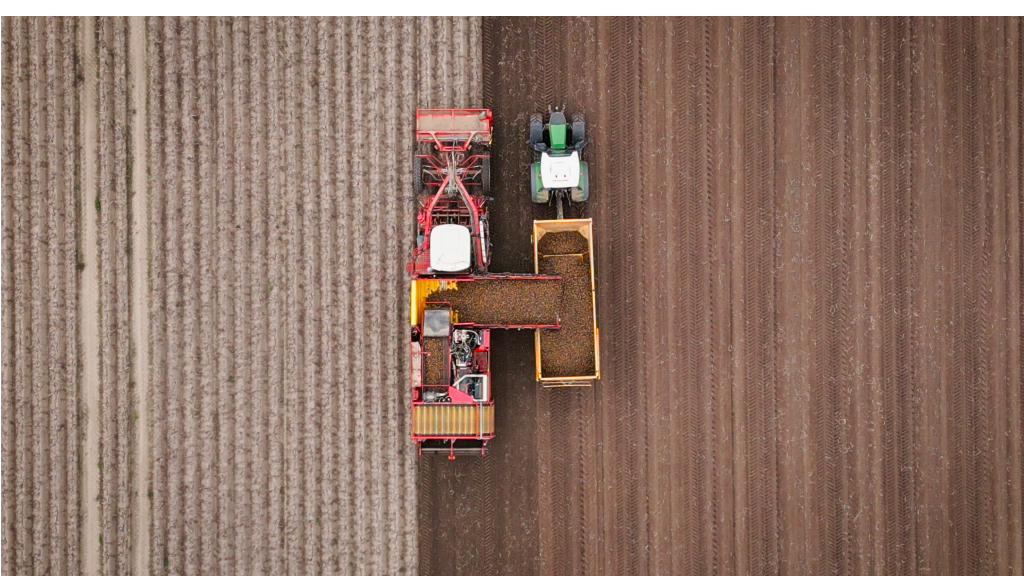
Harvesting potatoes. PHOTO: ICL

Promising potato pilot

Improved nutrient use efficiency (NUE) is the holy grail of crop production – enabling growers to get more from less, improve their returns, and at the same time reduce nitrogen losses and greenhouse gas (GHG) emissions.

Well, farmers can now reduce fertilizer usage without affecting yields, while also cutting their carbon footprint and potentially commanding a premium price for their crop. That’s according to results of a new agricultural pilot project in the Netherlands. It found that the use of controlled-release fertilizers (CRFs) can deliver an emissions reduction of up to 25.8% for potato growers, compared to traditional fertilizer use.

The pilot – carried out on over 31 hectares of potatoes at Flevoland and Zuid-Holland operated by the Dutch farmer co-operative Agrifirm – revealed that potato growers were able to reduce their carbon footprint by 7.5% per tonne of crop. This reduction was achieved using CRFs at the same application rates as conventional fertilizers. Models also show that the achievable carbon reductions with CRFs rises to 25.8%, if fertilizer usage is adjusted downwards while maintaining crop yields.

Run across three potato farms, producing both table potatoes and processing varieties for French fries, the primary aim of the CRF pilot was to obtain more experience in quantifying and certifying CO2 reduction at farm level. The potato farmers were given the choice of maintaining fertilizer use and boosting yields, or cutting inputs while maintaining yields. While each opted for the former, all three farms still benefited from a lower carbon footprint.

Certified CO2 emissions reduction and better NUE

Using CRFs, the three farms produced 1,832 tonnes of potatoes in total – a yield averaging 58.87 tonnes per hectare (t/ha). Across the entire area, they emitted 24.76 tonnes of carbon dioxide equivalent (CO2e) – two tonnes less than the baseline associated with conventional fertilizer use. Of these emissions, 44% related to production of the fertilizer, 34% to direct emissions, 20% to leaching and 2% to volatilisation.


More detailed evaluation of the results showed that using CRFs in potato growing delivered a 1.7% reduction in production emissions, a 12.6% drop in direct emissions, a 6.9% fall in leaching and 35.4% less volatilisation.

“We were looking at how a higher NUE could be achieved without negatively affecting yields,” explains Levi Bin, account manager at Agrifirm. “Working with the three farmers, we also focused on what it takes to get a certified reduction in carbon footprint.”

For the potato growing pilot, the emissions reductions associated with CRF use were certified by Proba, an independent advisory service (Fertilizer International 530, p52).

Dual benefits – less fertilizer, lower emissions

In the Netherlands, farmers are restricted on the amount of manure and mineral fertilizer they can use, which made it an ideal place to carry out the pilot study. In the future, such restrictions may come in elsewhere – while, in the immediate term, high input costs mean farmers are trying to reduce their fertilizer use where possible.

The production of nitrogen fertilizers is a notably carbon-intensive process that consumes natural gas, meaning they already carry a high carbon footprint even before they are shipped to their point of use. “If you look at the carbon footprint of growing potatoes, about 40-50% is related to fertilizer – especially nitrogen fertilizer [production],” says Levi.

The on-farm emissions associated with fertilizer use are greater still. “About 60% of nitrogen fertilizer’s carbon footprint is in-field,” adds Levi. “If you can use less nitrogen to produce the same yield, that is highly beneficial.”

CRFs are coated and gradually release nitrogen to match uptake by the plant. This improves NUE by reducing nitrogen losses through leaching or volatilisation. So, not only can farmers use less, the in-field emissions are also lower. “It’s a two-fold benefit,” sums up Levi.

The switch to CRFs also saved a lot of time in fertilizer applications, according to Mark Haagsma, a potato farmer in Luttelgeest involved in the trial. “Through slow release of the fertilizer, we have fewer peaks in the nitrogen balance, and this fits better with the crop needs,” he says. “It is practical and efficient – and we also have less leaching, contributing to sustainability goals.”

EU-approved biodegradable technology

Most CRFs have coatings which degrade slowly – but ICL’s latest CRF technology ‘eqo.x’ is 100% biodegradable (Fertilizer International 510, p24). It is the first CRF product to obtain EU-recognised biodegradability certification ahead of mandatory standards set to be introduced in October 2028.

“This certification is more than a regulatory achievement; it’s a statement of where the industry is headed,” says Ronald Clemens, global portfolio manager CRF at ICL. “With eqo.x, we are giving growers and our partners a proven, compliant, and future-ready solution that combines agronomic excellence with environmental progress.”

Levi Bin already recommends that farmers use eqo.x for growing high-value crops like potatoes and onions. He suggests it is best incorporated into the soil before ridging: “In principle you only need to apply it once in a season, as opposed to top-dressing with calcium ammonium nitrate (CAN), hence reducing tractor passes and associated labour and diesel costs.”

For these crop types, CRFs are typically blended with regular uncoated fertilizer, as this provides immediate uptake to the plant followed by slower, controlled availability.

Consequently, crops will suffer less stress early in the season and will experience fewer nutrient deficiencies through the growing period. “We saw better tuber setting in the pilot last year, although we need more trials to verify this,” observes Levi.

Lower Scope 3 emissions for food companies

At a time when many food processors and consumer packaged goods (CPG) companies have net zero goals and are seeking to reduce their Scope 3 emissions, CRF technology has tremendous potential. It can either be used to increase yields without boosting fertilizer usage, or used to reduce inputs without affecting yields.

The carbon measurements are also scientifically proven, as Levi points out: “So you can compare your carbon footprint against your previous baseline, with previous years, between crops, or with local or national benchmarks.”

While farmers could potentially monetise the carbon reduction in the form of carbon credits, Levi thinks the supply chain benefits are the real focus: “This is about insetting, not offsetting. So, if a food processor wants to reduce the carbon footprint of its French fries, this is a validated way of doing so. There is value in that – on top of the return on investment in improved efficiencies alone.”

The purpose of the Netherlands pilot is to enable food companies and other agricultural buyers to access lower-carbon crop commodities while contributing to real and measurable climate action, notes Levi: “The pilot phase is designed not only to demonstrate technical and environmental impact, but to also validate the operational, financial, and organisational feasibility of the model.

“The outcomes provide the necessary evidence and confidence to scale the initiative, enabling a mechanism for decarbonising agriculture at scale. It ensures that the transition to more sustainable farming practices is co-financed by those sourcing the crops, rather than placing the burden solely on farmers.”

Zeroing in on net zero

Companies like McDonalds, McCain, Ikea and PepsiCo all have net zero targets – and a large part of their Scope 3 emissions comes from the fertilizers used to produce raw potatoes, says Rutger Beens, co-founder of Proba, which provides tools to quantify and certify fertilizer emissions. “But farmers can’t simply stop using fertilizer; yields would collapse,” he notes.

Proba’s greenhouse gas methodology can quantify and certify these emission reductions, says Beens: “This means food companies can report and finance those reductions, creating incentives throughout the supply chain to move to more efficient fertilizers.”

“At a time when many food processors and consumer packaged goods (CPG) companies have net zero goals and are seeking to reduce their Scope 3 emissions, controlled-release fertilizer (CRF) technology has tremendous potential.

Working with the International Fertilizer Association (IFA) and a range of independent scientists, Proba can ensure that such data are robust and scientifically valid – giving food producers the confidence they need.

“Food companies increasingly want to reduce their Scope 3 emissions, but translating that ambition into action at farm level isn’t straightforward,” says Rutger. “Farmers need a reason to switch. Chain of custody models, like insetting, create the financial structure that makes this possible, allowing food companies to fund and claim emission reductions that happen within their own supply chain. When that works, the whole project becomes scalable.”

Despite recent political rollbacks on climate change commitments, most large food businesses still have net zero targets, he adds: “Shareholders and consumers are pushing companies to take action – and if you don’t, you’ll get left behind.”

Globally, there is more pull to from the processor and consumer end of the supply chain than anything driven by legislation, says Georg Lemperg, global sustainability partnerships manager at ICL Growing Solutions: “We’re seeing a lot of food companies wanting to reduce the carbon footprint of the supply chain to meet their voluntary targets.”

He sees the impact of CRF technology as being hugely important: “There aren’t that many easy ways you can have a significant impact on the carbon footprint of various foods, from potatoes and rice to coffee and palm oil.”

While there are many well-designed regenerative farming projects around the world – which are helping to reduce carbon emissions – these require multiple actions over multiple years to work, Lemperg adds: “What this technology offers is a really effective tool that achieves significant carbon reductions through improved NUE, while also making life easier for the farmer. It’s truly groundbreaking.”

However, one element that is still missing is having the retailers at the table, suggests Georg: “Having more constructive conversations to connect the whole value chain to the consumer would be helpful.”

Insetting over offsetting

Lemperg sees insetting as being the future of carbon reduction – where there is clear route from the crop in the field to the final branded product. Only for non-direct purchases of generic foodstuffs will offsetting through the sale of carbon credits take precedence. So, products like potatoes and coffee will likely benefit from insetting, whereas rice or palm oil may see farmers generating and selling carbon credits. “It could be an important way for them to supplement their incomes,” he suggests.

So where does Lemperg see the market developing from here?

“We wanted to prove that carbon verification can be achieved and the reductions can be proven. We’ve done that,” says Georg. “We now want to find partners who want to scale this up, to 1000s of hectares globally. We’ve got the business model, we can take it to other crops and other regions. If food companies really want to aim for nitrogen and carbon reduction, we can help them do it.” ■

Acknowledgment

Reporting and interviews by Olivia Cooper of agri-hub.

Latest in Agricultural

Cherepovets hit by drone strikes; phosphate impact unclear

Multiple drone strikes have hit the industrial city of Cherepovets in Russia's Vologda Oblast region, according to Russian news agency TASS. The area contains PhosAgro's largest phosphate fertilizer production site. Cherepovets has a production capacity of around 700,000 t/a NPK and around 814,000 t/year DAP/MAP, according to CRU data, making it the largest phosphate fertilizer production site across Europe and the CIS. The site also contains several sulphuric acid plants with a combined capacity of 4.5 million t/a, making it Russia's largest production hub for the acid. This entire volume is consumed domestically.

CRU Phosphates+Potash conference focuses on sulphur

CRU’s Phosphates+Potash Expoconference was held in Paris in mid-April, with the Iran crisis uppermost in everyone’s mind. Margins are under pressure, sulphur has become a strategic constraint, and the phosphates investment pipeline is thin. CRU Principal Consultant Humphrey Knight examined the fallout from the closure of the Strait of Hormuz, noting that fertilizers have been hit harder than most bulk commodities. A large share of exportable sulphur and traded urea normally originates in, or passes through, Gulf producers. The effective closure of the strait has squeezed the traded part of these markets, where international prices are set, and pushed benchmarks up sharply. The global phosphate market is structurally tight, and the combination of Chinese export policy and Middle East logistics has pushed the traded segment into a much more fragile state.