Nitrogen+Syngas 370 Mar-Apr 2021

31 March 2021
Price trends
Price trends
Market Insight courtesy of Argus Media
NITROGEN
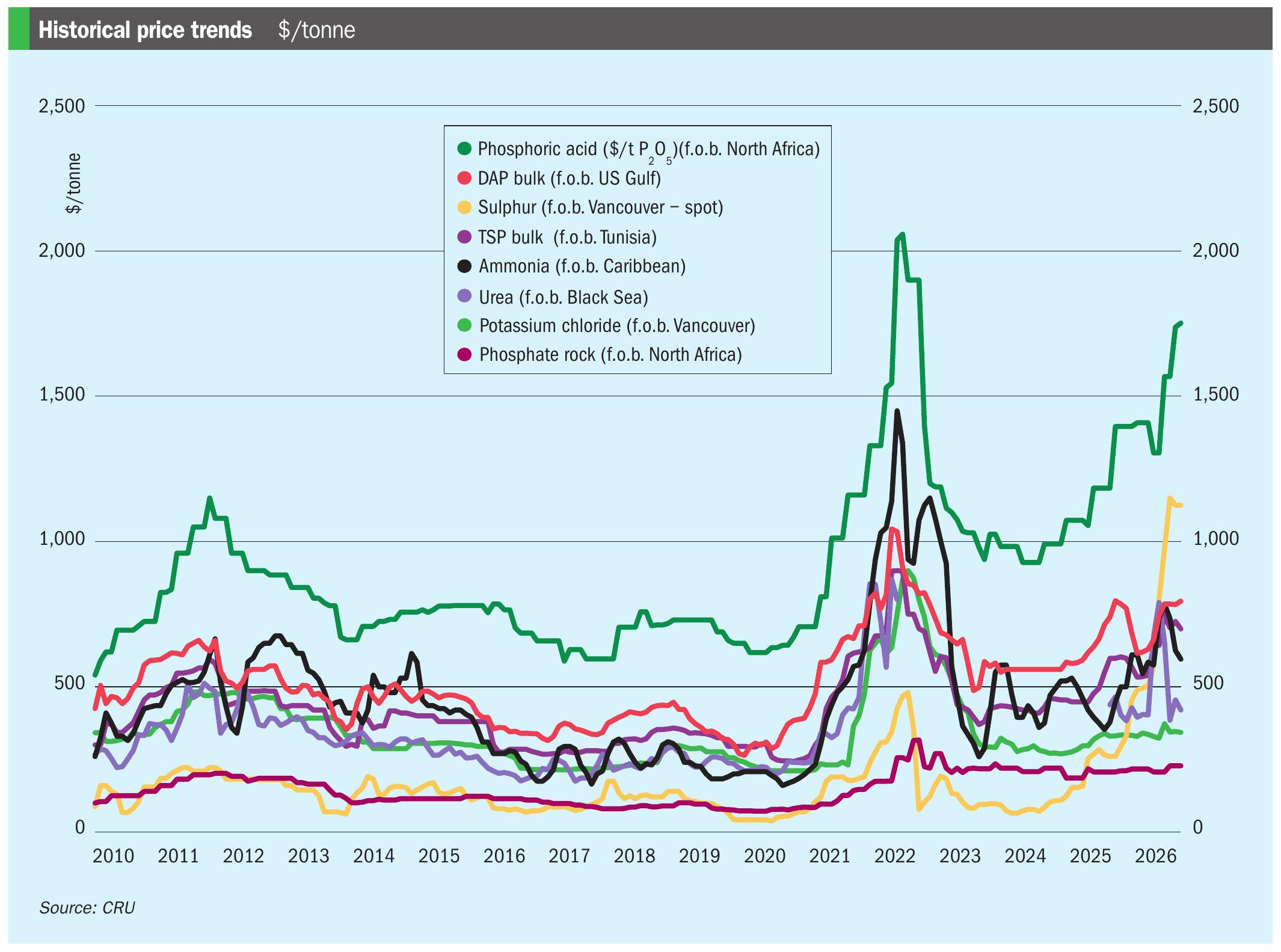
In the ammonia market, another spate of spot deals has emerged in recent weeks at steep premiums to any previously done business in the spot market, pushing f.o.b. prices in the Black Sea and c.fr prices in the US Gulf to highs not seen since late2015.
Severe supply tightness continued to dictate sentiment, and producers were able to lift offers significantly as spot cargoes became available. The deficit appeared to be most concentrated around the US, where following winter storm Uri in February, four production plants remained offline in the US Gulf, and some plants also remained offline in other regions following weather-related gas shortages.
Outside the US, Trinidadian producers were ramping up production as much as possible, but Nutrien’s outage on the island continued, and the producer was forced to step into the market for more Algerian tonnes towards the end of February at a price netting forward to $470/t c.fr US Gulf. The spot sales added upward pressure to the Tampa settlement for March, with a huge increase on the previous month’s $330/t c.fr expected.
Some producers are already reporting to be sold out for April. Price increases into May are widely expected. Argus’ trade balance shows a surplus in the second quarter, with prices falling gradually from April as production normalises. Other market drivers included concerns over the US application season, a Pivdenny price jump of over $40/t, and an outage in Saudi Arabia.
On the urea side, freight has been the dominant topic in the market recently. Rates have risen further after the jump in late February, with Middle East-Brazil freight rates now quoted at $38-40/t, double the rate at the start of the year. The volatility and uncertainty created impeded new sales of urea.
Prices have moved up in Egypt and the US but remained stable elsewhere. Egypt benefitted from strong demand from Turkey in particular, while the US needed to buy substantial quantities of granular urea to arrive by May. Plants in the US were restarting after gas-related closures in February, but additional imports will be needed to cover the production loss.
Elsewhere, the demand outlook is very favourable for 2021. Increased grain plantings are forecast across the globe due to attractive prices. These are always weather dependent, but for now optimism abounds. The market is showing stability in many areas but some marginal gains in f.o.b. levels are likely in March, possibly affecting North Africa and the US. The urea market is forecast to swing to a surplus in the second quarter as demand wanes in the west and new capacity comes on line. Recent market drivers included expectations of agricultural demand, the supply situation in the US and global freight rates.

END OF MONTH SPOT PRICES
natural gas

ammonia

urea

diammonium phosphate