Sulphur 424 May-Jun 2026
22 May 2026

New sulphur projects
SULPHUR PRODUCTION
New sulphur projects
Sulphur production continues to expand in the Middle East and East and South Asia both from new refineries and major sour gas projects.
Elemental sulphur production continues to come almost exclusively from recovered sulphur from refineries and sour gas plants. Prior to the conflict in Iran, most new sulphur output was expected to come from new refineries in China, India and other parts of Asia, as well as major sour gas projects in the Middle East, especially the UAE. However, it remains to be seen what the future may hold for the latter.
Refinery production
In general the trend for sulphur supply from refineries has been a steady increase for several decades, as regulations on the permitted sulphur content of fuels tighten to reduce emissions of sulphur dioxide, especially from vehicles, to reduce the impact on public health. The global push to reduce sulphur levels in vehicle fuels has, over the course of the past three decades, brought sulphur content of fuels from around 800 ppm in Europe and North America down to 10-15 ppm. The so-called Euro-V standard of 10 ppm has steadily become adopted worldwide, and is in force in all of Europe and North America, Australasia and industrial East Asia, Russia, China, India and Chile. The Euro-IV 50 ppm standard was additionally adopted in most of southeast Asia and the Philippines, east and south Africa and parts of South America.
As more markets move to lower sulphur standards, so refineries in those countries must extract that sulphur during fuels production. But moreover, refineries in major exporting countries must also meet these standards if they wish to service those markets. This means that large, export-oriented refineries in e.g. the Middle East or Nigeria must meet Euro-V standards even if local regulations are looser. All of this has previously driven increasing sulphur production from refineries.
However, concerns over the use of fossil fuels are also affecting demand and use for refined fuels. Use of electric vehicles is spreading rapidly, with the proportion of new vehicles that use an electric power train rising rapidly from 8% in 2021 to 25% in 2025. This figure shows considerable regional variation, however; in China 50% of all new vehicle registrations are electrical, while Europe it averages around 25%, although in Norway it is over 95%! Conversely, the US has only around 10% new vehicle registrations from electric and hybrid vehicles, with the removal of federal tax credits by the Trump administration. Ageing global populations (who drive less), the saturation of vehicle ownership in formerly industrialising economies, and the increasing use of ride sharing apps and other shared mobility services are all converging to counter the increased number of vehicles on the roads. The International Energy Agency’s most recent forecast puts global oil demand at 104 million bbl/d this year, down 0.4 million bbl/d on 2025 due to high prices, and currently projects peak global oil demand in 2029 before the factors mentioned above begin to lead to a contraction in global oil use.

Biorefineries
Global refining capacity is undergoing a massive shift, driven by falling refining margins in Europe and the United States, alongside strict carbon transition costs. This has led to high-profile closures and conversions to so-called ‘biorefineries’ in the US and Europe. Since 2009, out of close to 100 refineries operating in Europe, 20 refineries have closed and eight transformed to biorefioneries, including Porvoo in Finland, Grandpuits and La Mede in France and Livorno in Italy. In the US, part of Phillips 66’s refinery at Rodeo, California has been converted to produce renewable diesel from used cooking oil, fats, and soybean oil. HollyFrontier transformed its Cheyenne crude oil refinery into a renewable diesel plant, and Marathon Petroleum has repurposed its Martinez, California and Dickinson, North Dakota facilities to process renewable feedstocks. The Martinez facility was converted to a major renewable fuels plant.
Asia
At the moment, new refining capacity continues to come onstream in Asia and Africa. China has hitherto been the largest destination for new capacity. The country moved rapidly from a Euro-IV standard in 2008 to Euro-V in 2013-18, and Euro-VI from 2021-23. Refinery capacity grew rapidly and recently overtook the US to reach 18.5 million bbl/d, although operating rates lag most of the rest of the world at around 80%. Expansions and new refinery construction continues in China, with up to 1.9 million t/a of new sulphur output, as shown in Table 1. However, in a bid to meet 2030 emissions targes, the Chinese government has announced a cap to refinery capacity of 20 million bbl/d, and is trying to target small, less efficient refineries to close. PetroChina closed its Dalian refinery last year. With the rapid uptake of electric vehicles, China faces increasing refinery overcapacity.
Overall, net annual refining capacity globally is expected to grow by 700,000 bbl/d in 2026, largely driven by expansion projects in India at the Indian Oil Corporation’s Gujarat, Panipat and Barauni refineries. Other large refineries continue to ramp up production, including the Dangote refinery in Nigeria which is running at 500,000 bbl/d and Dos Bocas in Mexico which has reached two thirds of its 340,000 t/a nameplate capacity. But beyond that, projected new refinery additions in Iran look increasingly speculative at present, and India’s huge new Ratnagiri refinery project is also increasingly uncertain. Pakistan and Saudi Arabia have new projects slated over the next few years, but with fuel standards already tight and oil demand peaking, new sulphur from refineries will only total a couple of million t/a over the next few years.

Sour gas
The other main source of sulphur is from processing of sour gas. Use of natural gas has been on a rising trend for many years, rising 20% during the previous decade from 3.45 trillion cubic metres in 2014 to 4.12 tcm in 2021, according to the Statistical Review of World Energy. Last year saw an overall slight decline in world natural gas consumption, particularly in Europe, where price pressures due to the invasion of Ukraine and gradual suspension of Russian gas supplies. Elsewhere, however, gas is still in demand for power production, as it is seen as cleaner than coal in terms of carbon emissions and gas-fired power stations are cheaper and easier to set up. The rapid growth of a global LNG market has made access to natural gas cargoes available to anyone who can build a receiving terminal, and a much more liquid gas market has eased it away from being tied to oil indexed pricing. Nevertheless, as more renewable and nuclear power is installed, so the ‘dash for gas’ that characterised the previous three decades is slowing.
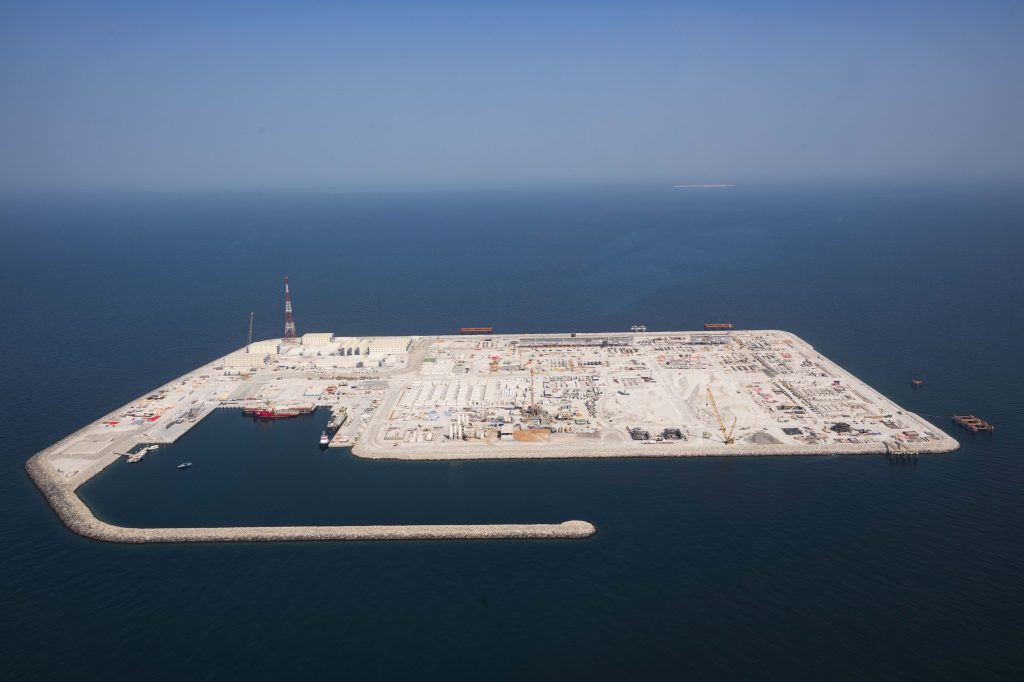
Globally around 40% of all gas resources are classed as sour, though in the Middle East this figure is as high as 60%. The major centres for sour gas production are Sichuan province in China, the Caspian Sea and surrounding area in Central Asia, and the Middle East. Prior to the recent conflict in Iran, major new sour gas projects that will produce additional sulphur volumes were centred on the Middle East (see Table 2), with 6.8 million t/a of new production expected, mainly from the massive Ghasha development in the UAE. Additional incremental production is expected from China, the US, Russia and Turkmenistan.
Supply/demand balance
At the moment, new supply from refining and sour gas, taken together, adds about 13 million t/a of new sulphur production capacity out to 2030, provided that there are no further project delays, most of it in the Middle East and China, though delays in commissioning and ramp-ups in production may mean that actual volumes of sulphur produced are smaller. It is notable that only 3 million t/a of that projected increase comes from oil refining, and the days when refinery sulphur additions were approximately equivalent to that of sour gas based sulphur seem to be over as oil demand peaks and the move to electric vehicles and more fuel efficient engines continues.
While the sulphur market has been in deficit, and particularly given the sulphur stranded by the Iranian conflict, a degree of bounce back is expected in production and distribution once a settlement is reached, assuming that that occurs this year. This would leave Middle East continuing to be the largest exporting region, as new refineries and sour gas projects push additional output much higher than projected demand increases from Saudi Arabia’s phosphate processing. China’s additional sulphur production however will continue to see it importing less over the coming years.