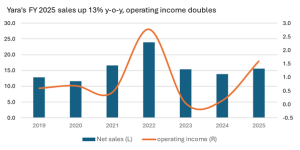
Yara’s 2025 earnings up 46% to $2.75bn
Yara’s full-year earnings (EBITDA) surged to $2.75bn in 2025, driven by stronger nitrogen margins, lower fixed costs and solid volumes.


Yara’s full-year earnings (EBITDA) surged to $2.75bn in 2025, driven by stronger nitrogen margins, lower fixed costs and solid volumes.
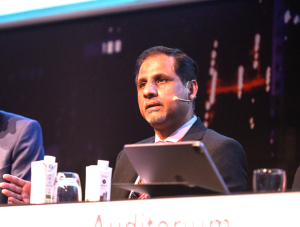
At the CRU Nitrogen + Syngas conference, CRU spoke with Syed Aamir Abbas, Chief Technical Officer at Fauji Fertilizer Company Limited (FFC), about how Pakistan’s fertiliser sector is navigating tightening natural gas availability and what that means for future supply security.

National Fertilizers Ltd (NFL) says its board has given in-principle approval to set up a bentonite sulphur (BS) plant at its Vijaipur unit, with a capacity of 25,000 t/a and an estimated capital cost of INR 1.04bn ($11.5m). NFL said there is currently no BS capacity at Vijaipur, and described the project as being at […]

Metso says it has won a €180 million order for the delivery of engineering and key process equipment for a new primary copper smelter investment at an undisclosed location in Asia. The planned production capacity of the copper smelter complex is 300,000 t/a of copper cathodes and 1.1 million t/a of sulphuric acid, based on licensed Outotec® Flash Smelting, PS Converting and Lurec® technologies. It includes the design and supply of key process equipment for the main areas of the smelter complex, and the gas cleaning and sulphuric acid plant, copper electrolytic refinery, and precious metals refinery. The delivery also comprises site services and spares.
Australia’s Nickel Industries is to sell a 10% share of the Excelsior Nickel Cobalt high-pressure acid leach (HPAL) project in Indonesia to South Korea’s Sphere Corp. The $240 million price tag represents a $2.4 billion valuation for the company. Sphere will acquire the stake from Hong Kong-based Decent Resource, while Nickel Industries will retain its 44% stake in the project, according to Nickel Industries.
PT Vale Indonesia Tbk says it has officially received the first two autoclave units for the Pomalaa high-pressure acid leaching (HPAL) project, a key component of the Indonesia Growth Project (IGP) Pomalaa. This delivery marks a critical milestone in preparing Indonesia’s high-tech nickel processing facility for operation. The welcoming ceremony was attended by PT Vale and PT Kolaka Nickel Industry (KNI) management, along with strategic project partners including Indonesia Pomalaa Industrial Park (IPIP), Huayou Southern Construction Command, MCC20, and other stakeholders.

Metso has booked the third part of its order for JSC Almalyk Mining and Metallurgical Complex’s copper smelter project based on the equipment and project services delivery contracts announced on August 9, 2024. The first parts of the order, worth €146 million were booked in 4Q 2024, and the second part, worth €50 million in 1Q 2025. The order value recorded in 4Q 2025 is €70 million.

Madhya Bharat Agro Products has announced board approval for a major capacity expansion at its Dhule manufacturing facility. The expansion represents a comprehensive enhancement of the company's fertilizer production capabilities, including 330,000 t/a of diammonium phosphate and NPK fertilizer, a 66,000 t/a phosphoric acid plant, and a 396,000 t/a sulphuric acid plant. The expansion plan is part of a strategy of vertical integration in fertilizer production. The addition of phosphoric acid and sulphuric acid production capabilities will support the primary DAP/NPK manufacturing operations, creating operational synergies and potentially reducing input costs, according to the company.
PT QMB New Energy Materials, a major Chinese-owned nickel smelter in Indonesia, is temporarily cutting production due to mounting waste management challenges, according to a 24 November report from local news source Sina, a move expected to temporarily impact regional sulphur demand. The facility, located in the Morowali Industrial Park, will reduce output for at least two weeks as its tailings ponds are nearing capacity while it awaits approval for a new facility. The shutdown may have implications for the sulphur market, as QMB is a major consumer.
Spain’s Methanol Reformer has signed a sales and purchase agreement with Mitsubishi Gas Chemical Company, Inc. (MGC) for the supply of an L18 methanol reformer compliant with Japanese industry requirements. The system will be delivered and installed at MGC’s Niigata plant, with commissioning planned for the second half of 2026. Methanol Reformer says that this, their first industrial project in Japan, reinforces the company’s presence in the Asian market, while for MGC, the collaboration supports the adoption of innovative hydrogen-generation solutions designed to enhance operational applicability and efficiency with reliability.