
Eighth ‘Ultra-Low Energy’ urea project for Stamicarbon
Stamicarbon has been awarded a contract for the licensing, process design package (PDP) and the supply of proprietary equipment for a new urea plant in Eastern China.


Stamicarbon has been awarded a contract for the licensing, process design package (PDP) and the supply of proprietary equipment for a new urea plant in Eastern China.

If decarbonising coffee starts with fertilizer, why don’t they feature more in conversations about sustainable coffee? In this article, Erna Maciulis of Proba outlines practical interventions that address fertilizer emissions from coffee growing. These can unlock significant progress towards Scope 3 emissions reductions – and be easily adopted without disrupting existing farm practices.
In this CRU Insight, Humphrey Knight assesses the key market factors driving high SOP pricing.

NEXTCHEM (MAIRE) to provide the license and PDP for a new nitric acid plant in China and technical assistance services for the revamping of a nitrogen fertilizer complex

Freeport Indonesia may be forced to suspend operations at its Manyar smelter at the end of October due to a lack of copper concentrate, according to local press reports. The news follows the mudslide at the Grasberg mine in September, which killed seven workers. Grasberg, which represents almost 3% of global copper mine production, has halted production and Freeport says that it may not return to pre-accident operating rates until 2027. Stocks of copper concentrate at Grasberg were estimated to be only sufficient to operate the Manyar smelter until the end of October. The $3.7 billion Manyar smelter only resumed operations in May after a fire broke out in October last year, damaging the plant.
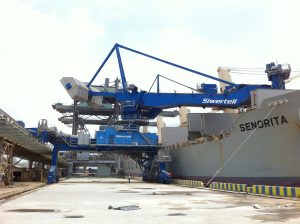
From ship to storage, Bruks Siwertell aims to ensure safe, reliable, high-capacity fertilizer transfers.

The Indonesian government has moved to limit new licenses for nickel projects in an attempt to correct overdevelopment of the industry and the subsequent crash in global nickel prices. The permit restriction applies to new nickel processing companies that produce intermediate products, both with pyrometallurgical (RKEF) and hydrometallurgical (HPAL) technologies. Currently, Indonesia already has 54 nickel processing plants operating, 38 in the construction stage, and 45 are still under planning.
Paradeep Phosphates Ltd (PPL) has announced a $400 million capacity expansion program, following its October 13th merger with Mangalore Chemicals & Fertilizers Limited (MCFL). This company says that the move aims to strengthen PPL's market position and enhance its production capabilities. The investment will involve increasing granulation capacity by 1.0 million t/a at the Paradeep site, as well as an additional 250,000 t/a of phosphoric acid and 750,000 t/a of sulphuric acid capacity at the company’s new Mangalore site. The expansion is expected to be completed within three years, according to PPL, and is expected to ensure 100% backward integration for fertilizer production, reduce import dependency, and enhance operational capabilities and profitability. low-contaminant phosphate concentrate that allows for easy conversion into purified phosphoric acid. The company has spent over C$100 million advancing the project and has received funding and investment from the Quebec Government.

As part of the Japanese government’s Green Transformation scheme, two hydrogen producers have been selected to receive subsidies for low-carbon production projects. Out of the overall $1 trillion GX scheme, $51 billion is earmarked for hydrogen and ammonia investments, with the bulk going towards a long-term programme that subsidises the increased production costs. The first two recipients are a Toyota Tshuho-led consortium (electrolytic hydrogen for steel), and Resonac (hydrogen from used plastics for ammonia). In the programme, production projects are required to have the support of a major hydrogen consumer – in Resonac’s case, this is Japanese chemicals giant Nippon Shokubai, who will offtake the ammonia produced from lower-carbon hydrogen.
Nippon Kaiji Kyokai (ClassNK) has granted approval in principle to SRC for ‘methanol superstorage’, an innovative tank design concept that uses a sandwich plate system technology to almost double shipboard storage capacity for both methanol and ethanol. The approval confirms that methanol superstorage is feasible for the intended application in accordance with the society’s 'Guidelines for Ships Using Alternative Fuels’.