Category: Asia

CIMC Enric commissions biomethanol project

CIMC Enric Holdings Ltd says that it has commissioned China’s first large-scale biomethanol facility in Zhanjiang, Guangdong Province, marking a major step forward in the decarbonisation of global shipping and clean fuel supply chains. The project, developed by CIMC Enric and its subsidiaries, is designed as a fully integrated closed-loop system converting forestry residues into green methanol for use as marine fuel. With an initial annual capacity of 50,000 t/a, it is the country’s first commercial scale green methanol plant, and is backed by the port of Zhanjiang and abundant local forestry wastes.

Contract awarded for nitric acid plant

NextChem has also announced that its nitrogen technology licensing division Stamicarbon, has been a licensing contract and the project development process for a new nitric acid plant in China. The project entails the application of Stamicarbon’s state-of-the-art mono-pressure technology, part of NX STAMI™ Nitrates series, which uses oxygen instead of air as feed for the process, enabling high energy recovery and low operational costs. NextChem says that the award builds on the Group’s longstanding expertise in nitrogen technologies and reflects its commitment to industrialising efficient, low-emission solutions for the agricultural supply chains.

ClassNK approves ammonia/methanol powered bulk carrier

ClassNK has issued approval in principle for a concept design of the Multiple Alternative Fuels Ready (ammonia/methanol/ LNG) bulk carrier developed by Oshima Shipbuilding Co., Ltd. The certification confirms the feasibility of the vessel from regulatory and safety perspectives. ClassNK has published Annex 1 Alternative Fuel Ready of the Guidelines for Ships Using Alternative Fuels, which summarises the requirements for adding class notations to ships that do not use alternative fuels at the time of construction but are designed and partially equipped to accommodate such fuels in the future.

Start-up for new nitric acid plant

Deepak Nitrite Ltd says that its wholly-owned subsidiary, Deepak Chem Tech Ltd, has begun production at its new nitric acid plant in Nandesari, Vadodara district, Gujarat. The 70,000 t/a plant has been completed at a reported investment cost of $57 million. According to the company’s filing, the new plant will allow Deepak to “reestablish supply security for key intermediates, support greater resilience across the group’s chemical value chain and enable deeper penetration into high-value applications”.

MHI successfully produces hydrogen at ammonia cracking pilot plant

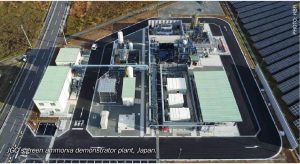
Mitsubishi Heavy Industries says that it has succeeded in producing 99% pure hydrogen by cracking ammonia using steam as the heating source. The production of hydrogen at pilot scale using the steam heating was conducted at the company’s pilot plant in the Nagasaki District Research & Innovation Centre, marking a world first. By contrast to technologies that use heat from burner combustion, MHI’s steam heating system operates at lower reaction temperatures, reducing operating costs. In addition, because a combustion furnace is not required, the system offers excellent features such as the potential for miniaturisation.

World’s largest integrated green hydrogen-ammonia-methanol project

The first 320 MW phase of what China Energy Engineering Corporation Ltd says will ultimately become the world’s largest integrated green hydrogen-ammonia-methanol project HyFlow has officially begun operation in Songyuan City in Jilin Province. With a total investment of nearly $4.30 billion, the Songyuan project uses a “wind-solarhydrogen-ammonia-methanol” integration model, creating an industrial chain that includes hydrogen production and storage, as well as hydrogen-derived chemicals such as ammonia and methanol, hydrogen energy equipment, and scientific research. The project eventually plans to develop 3 GW of renewable energy capacity from wind and solar power, alongside a target production capacity of 800,000 t/a of green ammonia and methanol. The annual production of green hydrogen in the project’s first phase is expected to be equivalent to approximately one-fifth of China’s current total annual green hydrogen production.