Author: richardhands

Sulphur ban extended

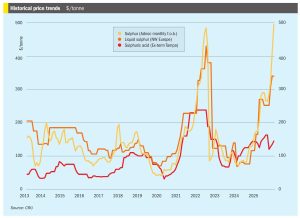
At the end of December, the Russian government extended its ban on the export of technical sulphur until at least the end of March 2026. The move prolongs the initial restrictions, which were first reported on 4 November and which were set to expire at the end of 2025. The initial ban was widely expected and followed early September drone strikes on the Astrakhan and Orenburg natural-gas plants. The official justification for the extension remains to “stabilise shipments of raw materials to the domestic market” and maintain production volumes for mineral fertilizers, according to the government’s press service Interfax.

Arianne to receive government support

Arianne Phosphate says that the government of Canada has approved contribution funding of up to C$735,000 to support the company’s ongoing work on processing phosphate rock and optimising its purified phosphoric acid (PPA) process. The funding, provided through Natural Resources Canada’s Critical Minerals Research, Development and Demonstration programme, is part of a C$80.3 million investment announced by Prime Minister Mark Carney to help build secure critical minerals supply chains in Canada. Phosphate was added to the Canadian critical mineral list in 2024. Arianne’s Lac à Paul project is the only fully permitted phosphate mine in the country. Arianne is now actively pursuing opportunities for the downstream production of PPA, a necessary ingredient for lithium-iron-phosphate batteries.

Market Outlook

• CRU’s latest global sulphur forecast is for a January price peak before a decline, with the key downside risk being a sharper correction if the supply deficit closes faster than expected. The global sulphur market’s upward momentum has been slowing, with attention shifting to geopolitical risks in Iran. Despite limited physical disruption being reported, the upside risk to prices could be substantial. Following the US bombing of an Iranian nuclear facility back in June, supply from Iran became bottlenecked, despite good production levels, as vessel owners became unwilling to call at ports like Bandar Abbas due to the increased risk.

Approval for phosphate expansion

Madhya Bharat Agro Products has announced board approval for a major capacity expansion at its Dhule manufacturing facility. The expansion represents a comprehensive enhancement of the company's fertilizer production capabilities, including 330,000 t/a of diammonium phosphate and NPK fertilizer, a 66,000 t/a phosphoric acid plant, and a 396,000 t/a sulphuric acid plant. The expansion plan is part of a strategy of vertical integration in fertilizer production. The addition of phosphoric acid and sulphuric acid production capabilities will support the primary DAP/NPK manufacturing operations, creating operational synergies and potentially reducing input costs, according to the company.

Indonesian nickel shutdown signals risk for sulphur demand

PT QMB New Energy Materials, a major Chinese-owned nickel smelter in Indonesia, is temporarily cutting production due to mounting waste management challenges, according to a 24 November report from local news source Sina, a move expected to temporarily impact regional sulphur demand. The facility, located in the Morowali Industrial Park, will reduce output for at least two weeks as its tailings ponds are nearing capacity while it awaits approval for a new facility. The shutdown may have implications for the sulphur market, as QMB is a major consumer.

Predicting the unpredictable

The start of the new year has shown that 2026 is already proving to be a very eventful one, beginning with the US abduction of Venezuela’s president Nicolas Maduro, which has prompted questions over production at the country’s ailing nitrogen assets, as well as the potential for a future boost to gas supplies to Trinidad. Meanwhile the Iranian government faces its most sustained public challenge since the 1979 revolution, and possible US military intervention, threatening continued exports from the country. In Europe, the future of fertilizers’ inclusion in the Carbon Border Adjustment Mechanism (CBAM) has been thrown into doubt barely a week after the new regulations came into force, as France and Italy pushed for an exemption for crop nutrient imports.

People

BASF has announced a new management board for the spin-off of its new Agricultural Solutions division as a separate company ahead of its listing and initial public offering (IPO) on the Frankfurt stock exchange. BASF says this will “establish the standalone business as an independent, pure-play agricultural company with global reach, robust growth prospects and strong cash flow generation.” BASF will remain the majority shareholder and will continue to benefit from the company’s growth and success, while implementing market customary corporate governance.

Green ammonia project “economically unfeasible”

World Energy GH2 has shelved its 1.2 GW green hydrogen and ammonia project in Stephenville, Newfoundland, after failing to secure offtake agreements. Project Nujio’qonik was conceived as a major green hydrogen/ammonia scheme backed by 2 GW of new wind capacity, intended to export green ammonia to Europe. However, despite a $50 million investment from South Korea’s SK Eco-plant and high-profile endorsement by then German chancellor Olaf Scholz, the developer has confirmed that the project is being replaced by a new initiative, called Clean Grid Atlantic, which will use the wind resource to power domestic markets instead.