Author: richardhands

Ammonia plant revamp for Kaltim

PT Pupuk Kalimantan Timur (Pupuk Kaltim) says that it has begun work on a revamp to its number 2 ammonia plant. The plant, which was originally constructed in 1984, has a capacity of around 1,500 t/d of ammonia. The revamp, which is being carried out internally by Pupuk Kaltim, aims to improve energy efficiency at the ageing plant and reduce carbon emissions, according to the company. The revamp is expected to extend the plant’s operational life, improve production reliability, and support Indonesia’s long-term fertilizer supply amid rising domestic demand.

Madras seeking approval for greenfield urea plant

Madras Fertilizers Limited (MFL) has submitted a proposal for a new $1.1 billion greenfield ammonia-urea manufacturing project in Chennai, aimed at strengthening domestic fertiliser production and reducing import dependence. The company says that the project is aligned with the government’s broader push for self-reliance in critical agri-inputs and improved food security. The proposed plant will have a capacity of 1.3 million t/a of urea and is currently at the feasibility study stage, but MFL says that its existing 1970s vintage plant is already running at 120% of nameplate capacity, and that a new larger scale facility would see significant improvements in output and operating efficiency.

Green hydrogen for Bilbao refinery

Repsol says that it is planning a 100MW green hydrogen plant to supply its Petronor refinery near Bilbao. From 2029, the plant will supply the refinery with 15,000 t/a of green hydrogen. Repsol says that the installation could prevent up to 167,000 tonnes of carbon dioxide emissions per year. The €292m ($346m) project has already secured €160m ($190m) in NextGenerationEU funds from the Spanish Recovery, Transformation, and Resilience Plan, after being recognised as a Project of Common European Interest by the European Commission.

Tax credit for green methanol project

ETFuels has been awarded €118.6m ($139.8m) in tax credits over 19 years under Business Finland’s Clean Transition program to develop a green hydrogen-based methanol project in Lapland. The credits will go towards the company’s Ranua facility, which is designed to produce 110,000 t/a of green methanol. According to ETFuels, the project, which is currently in early engineering stages, will use 300MW of renewable wind energy alongside battery storage facilities. The Ranua project is being developed in collaboration with Finnish energy firm Neova.

EU to suspend import duties

The European Commission (EC) officially proposed to suspend, for one year, the most favoured nation (MFN) duties on imports of several key nitrogen-containing fertilizers and inputs for their production, including ammonia and urea, officials said 24 February. The tariff suspension will be implemented for all countries, except Russia and Belarus, through duty-free tariff rate quotas, the Commission noted. Imports beyond these quotas will be subject to standard MFN duties, it added.

Another price shock

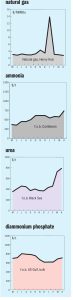
In just its first two months, 2026 had already managed to be a rollercoaster of a year, but at the start of March, the onset of hostilities against Iran by the US and Israel has managed to deliver another huge shock to markets, particularly commodities. Iran’s strategy of widening the conflict to neighbouring states, including by attacking Qatar’s massive LNG facility at Ras Laffan, effectively shutting it down, has sent the LNG market into chaos, and attacks on several tankers and other ships have paralysed maritime insurance markets and by default achieved the long-feared closure of the Straits of Hormuz.

Agreement signed with green ammonia developer

The government of Morocco has signed an agreement with the ORNX consortium to advance a $4.5 billion green ammonia project in the southern city of Laayoune, as part of Morocco’s ambitions to become a global hub for green hydrogen and derivatives. The development combine wind and solar electricity generation with hydrogen from electrolysis to feed green ammonia production. Under the terms of the agreement, more than 2 GW of renewable energy capacity will be installed, feeding 900 MW of electrolysers producing green hydrogen. To ensure operational stability and continuous output, the facility will also incorporate battery energy storage systems. In addition, a seawater desalination plant will be constructed to provide the purified water required for hydrogen production, addressing resource constraints in the arid coastal region. During its initial phase, the complex is expected to generate around 100,000 t/a of green hydrogen, which will allow the production of 560,000 t/a of green ammonia. The ammonia will be used both domestically in ammonium phosphate production as well as being exported internationally.