The Iran war and sulphur markets
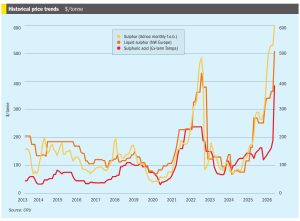
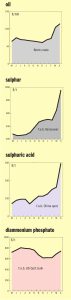
The US and Israel attacks on Iran and the Iranian response have thrown commodity markets into chaos, with sulphur and sulphuric acid particularly affected.
Coromandel International says that it has started trial production at its new sulphuric acid and phosphoric acid plants in Kakinada, Andhra Pradesh. The company says that this marks a crucial step towards transforming the unit into a fully integrated facility, significantly enhancing production capacity and diminishing reliance on imported raw materials for fertiliser manufacturing. The company is now focusing on a phased ramp-up. The new plants have of 2,000 t/d of sulphuric acid and 650 t/d of phosphoric acid, respectively. The integration of these acid plants is strategic, aligning with Coromandel's objective to strengthen backward integration in its fertiliser manufacturing value chain. By producing key intermediates in-house, the company aims to secure stable supplies, enhance cost efficiencies, and achieve greater self-sufficiency, thereby reducing dependence on imported raw materials. The project aims to replace over 50% of the Kakinada plant's imported acid requirements and mirror the integration levels seen at its Vizag and Ennore facilities.
Following an increase in its processing capacity, Duqm Refinery is now looking at further expansion projects at the $9 billion refinery project located, in the Special Economic Zone at Duqm (SEZAD) on Oman’s southeast coast. The refinery, which now has an expanded capacity of 255,000 bbl/d, is run by OQ8, a joint venture between Kuwait Petroleum International (KPI) and Oman’s OQ Group. Speaking to local media, CEO Abdulla Al Ajmi said that OQ8 has now begun front end engineering design on a reformer unit to upgrade naphtha into high-octane gasoline components such as reformate, a critical step in producing finished, specification-grade fuels. In addition to the proposed reformer unit, Duqm Refinery is also exploring opportunities to enhance value creation from its refining by-products, notably sulphur and coke.
The US Chemical Safety and Hazard Investigation Board (CSB) has released its final investigation report into the fatal release of hydrogen sulphide at the PEMEX Deer Park Refinery in Texas in October 2024.
Dyno Nobel has signed a binding agreement for the sale of the Phosphate Hill plant in Australia to Ryowa II GPS Pty Ltd, a wholly owned subsidiary of Mayfair Australia Corporation, it announced 9 March. The purchase is for a nominal A$1.00 (US$0.70), with a deferred value of up to A$100 million payable to Dyno Nobel subject to certain conditions and performance hurdles. Phosphate Hill produces around 400,000 t/a DAP and 200,000 t/a MAP.
Roeland Baan has informed the Board of Directors of Topsoe A/S of his decision to step down as President and CEO of Topsoe effective 31 May, 2026. The Board has appointed Elena Scaltritti, currently the company’s Chief Commercial Officer, as the new President and CEO, from 1 June, 2026.
Maire Group subsidiary KTKinetics Technology says that it has completed work on the Rijeka Refinery Upgrade Project in Croatia, having completed the engineering, procurement and construction activities. The scope of work included a new delayed coking unit to process heavy residue and eliminate the production of fuel oil while increasing refinery efficiency capacity, the revamping of the process units and the utility network and the implementation of the latest solutions for coke handling and storage and sea jetty construction and shipping loading facilities.
Four Chinese-operated nickel plants at the Indonesian Morowali Industrial Park have temporarily ceased operations following a fatal landslide in February, in a development that will significantly reduce regional demand for sulphur and sulphuric acid. The shutdowns affect facilities run by China’s GEM Co. and its partners, which together account for 30% of Indonesia’s high-pressure acid leaching (HPAL) capacity. The move comes amid heightened regulatory scrutiny. The largest of the four plants, PT QMB New Energy Materials, could remain offline for up to three months.
The North Caspian Operating Company (NCOC), which operates the huge Kashagan oil field in Kazakhstan, has said that it is seeking international arbitration to resolve its ongoing dispute with the government of Kazakhstan. Kazakhstan has imposed a swingeing $4.6 billion fine for alleged violations of sulphur storage regulations at the NCOC site. In December, a special administrative court in Astana turned down an appeal by NCOC, although it also granted leave to appeal in a higher court. NCOC, a partnership between Shell, Eni, TotalEnergies, ExxonMobil, China National Petroleum Corporation, Inpex and Kazakh state oil and gas company KazMunayGaz, continues to maintain that its sulphur handling operations have been conducted in compliance with Kazakhstan’s laws and that it had the required permits in place.
Taseko Mines’ Florence Copper project, featuring Metso’s copper solvent extraction and electrowinning (SX-EW) technology, is ramping up its commercial operations in Arizona. The successful harvesting of the first copper cathodes at the end of February 2026 is an important milestone for Taseko Mines and Metso, marking the first new greenfield copper production in the United States since 2008. The project caters to the rapidly growing copper demand while supporting the transition towards more environmentally responsible copper production in North America.