Nitrogen+Syngas 379 Sept-Oct 2022

30 September 2022
Price Trends
Price Trends
Market Insight courtesy of Argus Media
NITROGEN
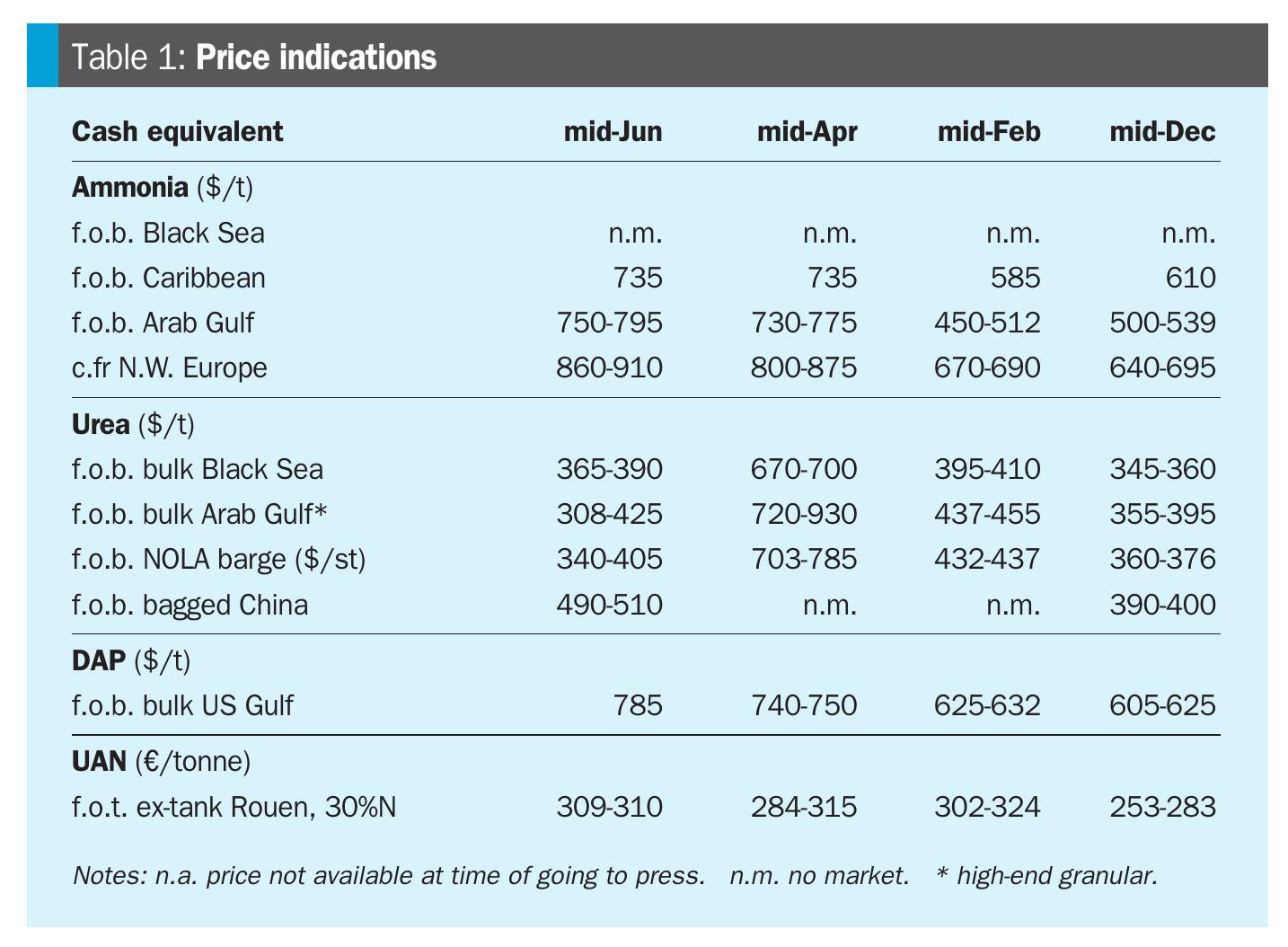
Ammonia prices have been bound within a range, with the market counterbalanced by increasing supply options globally, though this is set against the backdrop of the continuing gas crisis in Europe. Growing supply options for September are creating competition for sellers trying to place cargoes into Europe and putting slight downward pressure on spot prices.
In the spot market, OCP bought its first cargoes from Salalah – the 1,000 t/d Sala-lah ammonia plant in Oman loaded its first commercial export cargo in August and OCP bought 15,000 tonnes from Oman’s OQ Trading, loading in late-August on Gas Walio to Jorf Lasfar. OCP has bought another 25,000 tonnes for September-loading on an f.o.b. basis. Ameropa also purchased a cargo from Ma’aden for delivery into northwest Europe, all at undisclosed prices.
European buyers are covering positions as far in advance as possible, and other large buy regions previously dependent on Black Sea exports appear to be covered with new supply contracts. In the east, there is a growing disconnect between Asian markets and the west, as buyers look to distance themselves from the inflated pricing in Europe. While supply is outstripping demand for now, baseline European production cost estimates are now over $2,500/t. Global supply optionality continues to provide cargoes at around half the price of this cost, but whether or not producers can continue with current production strategies into 4Q at this level remains uncertain. European gas costs continue to be high; the month-ahead Dutch TTF contract closed at a new high of over $70/MMBtu today. Further volatility is anticipated as a result of supply uncertainty regarding Norwegian outages and weak Russian deliveries into the region.
Urea prices fell for consecutive weeks in mid-August, across most markets around the world on thin demand and amid producer length in key regions. Middle East prices dropped sharply as producers cut prices to clear remaining August and early September cargoes – three were confirmed trading between $550-556/t f.o.b. Similar f.o.b. prices were seen in southeast Asia in mid-August, with deals between $540-557/t f.o.b. in Brunei and Indonesia. Some pockets of activity bucked the softening trend though. Prices for granular urea delivered to Myanmar rose by around $30/t, while Iran f.o.b. prices climbed by $20/t from last business in a series of deals at $500/t f.o.b.. But overall, with demand in Europe, Brazil, US and southeast Asia low the market remains soft.
Natural gas crisis – feedstock costs for Europe and LNG-dependent nitrogen plants pushed to new highs in mid-August and more plants in Europe are talking about shutting down. Though premium nitrogen prices would normally attract product, some ammonium sulphate and urea suppliers from non-traditional origins are struggling to comply with the EU’s new quality and traceability regulations, blocking this trade flow.

END OF MONTH SPOT PRICES
natural gas

ammonia

urea

diammonium phosphate