Micronutrients – their unquestionable crop benefits
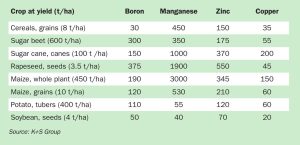
Dr Setareh Jamali Jaghdani and professor Jóska Gerendás of K+S Group outline how micronutrient management, by positively influencing plant physiology and development, helps maximise crop yields.
We highlight recent innovations, including fertilizers recovered from industrial residues, novel controlled-release coatings, and products that incorporate biological components designed to benefit both crop nutrition and soil heath.
We compare and contrast the 2023 financial performance of selected major fertilizer producers following the publication of fourth quarter results.
The 22nd New AG International Annual event is taking place at the Estrel Congress Centre, Berlin, Germany, 9-11 April 2024. Fertilizer International is delighted to be supporting the conference as media partner for the first time.
We review potash mining and mineral processing methods. Advances in equipment technology and major project investments are highlighted.
Applications of chloride-containing fertilizers need to be carefully managed for crops such as berries, broad beans, citrus fruits, nuts, potatoes and stone fruits. Selecting chloride-free nutrient sources instead can offer distinct advantages.
Many crops are sensitive to chloride due to a genetic susceptibility. Similarly, crops can become stressed when soil salinity reaches high levels, a situation that typically occurs in water scarce regions. So, when is low-chloride crop nutrition needed? Dr Heike Thiel of K+S Minerals and Agriculture GmbH provides some answers.
Market Insight courtesy of Argus Media. Urea: Scarcity continued to drive urea prices higher in some markets at the end of April. The US market remains short on urea and prices spiked to reflect this. Nola barges for April were trading as high as $450/st f.o.b. ($490/t cfr), 55 percent up on this year’s low point. Southeast Asia remains short on urea too, amid planned and unplanned turnarounds, with one cargo trading at around $345/t f.o.b.
The global potash market has endured a tumultuous 18 months, says Andy Hemphill, senior editor for potash and sulphuric acid at ICIS Fertilizers. Export sanctions, high offer prices and buyer unrest persist as we enter 2023.
Last year saw global trade in all commodities have to take into account the potential loss of supply from Russia, a key exporter of many commodities. Sulphur was no exception, with prices swinging wildly across the year.