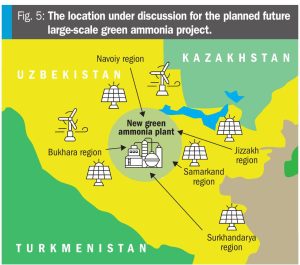
Green ammonia technology in Uzbekistan
A summary of Uzbekistan’s industrial baseline, historical operational experience with electrolysis, the 2025 green hydrogen pilot at Chirchiq, and the current outlook for scaling green ammonia production.
Thiozen Inc. has piloted a patented thermochemical process that removes hydrogen sulphide from sour gas while converting it into hydrogen.
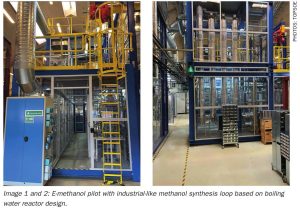
Topsoe explains how to avoid challenges and choose the optimal solutions for e-methanol plants based on CO2 feedstocks, electrolytic hydrogen and renewable power.
Hydrogen Poland and the Hungarian Hydrogen Technology Association (HHTA) have signed a memorandum of understanding (MoU) to cooperate on hydrogen regulations and green ammonia production across Central Europe, according to media reports.
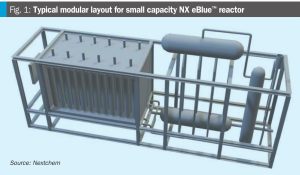
NX eBlue™ is a next-generation hydrogen production technology, ready for industrial deployment, that integrates electrification with renewable energy to deliver a low-carbon, high-efficiency alternative to traditional steam methane reforming. M. Antonelli, M. Mennella, and Dr. S. Romagnuolo of KT Tech S.p.A. describe NEXTCHEM’s proposal for the electrification of steam methane reforming.
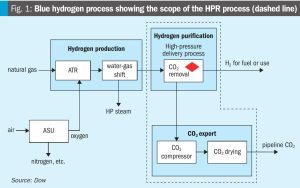
A novel high-pressure regeneration (HPR) process for carbon capture in blue hydrogen applications is introduced by Dow as a new offering for reducing costs. The process combines a specially formulated solvent with a heat integration network to deliver the separated carbon dioxide at high pressure while reducing capital costs and equipment sizes.
The Deutsche Gesellschaft für Internationale Zusammenarbeit (GIZ) and thyssenkrupp nucera have entered into a new agreement to accelerate the development of green hydrogen and Power-to-X markets in India. Announced at India Energy Week in Goa, the partnership brings together international development cooperation and private-sector technological expertise to unlock opportunities along the country’s hydrogen value chain.
Norwegian oil and gas major Equinor says that it is no longer pursuing its planned H2M Eemshaven blue hydrogen project in the Netherlands, citing policy uncertainty and insufficient funding. The project was a joint venture between Equinor and Linde, and would have produced hydrogen from natural gas piped from Norway, with a capacity of 210,000 t/a of hydrogen beginning in 2029. Around 95% of the carbon dioxide produced would then be piped back to offshore storage sites near the Norwegian coast. Equinor had received a grant of €162 million for the project from the European Innovation Fund last summer. However, uncertainties over whether the project would receive carbon credits under the EU’s RED III directive, and a lack of local hydrogen infrastructure at Eemshaven meant that the project was unable to secure offtake agreements.
Repsol says that it is planning a 100MW green hydrogen plant to supply its Petronor refinery near Bilbao. From 2029, the plant will supply the refinery with 15,000 t/a of green hydrogen. Repsol says that the installation could prevent up to 167,000 tonnes of carbon dioxide emissions per year. The €292m ($346m) project has already secured €160m ($190m) in NextGenerationEU funds from the Spanish Recovery, Transformation, and Resilience Plan, after being recognised as a Project of Common European Interest by the European Commission.
Worley has been awarded a five-year engineering, procurement and construction management (EPCM) services contract by Energinet Brint A/S to support Phase 1 of the Danish Hydrogen Backbone pipeline. Danish Hydrogen Backbone 1 will establish a national hydrogen transmission network for Denmark, linking large scale green hydrogen production from wind and solar to Germany and wider European markets, supporting Europe’s energy supply.