Sulphur 425 Jul-Aug 2026
14 July 2026
Options for refinery decarbonisation
REFINING
Options for refinery decarbonisation
While there has been a focus on switching to low carbon hydrogen feeds, many options exist to decarbonise refineries, including energy efficiency, carbon capture and changing to bio-feedstocks.
Refinery decarbonisation is potentially one of the most technically demanding parts of a transition to lower carbon production. Refineries are highly integrated industrial systems built around continuous operation, precise product specifications, and interdependent heat, power, hydrogen, and conversion units. That makes emissions reduction more complicated than in sectors where the main challenge is simply replacing one feedstock with another. The industry is gradually converging on a mixed pathway: low-carbon hydrogen is a central feature, but it has to be combined with energy efficiency, electrification, carbon capture, and in some cases site reconfiguration.
Hydrogen’s centrality is because it is one of the most important utilities in a refinery and also one of the largest sources of site emissions. Hydrogen is used in hydrotreating, hydrocracking, sulphur recovery, and product upgrading. In most conventional refineries it is made from fossil feedstocks, which means that even if the refinery is otherwise efficient, the hydrogen system can still account for a large share of direct CO2 emissions.
Hydrogen
Hydrogen decarbonisation can take several forms, and the industry is clearly not relying on one route alone. Green hydrogen produced by electrolysis is the most visible option, especially where there is access to low-carbon electricity and an industrial buyer with a steady load. Blue hydrogen, produced from natural gas with carbon capture, remains relevant in some contexts because it can fit into existing industrial hydrogen systems more easily than a fully new build renewable supply chain. Biohydrogen also has a role in certain biorefinery settings. There is also a growing market for long-term third-party supply contracts, where the refinery does not produce the hydrogen itself but instead secures delivery through a dedicated project or partnership.
Electrolysis is the technology attracting the most attention, but a refinery-linked electrolyser is a demanding asset. It requires a large and reliable electrical connection, water treatment, compression, hydrogen storage, and close integration with the refinery’s hydrogen headers and process units. It also needs a power supply strategy that works at an industrial scale. In many cases the project economics are shaped as much by electricity price, grid fees, and renewable certification rules as by the electrolyser itself. If the system runs at low capacity factors, hydrogen costs rise sharply. If it is built around intermittent renewable generation without enough storage, the refinery is exposed to supply variability that is unacceptable for continuous operation. This is why near-site projects are attractive; they reduce transport complexity and make it easier to tie production directly to demand.
Commercial structure matters almost as much as technology. The refinery sector is now using long-term offtake agreements, joint ventures, and supply tenders to derisk low-carbon hydrogen projects. Partnerships with industrial gas companies, utilities, and renewable power developers illustrate this shift clearly. Refiners need guaranteed supply at consistent quality, while hydrogen producers need guaranteed demand to secure financing. Long-term contracts bridge that gap and make capital-intensive infrastructure bankable. This is a crucial change in how downstream assets are being managed. Historically, refinery utilities were mostly self-generated, and the refinery owner carried the engineering and operating risk internally. Now the decarbonisation model is increasingly networked. The refinery becomes an anchor customer in a broader regional hydrogen system, and that system may include dedicated electrolysers, renewable power purchase structures, industrial gas partners, and shared infrastructure.
Energy efficiency
Although hydrogen attracts much of the attention, energy efficiency remains one of the most practical and lowest-cost decarbonisation levers available to refiners. Refineries consume very large quantities of heat, steam, and electricity, so even modest efficiency improvements can deliver meaningful emissions reductions. In a mature asset base, this usually means incremental optimisation rather than dramatic redesign. Better heat integration, reduced fuel consumption in furnaces, higher-efficiency boilers, improved steam balance, and more effective waste heat recovery all contribute to lower emissions. These measures are often less visible than green hydrogen announcements, but they are essential because they reduce the baseline energy demand of the site before more expensive decarbonisation projects are layered on top.
The technical challenge is that refinery processes are already highly integrated, so additional efficiency gains are often marginal and operationally complex. Heat exchanger networks are tightly coupled to process conditions, feed quality, and product specifications. A change in one unit can affect energy use across the site. For that reason, refinery efficiency programmes usually rely on detailed process modelling, digital monitoring, and ongoing maintenance discipline. Advanced control systems can help stabilise operations and reduce flaring, while energy management systems can identify hidden losses in steam traps, compressors, and utility loops. The biggest gains tend to come not from one major intervention but from many small improvements applied consistently across the site.
Energy efficiency also matters because it lowers the size of the decarbonisation challenge itself. A refinery that reduces its heat and power demand needs less hydrogen, less electricity, and potentially less carbon capture capacity. That makes efficiency foundational rather than secondary. In practice, many refineries are likely to use efficiency measures to buy time and reduce cost while larger infrastructure projects are being developed. This sequencing is rational because it helps avoid overbuilding low-carbon utilities before the refinery’s final configuration is clear.
Carbon capture
Carbon capture remains part of the refinery decarbonisation toolkit, particularly for residual emissions that cannot easily be removed through hydrogen substitution or electrification. Fired heaters, furnaces, and some process vents will continue to emit CO2 even in a more efficient refinery. Capture can be applied to hydrogen production units and larger combustion sources, but it creates a new chain of dependencies that includes transport, storage, compression, and regulatory oversight. It is therefore best understood as a complementary tool rather than a first-line solution. In practice, many refineries are likely to use hydrogen decarbonisation first, then add capture where the remaining emissions are difficult to eliminate.
From an engineering standpoint, carbon capture in refineries faces two main constraints. The first is source diversity. Refinery emissions are spread across many small and medium-sized point sources, which makes capture more complex than in a single large industrial stack. The second is heat integration. Capture systems consume energy, and that energy demand must be managed without undermining the emissions reductions that the project is intended to achieve. For hydrogen units, capture can be more straightforward because the exhaust streams are often more concentrated. For general combustion units, the economics are usually more challenging.
Nevertheless, capture is important because it addresses the parts of the refinery that are hardest to eliminate by other means. Even if a refinery replaces a large portion of its fossil hydrogen with green hydrogen, it may still have substantial emissions from process heat, utility boilers, and certain conversion operations. Capture can therefore serve as the residual abatement mechanism that allows the site to move from partial to deeper decarbonisation. In a broader industrial policy context, it also matters because it keeps decarbonisation options open for assets that may remain strategically important for years even as product demand shifts.
Feedstocks and product slate
Refinery decarbonisation also depends upon the feedstocks being processed and the products being made. This is especially important because different feedstocks carry different processing requirements and different lifecycle emissions profiles. Heavier, more sulphur-rich crude slates generally require more hydrogen and more processing energy than lighter, sweeter crudes. That means refinery emissions are not fixed; they vary with crude quality, throughput, and product mix.
As product demand changes, the industry is also seeing more focus on renewable and lower-carbon feedstocks. Biorefinery operations such as La Mède and Grandpuits show how feedstock transition and hydrogen transition are becoming linked. Renewable diesel, sustainable aviation fuel, and other bio-based products still require significant process energy and hydrogen inputs, so the climate performance of the final product depends not just on the feedstock itself but also on the utilities used to convert it.
Co-processing is another important theme. Some refineries are adapting existing units to process renewable feedstocks alongside conventional hydrocarbon streams. This can reduce the need for entirely new standalone assets, but it increases operational complexity because the refinery has to manage variable feedstock quality and ensure product consistency. Feedstock flexibility may become a competitive advantage, especially if regulatory regimes increasingly reward low-carbon liquid fuels. However, it also requires investment in pretreatment, storage, and process control.
Site integration
Refinery decarbonisation is increasingly regional in nature. A refinery is part of a wider industrial ecosystem that may include ports, pipelines, chemical plants, renewable generators, storage assets, and hydrogen networks. This is especially obvious in European refineries; sites in Belgium, the Netherlands, Germany, and France all sit within different infrastructure and policy contexts, and each site requires a distinct project design.
This regional dimension matters because low-carbon hydrogen and carbon capture both depend on infrastructure that often lies beyond the refinery fence line. Electrolysers need grid access and sometimes direct renewable supply. Carbon capture needs transport and storage. Hydrogen may need pipelines or local storage. Industrial partnerships, joint ventures, and long-term supply arrangements all form part of the necessary ecosystem. This is likely to become the standard model across the sector because the scale of investment is too large and the infrastructure too interconnected for one company to build everything alone.
Economics and competitiveness
Refinery decarbonisation is expensive, and that cost has direct competitiveness implications. Low-carbon hydrogen generally carries a cost premium versus conventional fossil hydrogen, especially when power prices are high or electrolyser utilisation is low. Carbon capture also adds capital and operating cost. Energy efficiency measures are usually cheaper, but they do not deliver enough abatement on their own. This means refiners must balance decarbonisation ambition against margin pressure and market uncertainty.
The economics are shaped by policy as much as by technology. Carbon pricing, renewable fuel mandates, hydrogen incentives, industrial decarbonisation support, and emissions regulations all affect the business case. In Europe, this policy environment is one of the reasons decarbonisation is moving fastest. The combination of regulatory pressure and industrial strategy makes it more likely that low-carbon refinery projects will be built, even if their economics are challenging in purely merchant terms.
Competitiveness also depends on timing. Refineries that move early may secure renewable power, hydrogen supply, and industrial partners before the market tightens further. Those that wait could face higher costs, weaker access to infrastructure, and more difficult compliance obligations. At the same time, an early mover strategy carries risk because technology costs may fall and policy frameworks may evolve. That is why many refineries are sequencing projects carefully, beginning with the largest and most bankable emissions reductions, then expanding as market conditions improve.
Impact on sulphur production
Green/low-carbon hydrogen mostly changes the source of hydrogen, not the sulphur balance. If the refinery uses the same crude slate and makes the same products, sulphur output should be roughly unchanged. However, if low-carbon hydrogen enables the refinery to keep running deep desulphurisation units at high severity, then sulphur recovery could stay high even as emissions fall.
Feedstock changes and biorefining are the main cases where sulphur output can change materially. If a refinery shifts toward lower-sulphur crudes, hydrotreated renewable feedstocks, or bio-feedstocks then sulphur recovery may fall significantly. If a refinery meaningfully shifts its feed slate toward bio-feedstocks or low-sulphur crude, sulphur recovery volumes can decline by 30–80%, depending on how much fossil feed remains.
CASE STUDY: SHELL PERNIS
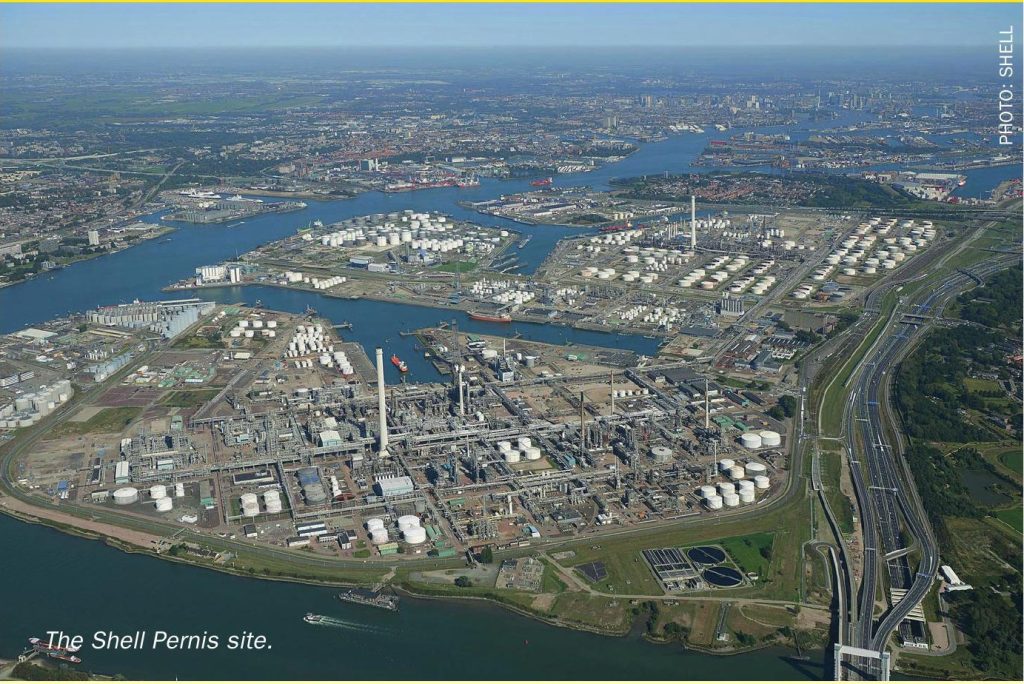
As described in a recent publication, Shell Pernis in the Netherlands is an example of how a complex European refinery can approach decarbonisation in stages rather than through a single step change. The refinery sits in one of Europe’s most industrialised and infrastructure-rich locations, which matters because refinery decarbonisation depends heavily on access to power, hydrogen, and CO2 transport infrastructure. Pernis is a relevant example for blue hydrogen, carbon capture, and broader utility-system transformation, illustrating the main options available to a mature refinery seeking deep emissions reductions without abandoning its core industrial role.
1. Hydrogen is the central lever. Pernis, like most complex refineries, depends on hydrogen for hydrotreating and upgrading. Replacing fossil-derived hydrogen with low-carbon hydrogen can cut a large share of direct emissions without fundamentally changing the refining process. In a European context, the most practical routes are likely to be imported green hydrogen, blue hydrogen backed by carbon capture, or a combination of both as infrastructure develops. For Europe, imported low-carbon hydrogen becomes more attractive as grid decarbonisation progresses and hydrogen networks mature.
2. Electrification is most effective at the utility level. Rather than electrifying every heater at once, a site like Pernis can reduce emissions by converting steam and power systems first: electric boilers, electric drives, and selected heat-recovery applications offer the best early returns. This aligns with other sources, which find that condensing turbine replacement and electric steam production are among the most attractive options. For a large existing site, that approach also reduces operational disruption.
3. Carbon capture remains essential for residual emissions, especially from process units such as the FCC and hydrogen production assets. For a refinery like Pernis, capture is most viable when it is part of a regional cluster with shared compression, transport, and storage infrastructure. That is why the Dutch and wider North Sea carbon storage context is so important. Without that infrastructure, the economics become much harder.
Shell Pernis represents a likely European refinery transition model: efficiency first, then electrification, then low-carbon hydrogen, and finally carbon capture for the stubborn remainder. It is not a low-capex transformation, but it is a technically credible one for a complex refinery that will continue to serve fuels, petrochemicals, and industrial demand
References