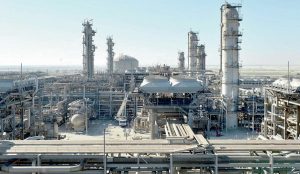
Sulphur plant revamps to meet future challenges
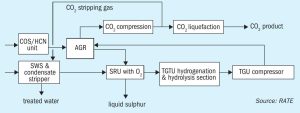
RATE USA discusess some of the many solutions available to revamp sulphur plants to meet stricter environmental regulations with regard to SO2 and CO2 emissions.
The CO2 emissions in a hydrocarbon fed hydrogen plant occur largely during the energy intensive syngas production step. Hydrogen production is therefore a major factor in the CO2 emission balance of an ammonia plant. BASF’s OASE® technologies for CO2 capture are capable of achieving cost-effective 99.99% carbon capture at scale. In this article Elena Petriaeva and Bernhard Geis of BASF investigate different grey and blue hydrogen production technologies.
Following the completion of expansion work on the ultra-sour gas Shah field in May 2023, production has been ramped up. Occidental, which owns 40% of the Shah project and which operates the field in conjunction with ADONC Sour Gas, reported in July that it had achieved record output at Shah, with gross gas sales reaching 722 million scfd in Q2 2023 (equivalent to 1.1 billion scf/d of raw gas, which is 23% H2S and 10% CO 2 ). The expansion has taken processing capacity at Shah to 1.45 billion scf/d and forms part of the UAE’s plans to achieve gas self-sufficiency by the end of the decade. The expansion was conducted by Saipem, who were awarded a $510 million contract in 2021 to expand output from 1.3 billion scf/d to the current 1.45 billion scf/d. Work was completed two months ahead of schedule, according to Occidental.
TarT technology, one of 8 Rivers’ decarbonisation technologies, shows promise as an economical, efficient, sour gas sweetening process with near-zero carbon dioxide emissions, and may be key to unlocking access to the world’s sour gas reserves.
Some 1,400 delegates from 533 companies and 83 countries gathered in Prague, Czech Republic, for the 90th International Fertilizer Association (IFA) Annual Conference, 22 May – 24 June 2023. We report on the main highlights of this three-day flagship event.
Antoine Hoxha, the new Director General of Fertilizers Europe, looks ahead at the future of the EU fertilizer industry, setting out his vision of an industry transformed by decarbonisation, new energy markets, sustainable agriculture and the circular economy.
The world’s transition toward the use of hydrogen and ammonia as clean energy and fuel sources will depend upon production technologies that are affordable, scalable, and meet net zero carbon targets. 8 Rivers recently introduced8 RH2 , a groundbreaking solution that offers world-leading efficiency in hydrogen production and captures over 99% of CO2 emissions. Maulik Shelat of 8 Rivers provides an overview of the technology with a comparison to other low-carbon hydrogen production technologies.
Linde has developed a new adsorptive carbon dioxide removal process, called HISORP® CC, including but not limited to blue ammonia production. Based on a combination of mature technologies the process overcomes the drawbacks of traditional CO2 removal techniques and provides a carbon capture rate of greater than 99%. Thomas Ried discusses the pros and cons of different process configurations for CO2 removal and the benefits of the new technology.
Gas Chemical Complex MTO Central Asia LLC has signed an agreement with Air Products to build a new methanol production facility. Known as Methanol Island, the facility would have a capacity of 1.34 million tons per year, as a part of the Methanol-to-olefin (MTO) gas chemical complex in Uzbekistan. The facility, to be built in the Karakul Free Economic Zone situated in Uzbekistan’s Bukhara region, will cover 15 hectares. It is planned to enter operation in 2025 for an expected operational life of 25 years.
The first global review of phosphate rock resources since 2010 has reported that technically recoverable reserves should last for more than 300 years.