Sustainable refineries
Liquid fuels will be with us for decades to come, but refiners will be pushed to decarbonise their activities, via greater use of biofuels, and green/blue hydrogen use.
Rising costs of fossil fuels in many markets, including coal in China and high gas costs in Europe are pushing up ammonia production costs. Can the falling cost of electrolysis make green ammonia production cost competitive in the near future?
Previously, recuperative reforming has been mostly applied for capacity increase revamps, but nowadays it is a key enabler for efficient low carbon hydrogen and syngas production. Jan-Jaap Riegman of Technip Energies, Francesco Baratto of Casale and Stefan Gebert of Clariant discuss the benefits of recuperative reforming for reducing the carbon footprint of existing assets.
ExxonMobil has awarded the contract for front-end engineering and design (FEED) of what it describes as the world’s largest low-carbon hydrogen production facility. A final investment decision for the project is expected by 2024, subject to stakeholder support, regulatory permitting, and market conditions. Technip Energies will conduct the FEED for the Baytown integrated complex, which will produce up to 1 bcf/d of low carbon hydrogen, while capturing more than 98% of associated CO2 emissions, totalling around 7 million tCO2 e/year. Offtake agreements are reportedly under discussion with third party customers. Start-up is planned for 2027-2028. The carbon capture and storage network being developed for the project will also be made available for use by third-party CO2 emitters in the area in support of their decarbonisation efforts.
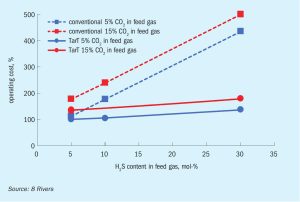
Fluor demonstrates how SRU/TGTU plants within sour gas facilities can facilitate the capture of CO2 and generate H2 by implementing advanced sulphur recovery technologies.
CO2 emission abatement strategies have become increasingly important as the world strives to combat global climate change. RATE discusses carbon capture options available for sulphur recovery units.
Stamicarbon has won a contract for a large-scale urea project in China. The urea plant, with a production capacity of 3,800 t/d, will be the largest ever licensed by Stamicarbon in the country. The customer, the plant’s location and the value of the contract have not been disclosed.
Yara International has approved a project to partly convert its Pilbara plant near Karratha in Western Australia to green ammonia production.
A report on CRU’s annual Sulphur + Sulphuric Acid conference, which returned to being face to face meeting at the end of October 2022.
Topsoe has agreed to supply an initial 500 MW of industrial-scale, solid oxide electrolyser cells (SOEC) to First Ammonia, a US company aiming to produce green ammonia for transportation fuel, power storage and generation, as well as fertilizer, at sites in northern Germany and the southwestern United States. The companies envisage that over the lifetime of the agreement some 5 GW of SOEC electrolysers will be supplied, potentially replacing almost 5 bcm of natural gas and eliminating the emission of 13 million t/a of CO 2 emissions. The facility to manufacture the electrolyser cells will be built in Herning, Denmark, and has recently received a final investment decisions from Topsoe’s board.