SulGas Mumbai 2024
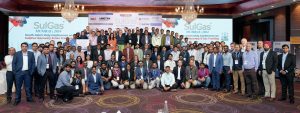
We report on the key highlights of the annual SulGas® conference, organised by Three Ten Initiative Technologies LLP,, which took place in Mumbai, India, from January 31 to February 2, 2024.
We look at current progress towards the greater use of recovered phosphorus, and whether there are lessons to learn from the success of the fast-growing carbon capture industry. We also highlight two pioneering European companies, EasyMining and Glatt, who are racing to bringing recovered phosphorus products to market.
The US is experiencing a new boom in nitrogen projects, with a number of carbon capture ammonia plants under development.
New blue production schemes are available to meet the need to significantly reduce the overall carbon intensity of high-volume hydrogen and ammonia production for a large-scale emerging market. KBR, Air Liquide, Mitsubishi Heavy Industries, Casale and Johnson Matthey report on their latest technologies.
Freeport Indonesia has inaugurated the $250 million expansion at its PT Smelting copper smelter in Gresik, East Java, in a ceremony attended by Indonesian president Joko Widodo. Smelting, a joint venture between Freeport McMoRan and Mitsubishi Materials, has increased copper concentrate processing capacity to 1.3 million t/a, up from the previous figure of 1.0 million t/a, with copper cathode production of 300,000 t/a.
In spite of nearly two years of western sanctions, Russian exports of nitrogen fertilizer have recovered almost to pre-war levels, while high prices led to record earnings in 2022.
The Saudi Arabian Mining Company (Ma’aden) has entered into a partnership with Metso and thyssenkrupp Uhde to develop and license an integrated process to reduce carbon emissions and recycle phosphogypsum in Saudi Arabia. A framework agreement between the three partners was jointly announced on 10th January.
While producing ammonia with hydrogen from electrolysis remains expensive, large scale lower carbon ammonia has focused on carbon capture and storage from existing plants, so-called ‘blue’ ammonia. But exactly how green is blue?
RATE USA discusess some of the many solutions available to revamp sulphur plants to meet stricter environmental regulations with regard to SO2 and CO2 emissions.
The CO2 emissions in a hydrocarbon fed hydrogen plant occur largely during the energy intensive syngas production step. Hydrogen production is therefore a major factor in the CO2 emission balance of an ammonia plant. BASF’s OASE® technologies for CO2 capture are capable of achieving cost-effective 99.99% carbon capture at scale. In this article Elena Petriaeva and Bernhard Geis of BASF investigate different grey and blue hydrogen production technologies.