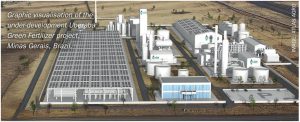
Brazil’s UGF project – delivering the energy transition
Brazil is well-positioned to lead the global transition to low-carbon ‘green’ fertilizers, suggests Petter Ostbo, CEO and founder, Atlas Agro.
Recent developments show the Carbon Border Adjustment Mechanism (CBAM) remains active for fertilizers, but the European Commission proposes tariff reductions to offset import costs. Tariff suspension details The Commission will temporarily suspend remaining Most-Favoured-Nation (MFN) tariffs on ammonia, urea, and certain other fertilizers. Import tariffs from most-favoured nations stand at 6.5%, excluding higher staged tariffs […]
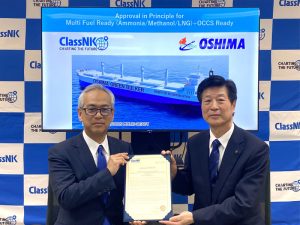
ClassNIK and Oshima Shipbuilding agree AiP for ammonia/methanol/LNG and OCCS Ready Bulk Carrier
Barents Blue partners with Proton Ventures on Barents Clean Ammonia project, Europe's largest clean ammonia production plant
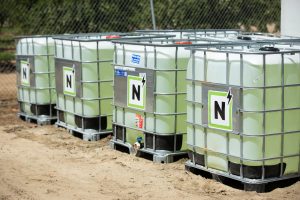
Nitricity has secured $50 million in funding and commenced building a liquid fertilizer production plant in Delhi, California.
Sustainability consultancy ERM has been has been tasked with developing a low-carbon roadmap for the potash and phosphate industry.
Could demand mandates help the build the market for green fertilizers – by placing mandatory purchasing requirements on large-scale end users?
John Carr, Lei Zhang & Yu Zheng of Syensqo review currently available decadmiation techniques, including the company’s ACCO-PHOS® technology.
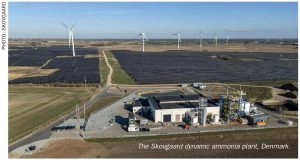
As I write this editorial, the 30th meeting of the Conference of the Parties (COP) to the UN Framework Convention on Climate Change – aka COP-30 – is taking place in Brazil. It is fair to say that the attempt to try to restrict a large greenhouse gas-driven temperature rise across the planet has become one of the defining issues of our age, and particularly for an energy-intensive industry such as our own, responsible as it is for up to 2% of global carbon and carbon equivalent emissions. The move towards lower carbon intensity production of hydrogen, ammonia and methanol, via carbon dioxide capture and sequestration, gasification of biomass or waste, or electrolysis of water using renewable power, has come to dominate our news coverage, and in this issue we also carry articles on the state of play of both ‘blue’ and ‘green’ ammonia production, as well as technology for ‘cracking’ ammonia back to hydrogen and nitrogen for its potential use as a hydrogen carrier.
Ammonia producer CF Industries says that it has shipped its first cargo of low-carbon ammonia from its Donaldsonville, Louisiana facility. The 23,500 tonne shipment was purchased by commodities specialist Trafigura to be used in Antwerp, Belgium by engineering materials firm Envalior in the production of low-carbon caprolactam.