Australia’s acid conundrum
The progressive closure of smelter capacity in Australia poses potential problems for acid consumers across the country.
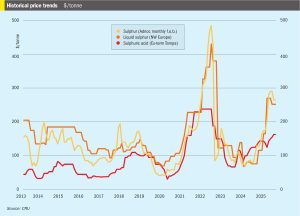
• Global sulphur prices are expected to experience decreases over the next few weeks. Buyers in Asia report that they are covered for contracted supply throughout July, and domestic prices in China are likely to decrease further, putting downward pressure on sulphur prices.
Phosphate prices have been at high levels for a couple of years now, and talk at the recent International Fertilizer Association (IFA) meeting in Monaco was that it was not only continuing to support higher sulphur prices in spite of oversupply in the sulphur market, but that there seemed to be no prospect of it falling in the short term.
The end of June saw declines in sulphur prices in many regions amid subdued global demand across regions. Most import markets are sufficiently covered through July at least, resulting in limited activity while supply increases. These conditions have exerted downward pressure on prices as bearish sentiment spread across regions.
Titanium dioxide is one of the major chemical uses for sulphuric acid outside of phosphate and metals processing, and sulphate route plants remain concentrated in China.
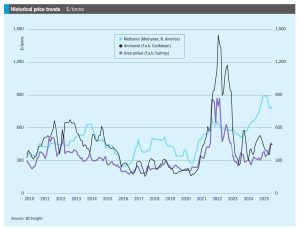
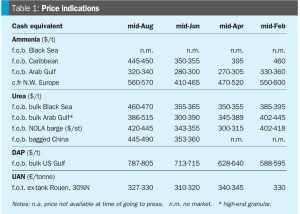
Ammonia benchmarks on both sides of the Suez were little changed in mid-June with a seemingly balanced supply-demand outlook, although those of a more bullish persuasion continue to support the notion that prices will soon – if they have not done so already – reach a floor. In Algeria, while activity was limited, producer Sorfert was believed to be seeking prices of $410415/t f.o.b. for July delivery, up $10-15/t and equivalent to >$450/t c.fr NW Europe. Imminent tariffs on imports of Russian fertilizers into the EU may trigger an uptick in downstream capacity utilisation across the continent.
• The short term outlook appears balanced for the most part, although more bullish participants seem to be holding sway over market sentiment.
Increased merchant ammonia capacity over the next few years may lead to longer term price declines.
Ju ne saw fertilizer markets – urea markets in particular – thrown into chaos by the widening of hostilities in the Middle East. Israel’s and then the United States’ strikes on Iranian nuclear facilities and the retaliatory attacks on Israel and Qatar for a while held out the potential for the conflict to widen, perhaps even leading to attempts to close the straits of Hormuz at the entrance to the Gulf, something not seen since the ‘tanker war’ of the 1980s when Iraq tried to cripple Iran’s oil exports during the eight year Iran-Iraq War.
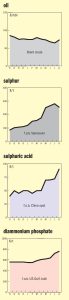
Price trends and the market outlook, 19th June 2025