Decarbonisation

21 July 2026
Phosphate and potash industry decarbonisation roadmap published
The global potash and phosphate industries have been offered practical, science-based guidance on greenhouse gas emissions reduction in a newly-published roadmap. This covers the whole value chain, from raw materials and production through to transport, trade and agricultural use.
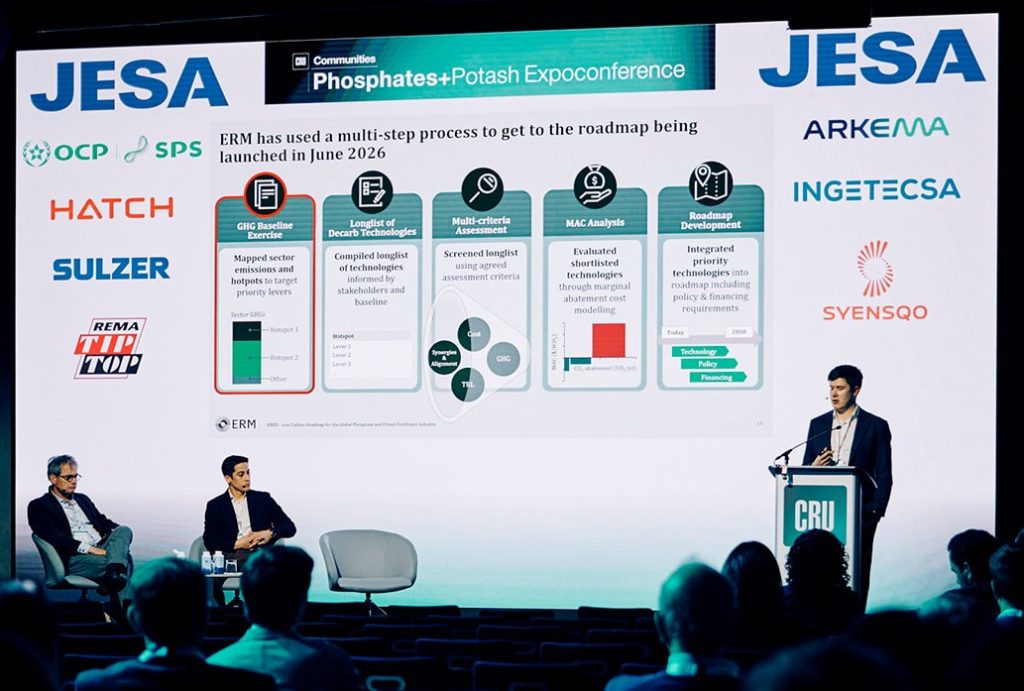
The roadmap — Decarbonizing the Phosphate and Potash Fertiliser Industry — sets out how these two sectors can cut their emissions in line with the Paris Agreement, while maintaining fertilizer affordability, supply resilience and food security. It is an initiative of the European Bank of Reconstruction and Development (EBRD) and was developed by sustainability consultancies ERM and Systemiq in collaboration with the International Fertilizer Association (IFA).
The phosphate and potash sectors were consulted extensively about the roadmap over a nine month period, through a series of workshops, surveys, one-to-one consultations and reviews by an advisory group.
The roadmap is designed to help fertilizer producers, investors and policymakers assess both the near-term and long-term levers for decarbonisation and identify the enabling conditions for this transition. It also balances the trade-offs between the speed of action on decarbonisation versus its cost and the impacts on food system stability.
Deep emissions cuts by the potash and phosphate industries, while possible, will require shifts in production systems, regulation and infrastructure, according to ERM.
The roadmap identifies four defining features/enablers of phosphate and potash decarbonisation. These could deliver significant emissions reductions as part of a long-term transition, advises ERM, if technical, cost and policy barriers are removed:
- Low-carbon energy underpins the system. Renewable electricity, power purchase agreements (PPAs) and low-carbon heat are necessary to displace fossil-based power and steam, with carbon capture and alternative fuels (such as biofuels) playing supporting roles where viable.
- Carbon capture and storage (CCS) and electrification unlock process emissions reduction. CCS in phosphoric acid production and targeted process electrification provide the primary routes to abate the sector’s most complex emissions.
- Nutrient use efficiency is the primary downstream lever. Precision agronomy, 4R practices (right source, right rate, right time, right place) and enhanced efficiency fertilizers (EEFs) can cut emissions without compromising yield or soil health.
- Non-sulphur production pathways could become long-term strategic options. The diversification of phosphate production via alternative process pathways is being driven by rising competition from battery raw materials and heightened geopolitical volatility.
Early action on decarbonisation by phosphate and potash producers will be critical, says ERM, to avoid long-term emissions from new assets and infrastructure, as well as enable the investment, technologies and partnerships needed to decarbonise the sector at scale.
The roadmap highlights several near-term measures that can help reduce production emissions. These include energy efficiency improvements, heat recovery, renewable electricity procurement and mining equipment decarbonisation.
Overall, ERM sees the roadmap as very much a positive that provides “an opportunity to boost competitiveness, resilience and food system stability”. Achieving its objectives on decarbonisation will require:
- Coordinated action across industry, finance and government, underpinned by policy certainty, investment and deployment of low-carbon technologies.
- Agri-food companies, retailers and producers to work more closely together to create demand for low-carbon fertilizers and unlock decarbonisation investment.
- Investors to scale-up innovative funding mechanisms that support the transition.
- Policymakers to provide clear long-term signals and enabling infrastructure.
- Producers to accelerate deployment of priority emissions reduction technologies.
- Standards setting that reduces fertilizer-related emissions while safeguarding agricultural productivity.
Richard Platt, partner at ERM, said: “By decarbonizing the phosphate and potash industry, we have a strategic opportunity to help drive a transition that strengthens competitiveness, resilience, and food system stability in a rapidly changing world. If we want a sustainability transition that can withstand geopolitical stress, the next phase must focus on real value chains, real risks, and real investment conditions.”
Global emissions from phosphate and potash production and use totalled 440 million tonnes carbon dioxide equivalent (MtCO2e) in 2024. These are divided between 94 MtCO₂e associated with raw materials, 60 MtCO₂e associated with production (15%), 7 MtCO₂e associated with downstream transport and 287 MtCO₂e associated with agricultural use (60%).
Under business as usual scenarios, total phosphate and potash emissions are set to reach 550 MtCO₂e per annum by 2050, an approximate 25% increase from today, with limited scope for efficiency improvements to offset rising demand.
The roadmap shows that an 89% reduction in production emissions — from 60 MtCO₂e to 7 MtCO₂e — is technically feasible under a ‘net zero by 2050’ scenario. Achieving this would, however, require large-scale changes to production systems and regulation, and also involve significant economic and environmental trade-offs. Additionally, the technologies needed to decarbonise fuel use and address process emissions are at varying stages of maturity and would require demonstration and scale-up.