• Skip to main content

    401 May-Jun 2026

    Feasibility study on Indonesian biomethanol project

    Written by Richard Hands


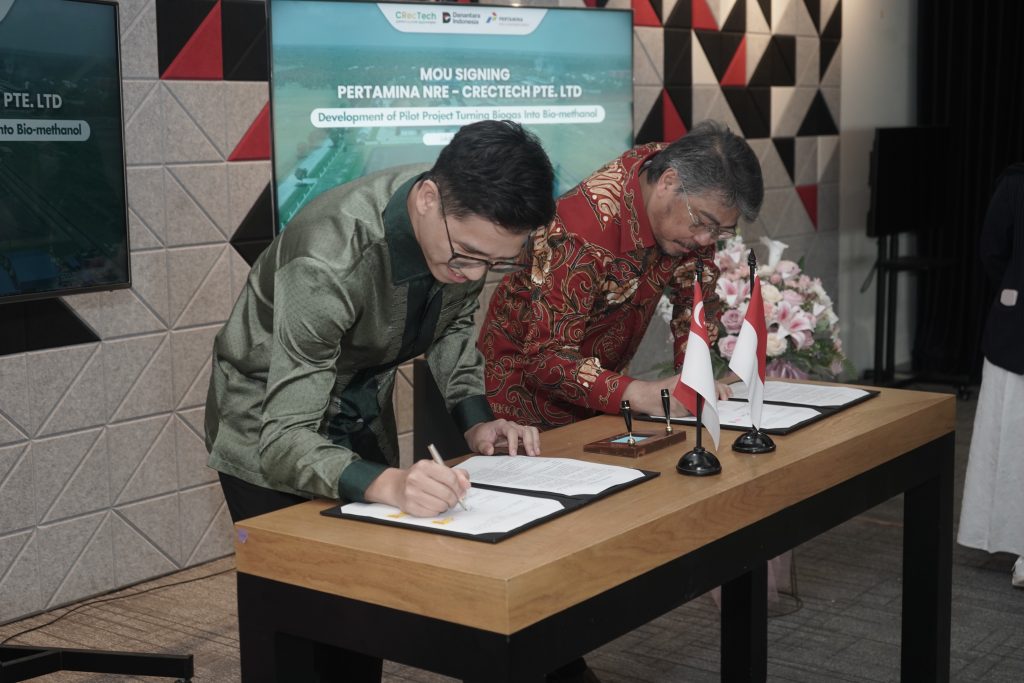
    Pertamina New & Renewable Energy (NRE) has signed a memorandum of understanding (MoU) with CRecTech to explore the development of a pilot biogas-to-biomethanol facility in the Sei Mangkei Special Economic Zone (SEZ) in Sumatra, Indonesia. CRecTech is a Singapore-based clean technology company that converts carbon-based gases into high-value chemicals and fuels through its proprietary CRecREF™ catalytic technology.

    CEO of Pertamina NRE, John Anis, says that this collaboration forms part of the company’s strategy to accelerate the development of clean energy based on local resources: “This collaboration represents a concrete step by Pertamina NRE in accelerating the utilisation of biogas into higher value-added products such as biomethanol. Indonesia holds significant potential, both in terms of market demand and feedstock availability – particularly from palm oil waste, which has yet to be fully optimised. Through our partnership with CRecTech and its innovative technology, we are confident in building a competitive and sustainable green fuel value chain. Moving forward, we hope this initiative will not stop at the pilot stage but can be scaled up to a larger commercial level, delivering tangible impact on the development of Indonesia’s green energy ecosystem,” he said.

    Via the partnership, Pertamina NRE and CRecTech will conduct a joint study to evaluate the feasibility of developing a pilot biogas-to-biomethanol facility in the Sei Mangkei SEZ. Should the study yield positive results, the collaboration will proceed with the deployment of CRecTech’s CRecREF™ catalytic technology at the Sei Mangkei Biogas Power Plant. Indonesia possesses significant biogas potential, especially from the palm oil industry through the processing of palm oil mill effluent (POME). Pertamina NRE has identified several locations within its portfolio, including Sei Mangkei, with large-scale feedstock availability.

    Latest in Asia

    Nickel Industries starts up ENC acid plant

    Nickel Industries announced started up the sulphuric acid plant at its new Excelsior Nickel Cobalt (ENC) HPAL project in the final week of June. The ENC Project is a massive, multi-billion dollar high-pressure acid leach (HPAL) facility located in the Indonesia Morowali Industrial Park (IMIP) in Central Sulawesi, Indonesia. It is operated by Australia’s Nickel Industries to supply battery-grade materials for the electric vehicle (EV) market. At capacity, it is expected to yield roughly 72,000 t/a of contained nickel equivalent as mixed hydroxide precipitate (MHP), nickel sulphate, and nickel cathode.

    Russia bans rail transport of Kazakh sulphur

    Russia has ordered a “temporary cessation” of rail transport of all sulphur originating from Kazakhstan that is destined for Russian seaports and railway checkpoints, representing a significant policy shift, according to an official order from the Federal Agency for Railway Transport (Roszheldor). The directive, which took effect from May 26th, orders a halt to the loading and movement of Kazakh sulphur “until further notice.” While the measure is officially described as temporary, the order provides no specific timeline for when the transit might resume. The action cites instructions from Russia’s First Deputy Prime Minister, D.V. Manturov, as its basis.

    Restart for Hongda smelter

    Hongda's 100,000 t/a zinc smelter, in China's Sichuan Province, completed scheduled maintenance and equipment upgrading and officially resumed production on 21st June, the company said. The smelter had been shut down for planned maintenance since January, during which time a modernisation project for the electrolytic zinc smelting system was also carried out. Following the nearly six-month revamp, the resumption of production is expected to improve overall operational efficiency, reduce unit production costs, and increase the utilisation rate, The company said. The stable supply of sulphuric acid generated by the zinc smelter will effectively leverage the synergies of the "sulphur-phosphorus" industrial chain in the company, an help alleviate cost pressures on the company's phosphorus chemical business segment.